
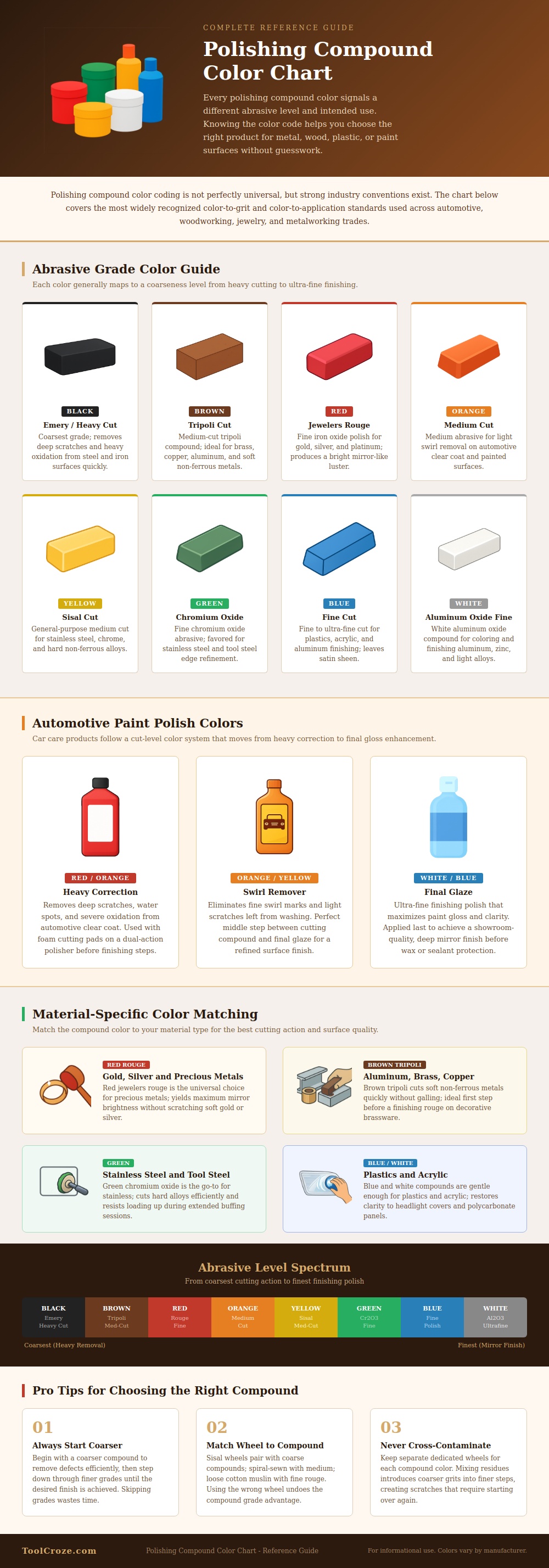
Polishing compounds is categorized by color because the color of the polishing compound indicate the level of abrasiveness of that compound. The color of a polishing compound will tell you the amount of material that the polishing compound will remove from surface that you are polishing. If the compound are too fine for the damage on the objects surface, the compound will not be able to remove the deep scratch on that object.
Additionally, if the compound is too coarse for one of the finishing step with the object, the compound will scratch the objects surface. Thus, individuals must understand the color coding of polishing compounds in order to correctly utilize the compounds. Polishing compounds are a method of sanding that utilize microscopic abrasive particles to remove imperfection from the treated objects surface.
How to Use Polishing Compounds by Color
The compounds should always be used in order from the heaviest cutting compounds to the lightest polishing compounds. Black compounds is the heaviest cutting compounds and are used to remove deep layer of oxidation from metals like steel and iron. Compounds that are brown or yellow is of medium strength and are used to remove the bulk of the oxidation from the metals surface.
Once a medium strength compound treats the metal, the metals surface should be treated with a finishing compound. Red rouge compounds is used to finish metals like gold and silver. Green chromium oxide compounds are used to finish metals like stainless steel.
Finally, compounds that are white or blue is also used as finishing compounds and are used to produce a high level of shine to the metal being treated. Many individuals will attempt to use a compound that is too fine to treat the metals oxidation to achieve a shiny finish too soon in the process. Using a fine compound on a metal that has deep scratches will only polish the top of those scratches and will not remove the deepest part of the scratches.
Thus, if an individual use a fine compound too soon, there metal will have a shiny appearance from a distance but will appear rough to the eye up close. The individual must work through each grade of compound to achieve the desired shiny finish. Polishing compounds are applied to automotive clear coats in the same way that metal polishing compounds are applied.
Automotive clear coats are plastic-like resin. Heavy cutting compounds like red and orange compounds is used to treat heavy oxidation or water spot. A swirl remover should be used following the application of the heavy cutting compounds.
Finally, a glaze compound is used to maximize the clarity of the treated clear coat. The tool that is used to apply the polishing compound is just as important as the compound itself. The compound should match the polishing pad that is used.
For example, using a coarse compound on a soft polishing pad will cause the compound to fly off the pad. Additionally, using a heavy cutting pad when applying the final glaze is an inefficient use of time and effort. The pad and compound must work together to create the necessary friction to polish the object proper.
One of the most common problem with applying polishing compounds is contamination. Using the same polishing pad to treat an object with a black heavy cut compound and a white fine compound will leave coarse grit on the pad. This leftover grit will become rubbed into the object when using the pad for the final compound.
This will create new scratches on the objects surface. Thus, to avoid this problem, a dedicated polishing pad should be used for each color of compound. Polishing compounds should always be applied in order from the compound that is the coarsest to the compound that is the finest grade.
Each compound should be used to treat the objects surface in order to eventually produce a reflective compound.
