Epoxy Ratio Calculator
Calculate resin and hardener by weight or volume, convert with density correction, add loss, and split the mix into practical batch sizes.
⚙ Project Presets
📏 Mix Inputs
Epoxy Mix Results
🧪 Epoxy System Grid
📊 Reference Tables
| Epoxy System | Common Ratio | Basis | Best Use |
|---|---|---|---|
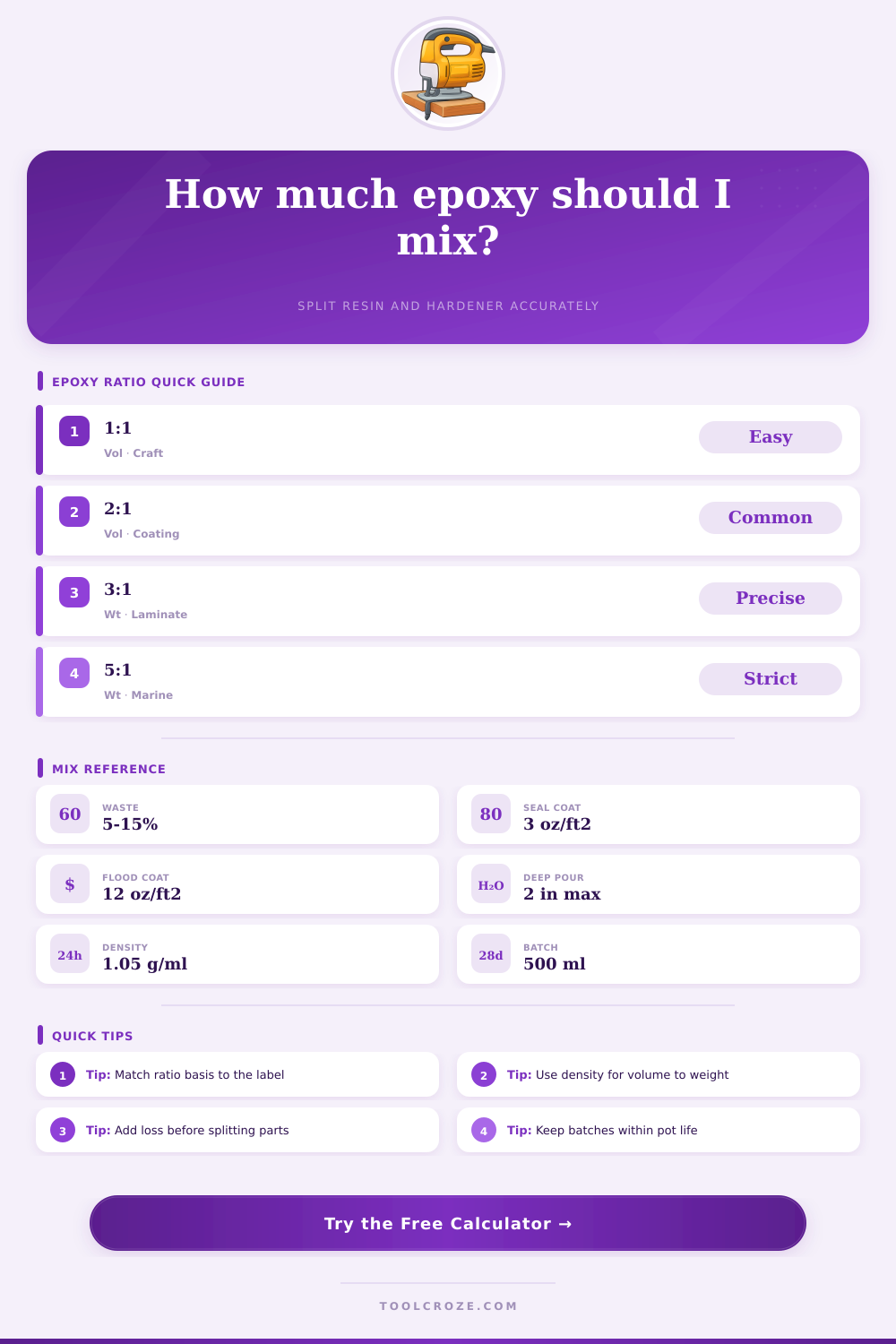
| Craft clear coat | 1:1 | Volume | Coasters, small molds, simple repair |
| Tabletop coating | 2:1 | Volume | Seal coats, flood coats, bar tops |
| Laminating epoxy | 3:1 | Weight | Fiberglass, carbon, veneer layup |
| Marine structural | 5:1 | Weight | Boat repair, fillets, bonded parts |
| Material or Part | Density Range | Use in Calculator | Why It Matters |
|---|---|---|---|
| Epoxy resin | 1.05-1.20 g/ml | Resin density | Converts part A volume to weight |
| Slow hardener | 0.95-1.05 g/ml | Hardener density | Changes scale weight at same volume |
| Fast hardener | 0.98-1.12 g/ml | Hardener density | Can vary by chemistry and filler |
| Filled epoxy | 1.20-1.60 g/ml | Adjusted density | Use after filler only if measuring filled mix |
| Application | Starting Loss | Batch Size | Practical Check |
|---|---|---|---|
| Small mold | 5% | 100-250 ml | Weigh cups before pigment |
| Seal coat | 10% | 250-750 ml | Expect roller and brush hold-up |
| Flood coat | 10-15% | 500-1000 ml | Watch edge runoff and drips |
| Deep pour | 15-20% | Per label limit | Control heat and pour depth |
| Coverage Rule | Approx. Amount | Thickness | Use Case |
|---|---|---|---|
| Seal coat | 3 fl oz/sq ft | 1/32 in | Wood pore sealing |
| Flood coat | 12 fl oz/sq ft | 1/8 in | Tabletop clear coat |
| Thin laminate | 4-8 fl oz/sq yd | Fabric dependent | Fiberglass wetout |
| Solid casting | 1.805 fl oz/in3 | By mold depth | Void fill and molds |
💡 Mixing Tips
Epoxy resin are a chemical substance that requires the correct mixing ratio to harden. If the ratio of epoxy resin is incorrect, the resin will remain stickily or tacky instead of hardening into a solid substance. This is due to the chemical reaction between the two part of epoxy resin; if the two parts of epoxy are not measured correct, the molecules will not chemically bond with each other.
Many people try to use volume measurement to mix their epoxy resin, but using volume measurements can lead to errors in the amount of each component of the epoxy resin. Each component of epoxy resin can have a different density. One component can be heavier than the other component of epoxy resin.
How to Mix Epoxy Resin Correctly
Therefore, using measuring cups to measure a component of epoxy resin that require a weight measurement will lead to imbalance in the chemical reaction. Using a digital scale to weigh out the components of epoxy resin is more accurate than measuring the component by volume. To calculate how much epoxy resin is required for a project, it is important to account for the absorption of the epoxy resin by the material.
If the material to be coated with the epoxy resin is porous, such as wood, the wood will absorb some of the epoxy resin. Therefore, you will have to increase the amount of epoxy resin needed for the project to account for the capacity of the wood to absorb the epoxy resin. Additionally, epoxy resin will be lost in the mixing process.
Some of the epoxy resin will stick to the side of the mixing bucket, and some will adhere to the bristles of a brush or the nap of a roller. Therefore, in addition to the amount of resin needed to complete the project, you should purchase more epoxy resin to account for epoxy resin that will be lost during mixing. If the amount of epoxy resin that is only calculated to complete the project is used, it is likely that the epoxy resin will run out before the project is complete.
A small percentage of extra epoxy resin to the calculations will ensure there is enough resin to complete the project. When mixed, epoxy resin creates a chemical reaction that generates heat, known as an exotherm. If a large amount of epoxy resin is mixed in one container, that exotherm will cause the temperature of the epoxy resin to increase, which will increase the rate of the chemical reaction.
The increased chemical reaction can cause the epoxy resin to smoke, or the heat could cause the epoxy resin to crack or melt the plastic container in which it is being mix. To avoid these issues, the cook will break the project into smaller batch of epoxy resin. Smaller batches of epoxy resin will generate less heat during the chemical reaction, which will allow the individual to maintain a more stable temperature throughout the epoxy resin project.
Another factor to consider is the pot life of the epoxy resin. The pot life of the epoxy resin is the amount of time that the epoxy resin will be workable after the resin and the hardener have been mixed together. During this time, the epoxy resin will transform from a liquid to a solid material.
The epoxy resin must be stir, poured into the project, and the air bubbles must be removed during the liquid state of the epoxy resin. Therefore, you must subtract the time that will be required to stir the epoxy resin from the total amount of pot life of the epoxy resin. All tools will need to be prepared prior to mixing the epoxy resin with the hardener so that the epoxy resin can be used prior to the end of its pot life.
The ratio of epoxy resin to hardener is critical in projects that utilize fiberglass or laminate material. Epoxy resin act as the structural glue for the fiberglass or laminate material. If the ratio of the epoxy resin to the hardener is incorrect, the epoxy resin will not adequately saturate the fiberglass or laminate material.
If the epoxy resin does not adequately saturate the material, there will be air pockets within the material that weakens the structure of the object that is create. Due to the importance of accuracy in the amount of epoxy resin to hardener, a weight-based system is used to measure the epoxy resin. A digital scale will provide more accuracy in measuring the epoxy resin than a measuring cup.
Finally, the total yield of the epoxy resin calculation needs to be calculate. The total yield is the total amount of liquid epoxy resin that will be within the mixing bucket. If the total yield of epoxy resin is too great for the capacity of the container in which the epoxy resin will be mixed, it is better to pour the epoxy resin in stages.
Pouring several layers of epoxy resin then pouring one large mass into the project will allow for more control of both the volume and heat of the epoxy resin. Therefore, control of the volume and heat of the epoxy resin will allow for the epoxy resin to produce a predictable result.