
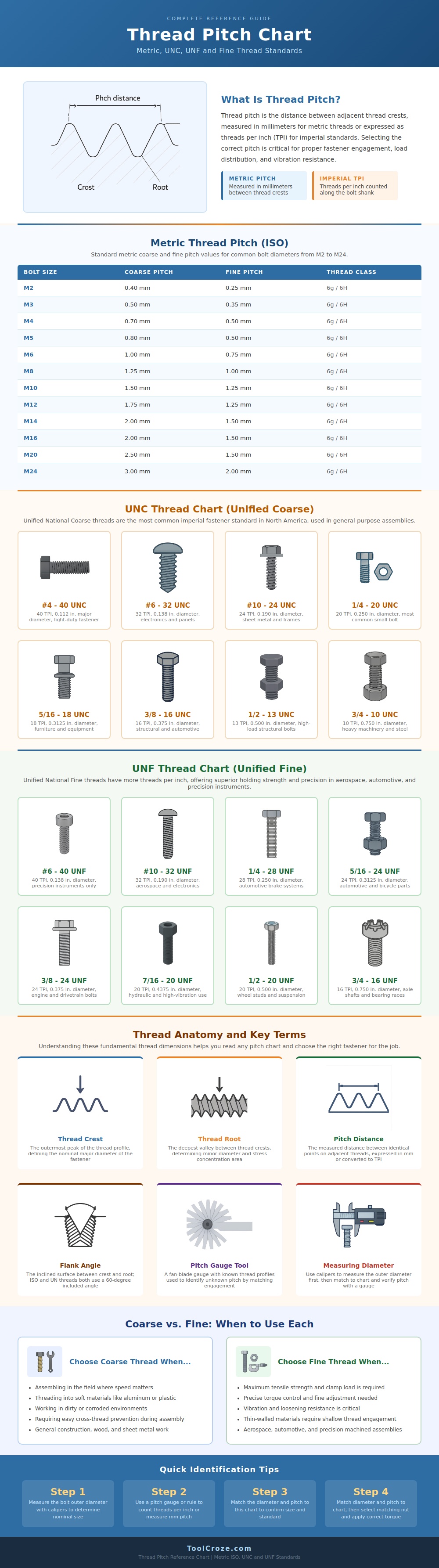
Thread pitch is an distance between the peaks of the threads on a bolt. Thread pitch is the factor that will determine if a bolt and a nut will fit together. If the bolt and the nut has different pitches for there threads, then you will strip the threads on both the bolt and the nut, which will damage the hardware.
In order for bolts and nuts to work together, the bolt and the nut must have the same thread pitch. Thread pitch is a critical measurement on a bolt as it determine the relationship that exists between the bolt and the hole. There are different systems for measuring the pitch of the threads on bolts.
Thread Pitch: How Bolts and Nuts Fit Together
The systems include the metric system and the imperial system of measurement. The metric system measures the distance in millimeters between the peaks of the threads. The imperial system counts the number of threads that are include in one inch of the bolt.
Metric thread pitches are mostly used for European-made product and machinery, while the North American industry standards use imperial thread pitches for products and machinery. The imperial system use the United National (UNC) standards for thread pitches. The UNC standard features two types of threads: United National Coarse (UNC) and United National Fine (UNF).
UNC threads are used for applications where soft material are being secured. The Coarse pitch of UNC threads makes it more harder for the bolt to get cross-threaded. UNF features a higher number of threads per inch than UNC threads.
With the increased number of threads per inch for UNF threads, there is a larger area of contact between the bolt and the material being secure. This allows UNF threads to handle vibrations more better than UNC threads. The metric system features two type of thread pitches: coarse and fine threads.
Coarse threads are used for the majority of tasks. Fine threads are used in situations where a tighter fit is require of the bolt. In both systems, the pitch of the thread must be correctly chosen for the bolt to correctly fit within the hole.
Bolts have several parts to their thread pitches. These parts include the crest, the root, and the flank. The crest is the peak of the thread.
The root is the valley of the thread. The flank is the slope of the thread from the crest to the root. Most thread pitches use a 60-degree angle for both flanks of the thread.
These 60-degree angles allow the bolts to lock into the holes. A pitch gauge can be used to determine the thread pitch of a bolt. The pitch gauge features different sized threads to which the bolt threads can be matched.
In order to correctly identify a mystery bolt, the first step is to measure the diameter of the bolt using a caliper. You must measure the pitch of the bolt after the diameter of the bolt is measure. It isnt necessary to guess the thread pitch of the bolt by looking at the head of the bolt.
The head of the bolt is simply the handle of the bolt. Once you have measured both the diameter and the thread pitch, a chart can be used to find the standard for the bolt. Coarse threads are used in situations with high vibration, as well as for constructing general plans and projects.
They are easier to place into the object being secure, as there is a higher chance of not getting the bolt cross-threaded. Fine threads, on the other hand, are used in high-performance machinery. They produce more clamping forces.
However, you must take care when choosing fine threads. If the material being secured is soft, using a fine thread bolt will strip the threads within the hole if the material is soft. Therefore, the proper selection of the pitch of the bolt relative to the hole will ensure the proper working relationship between the two, as well as prevent the stripping of the threads altogether.
