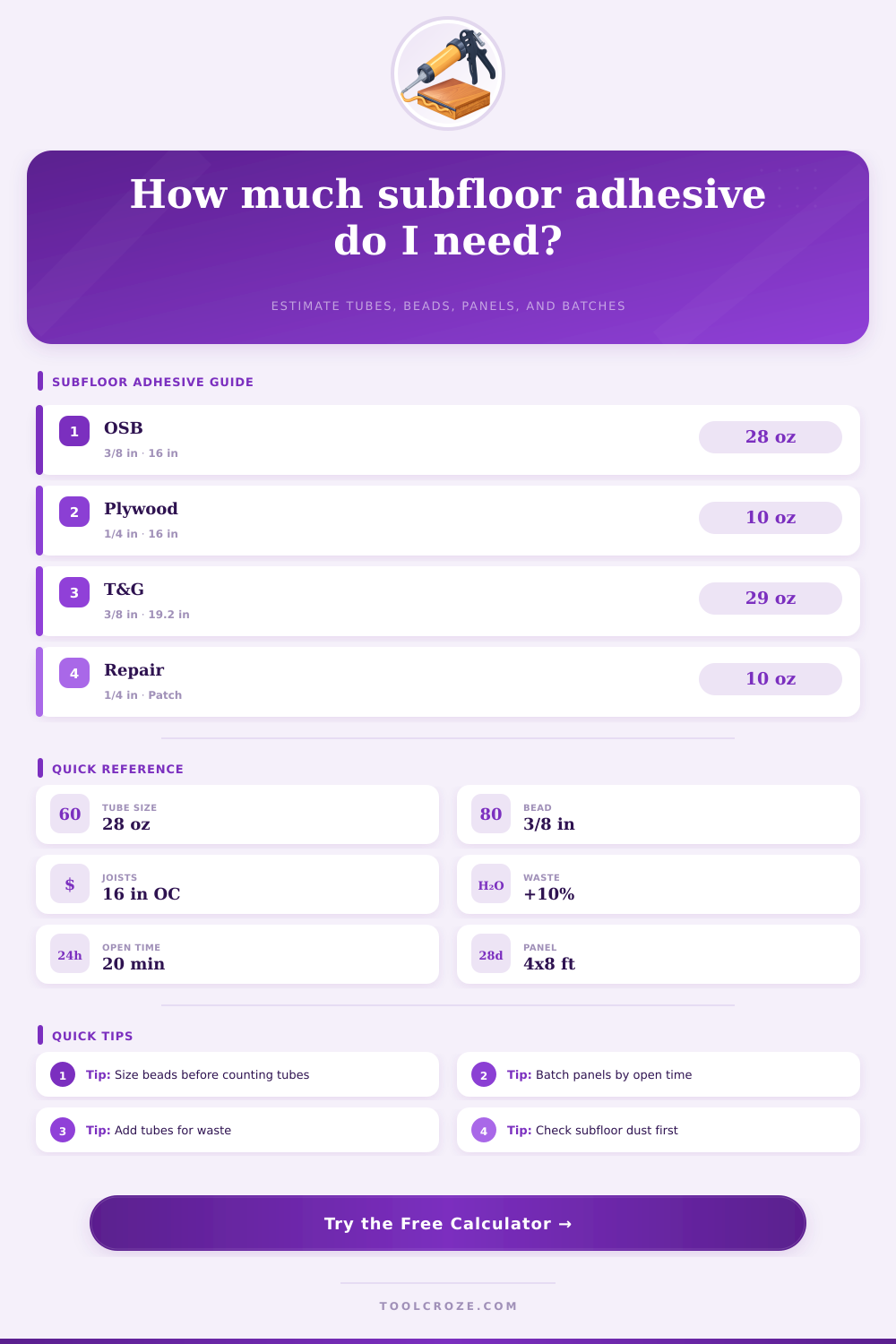
Subfloor Adhesive Calculator
Estimate adhesive tubes from panel size, joist spacing, bead diameter, cartridge volume, squeeze loss, and working time.
📌Preset Subfloor Jobs
⚙Calculator Inputs
📊Results
Calculation breakdown
🧪Coverage Factor Grid
🗂Layout Comparison Grid
- Lowest adhesive volume
- Best for simple new framing
- Depends on clean, flat joists
- Adds end and edge support
- Useful at cut panel edges
- Moderate tube increase
- Highest bead footage
- Helpful for high-load floors
- Plan smaller open-time batches
- Uses serpentine coverage
- Matches patch work better
- Use extra loss allowance
📚Subfloor Adhesive Reference Tables
| Cartridge | Volume basis | 1/4 in bead | 3/8 in bead | Best use |
|---|---|---|---|---|
| 10 fl oz tube | 18.0 in³ | 36 ft | 16 ft | Patch or small room |
| 28 fl oz tube | 50.5 in³ | 103 ft | 45 ft | Subfloor deck |
| 29 fl oz tube | 52.3 in³ | 107 ft | 47 ft | Heavy-duty adhesive |
| 600 ml sausage | 36.6 in³ | 75 ft | 33 ft | Production work |
| Joist spacing | 4 ft panel lines | 8 ft panel joist bead | 10 panels | Notes |
|---|---|---|---|---|
| 12 in OC | 5 lines | 40 ft | 400 ft | Stiff floor layout |
| 16 in OC | 4 lines | 32 ft | 320 ft | Common framing |
| 19.2 in OC | 4 lines | 32 ft | 320 ft | I-joist layout |
| 24 in OC | 3 lines | 24 ft | 240 ft | Check panel rating |
| Panel type | Common size | Area | Typical bead | Planning note |
|---|---|---|---|---|
| OSB sheathing | 4 x 8 ft | 32 ft² | 3/8 in | Clean joist crowns |
| Plywood sheathing | 4 x 8 ft | 32 ft² | 1/4 to 3/8 in | Watch veneer gaps |
| T&G panel | 47.5 x 95.9 in | 31.6 ft² | 3/8 in | Allow edge fit loss |
| Patch panel | 2 x 4 ft | 8 ft² | 1/4 in | Higher start-stop loss |
| Condition | Open time | Loss factor | Batch advice | Calculator input |
|---|---|---|---|---|
| Cool and clean | 25 to 30 min | 5% | Normal panel pace | 5% loss |
| Warm and dry | 15 to 20 min | 8% | Shorter bead runs | 8% loss |
| Dusty remodel | 10 to 15 min | 12% | Vacuum before bead | 12% loss |
| Irregular repair | 8 to 12 min | 15% | Small batches | 15% loss |
💡Practical Tips
⚠Safety Note
Squeaky floor are typicaly the result of the subfloor moving independent of the floor joists. The most common cause of this type of movement is the failure of the bond between the subfloor and the floor joists. To prevent floors from becoming squeaky, you must use subfloor adhesive to create a bond between the subfloor and floor joists.
If too little subfloor adhesive is used, the subfloor will become a moving independent structure from the floor joists and may create noise when individual walk upon the floor. The amount of subfloor adhesive that is necessary to create such a strong bond between the subfloor and the floor joists is difficult to calculate due to the fact that linear measurement are used instead of measuring the area of the subfloor. You must apply the subfloor adhesive in beads along the floor joists, and the length of those beads will determine the amount of subfloor adhesive that is necessary.
How Much Subfloor Adhesive Do You Need
If the bead of subfloor adhesive that is applied is too thick, then more subfloor adhesive will be used than was calculated for a job. For instance, increasing the diameter of the bead from a quarter inch in diameter to three-eighths of an inch in diameter will increase the amount of subfloor adhesive that will be used along the floor joist per foot of length. Thus, the diameter of the bead must be decide before beginning the project.
The layout of the beads of subfloor adhesive will also impact the amount of subfloor adhesive that is purchased for a job site. Some individuals choose to apply the subfloor adhesive along the floor joists in lines, while other individuals apply the adhesive in wraps around the perimeter of the floor joists or along only one edge of the floor joists. If more lines of subfloor adhesive are used, the amount of subfloor adhesive that will be used will increase.
Thus, an individual must find a balance between the cost of the subfloor adhesive cartridges and the desire of the flooring project to have a silent subfloor. Another factor to consider in the calculation of the amount of subfloor adhesive to purchase is the potential waste of that subfloor adhesive. Some waste occur when the subfloor adhesive is applied in beads, but the subfloor panel is started or stopped in the middle of the bead.
Additionally, if the floor joists are not flat, the subfloor adhesive can squish out between the subfloor and the floor joists. Similarly, if the work area is especially dusty, some of the subfloor adhesive may not properly bond with the subfloor panels. Thus, some waste of subfloor adhesive is to be expected; providing for waste in the calculation of how many cartridges of subfloor adhesive will be purchased will ensure that the subfloor adhesive doesnt run out during the project.
The open time of the subfloor adhesive is another factor to consider. Open time is the length of time during which the subfloor adhesive can be installed after it has been applied. If the subfloor adhesive skins over during that time, it will be impossible to install the subfloor panels on the floor joists.
Any subfloor adhesive that is wasted in this fashion is money lost to the flooring project. Thus, the work must be planned into batches to ensure that the subfloor panels are installed before the open time of the subfloor adhesive is exceeded. The type of material that will be placed on the floor joists will also impact the amount of subfloor adhesive that is required.
For instance, oriented strand board (OSB) panels and plywood panels may require different amounts of subfloor adhesive than tongue and groove floor panels. Additionally, if the adhesive is being applied to repair a squeak in the floor, a serpentine pattern of subfloor adhesive may be used. However, serpentine patterns are less efficient than straight lines; thus, there will be waste with any repair job.
Finally, the total number of tubes of subfloor adhesive that will be purchased should be round up to the nearest tube. It is always better to have one extra tube of subfloor adhesive than to find that the subfloor adhesive has run out during the project. Additionally, subfloor adhesive isnt a replacement for mechanical fasteners.
Nails and screws are still required to provide the clamping force that is required to allow the subfloor adhesive to bond to the floor joists. Thus, if the size of the adhesive bead is thoughtfully consider, if waste is accounted for, and if the open time is respected, a solid and silent floor will be created.