Adhesive Coverage Calculator
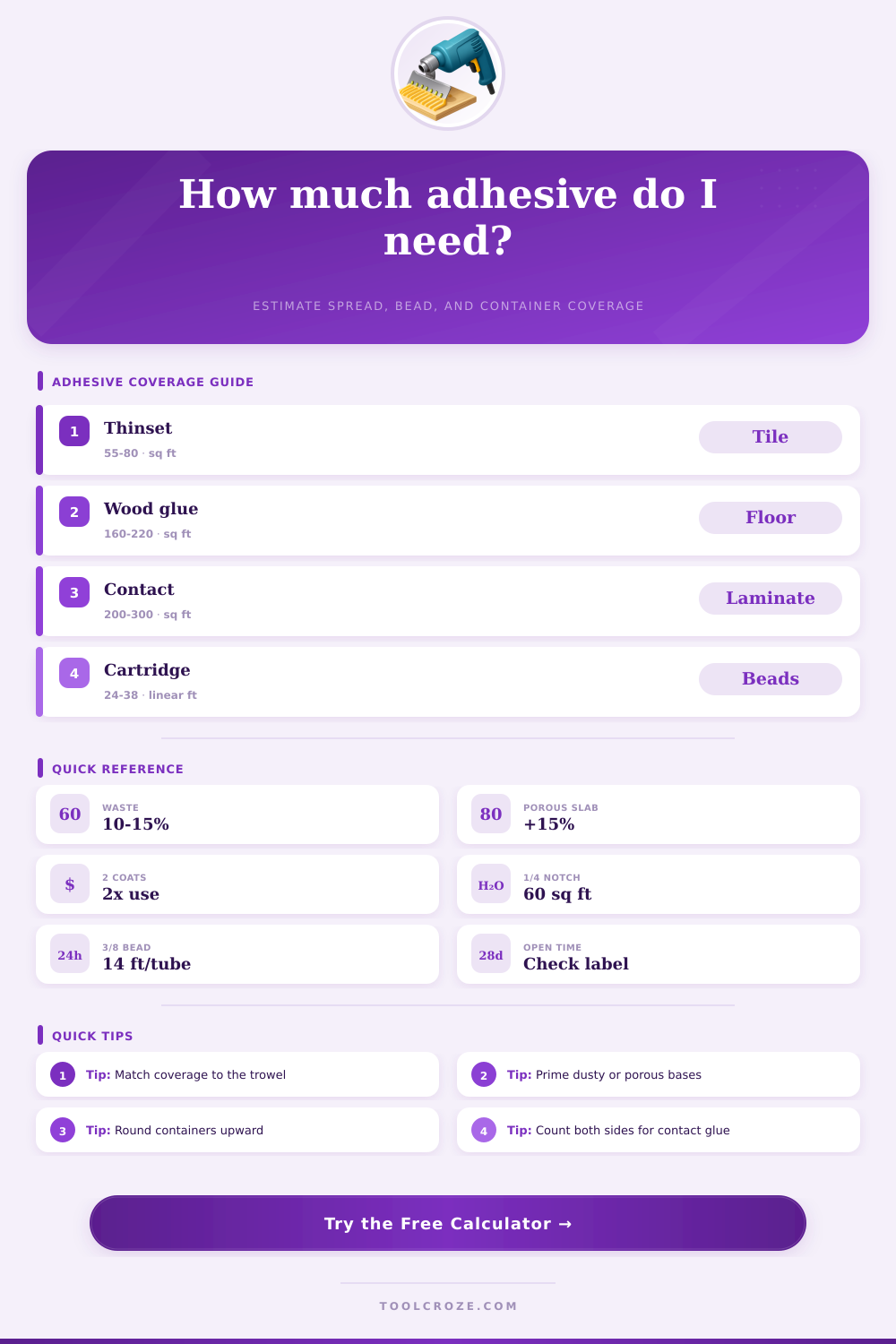
Estimate adhesive quantity from real coverage rates, trowel notch, bead diameter, coats, substrate porosity, openings, and waste allowance.
⚙Project Presets
📏Adhesive Inputs
Adhesive Coverage Results
🧪Adhesive Data Snapshot
📋Coverage Reference Tables
| Adhesive Type | Typical Coverage | Common Unit | Coverage Driver |
|---|---|---|---|
| Polymer-modified thinset, 1/4 in notch | 60-80 sq ft | 50 lb bag | Tile size and notch depth |
| Large-format tile mortar, 1/2 in notch | 35-50 sq ft | 50 lb bag | Back-buttering and floor flatness |
| Pressure-sensitive LVP adhesive | 160-260 sq ft | 1 gallon | Roller nap and slab porosity |
| Urethane wood-floor adhesive | 35-65 sq ft | 1 gallon | Notch shape and plank width |
| Solvent or water-based contact cement | 200-300 sq ft | 1 gallon per side | Both faces normally coated |
| Wallpaper paste, premixed | 180-280 sq ft | 1 gallon | Paper backing and wall absorbency |
| Trowel or Film | Multiplier | Best Match | Calculator Effect |
|---|---|---|---|
| Smooth roller or fine film | 0.72 | Primer, epoxy, contact adhesive | Uses less than label trowel rate |
| Fine V-notch or light spread | 0.88 | Carpet tile, vinyl tile | Slightly improves coverage |
| Label application rate | 1.00 | Known technical data sheet rate | No trowel correction |
| 1/4 in square notch | 1.18 | Small floor tile, wood adhesive | Reduces effective coverage |
| 3/8 in square notch | 1.35 | Porcelain tile, uneven backs | Needs more adhesive |
| 1/2 in notch or heavy bed | 1.55 | Large format tile, rough slab | Lowest coverage rate |
| Bead Diameter | 10.1 fl oz Yield | 29 fl oz Yield | Typical Use |
|---|---|---|---|
| 1/8 in round bead | 147 linear ft | 423 linear ft | Light trim or sealing |
| 3/16 in round bead | 65 linear ft | 188 linear ft | Panel layout lines |
| 1/4 in round bead | 37 linear ft | 106 linear ft | Baseboard or drywall adhesive |
| 5/16 in round bead | 24 linear ft | 68 linear ft | Subfloor and construction adhesive |
| 3/8 in round bead | 16 linear ft | 47 linear ft | Heavy panel adhesive |
| 1/2 in round bead | 9 linear ft | 26 linear ft | Large void filling only |
| Project | Typical Size | Starting Rate | Useful Allowance |
|---|---|---|---|
| Alcove shower wall tile | 80-110 sq ft | 55-75 sq ft per bag | 15% for corners and cuts |
| Kitchen LVP install | 120-220 sq ft | 180-240 sq ft per gallon | 10% for porous slab |
| Plastic laminate countertop | 35-70 sq ft both faces | 220-280 sq ft per gallon | Count top and laminate side |
| Garage epoxy primer | 300-500 sq ft | 200-300 sq ft per gallon | 15% for rough concrete |
| Drywall panel adhesive | 12-18 panels | 1/4 in bead yield | Rows per stud layout |
| Wallpapered feature wall | 70-140 sq ft | 200-280 sq ft per gallon | 5% for seams and trimming |
⚖Application Comparison Grid
💡Coverage Tips
When tiling a floor, calculating an amount of adhesive needed is a necessity. The adhesive coverage on the bag of adhesive are not the same as the amount of adhesive that will be used on the floor. The coverage estimate is theoretical; the subfloor might not be an ideal surface for the adhesive to adheres to.
The adhesive that will be used will vary depending on several factor. It is essential to understand these factor to ensure that the adhesive doesnt run out before the tiling job is complete. The tool that is used to apply the adhesive will impact the amount of adhesive needed.
How Much Tile Adhesive You Need
For example, when using a notched trowel, the size of the notches will impact the amount of adhesive that the worker will use. Using a trowel with large notches will require more adhesive than a trowel with small notches. If a small notch trowel is being use to apply adhesive to a floor with high elevations, then it is likely that more adhesive will be used to cover these elevated area.
Thus, the volume of the trowels notches will impact the amount of adhesive use for tiling the floor. The substrate that the adhesive will adhere to will also impact the amount of adhesive needed for tiling the floor. The substrate will behave different depending on the substrate used.
For instance, a smooth concrete floor will not absorb the adhesive like a raw plywood floor will. Porous substrate will absorb the adhesive and water. Thus, more adhesive will be required for these types of substrate since the adhesive will dissapear into the substrate.
The amount of adhesive that will be wasted during the tiling process also need to be accounted for when computing the amount of adhesive needed. The adhesive that will be wasted include the adhesive that might be spilled on the floor while tiling the area. Furthermore, the adhesive that is left in the adhesive bucket when mixing the adhesive will also be wasted.
Additionally, adhesive squeezed out of the side of the tile will be wasted. Waste resulting from mistake or cutting tiles to accommodate corners will also be accounted for. Adding a percentage for the waste results of adhesive will ensure that there is enough adhesive to complete the tiling project.
The mathematical equation for calculating the amount of adhesive to be use will change if adhesive cartridges are used instead of a trowel. The adhesive cartridges will leave a bead of adhesive on the floor. The volume of the bead of adhesive is a cylinder.
The formula for the volume of a cylinder states that the volume increase as the diameter of the cylinder increases. Therefore, by using adhesive with a large diameter to adhere to the floor, more adhesive will be used per linear foot of tiling. Thus, more adhesive cartridges will be used.
Another factor that will impact the amount of adhesive needed is the open time of the adhesive. The open time of the adhesive will determine how long the adhesive remains tacky to adhere to the floor. In areas that are hotter or more breezy, like the garage, the adhesive will skin over more quick.
If the adhesive skins over quick, it might be necessary to reapply the adhesive to the floor. Thus, if adhesive is reapply due to the open time of the adhesive expiring, there will be more adhesive needed for the tiling job. Another product to consider is contact cement.
Contact cement will require more of the product than other adhesives. This is due to the fact that contact cement must be applied to the substrate and the other material to be cemented. By calculating the square footage of the floor only, there might not be enough contact cement to adhere to the floor and the material being cemented to the floor.
Thus, calculating the area of both the floor and the material will ensure there is enough contact cement for the project. By accounting for the substrate of the floor, the size of the trowel that will be used to apply the adhesive, the waste of the adhesive, and the open time of the adhesive, it is possible that there will be enough adhesive to complete the tiling job. By planning for these variables, it is also likely that the contractor will not have to visit the store for adhesive.