🔩 Fastener Spacing Calculator
Size edge and field fastener spacing for sheathing, decking, cement board, and metal cladding using design load, tributary width, row count, and fastener capacity.
📌 Presets
⚙ Calculator Setup
🎯 Results
📊 Material and Spec Comparison
📑 Edge and Field Layout Table
| Assembly | Typical Edge | Typical Field | Common Fastener |
|---|---|---|---|
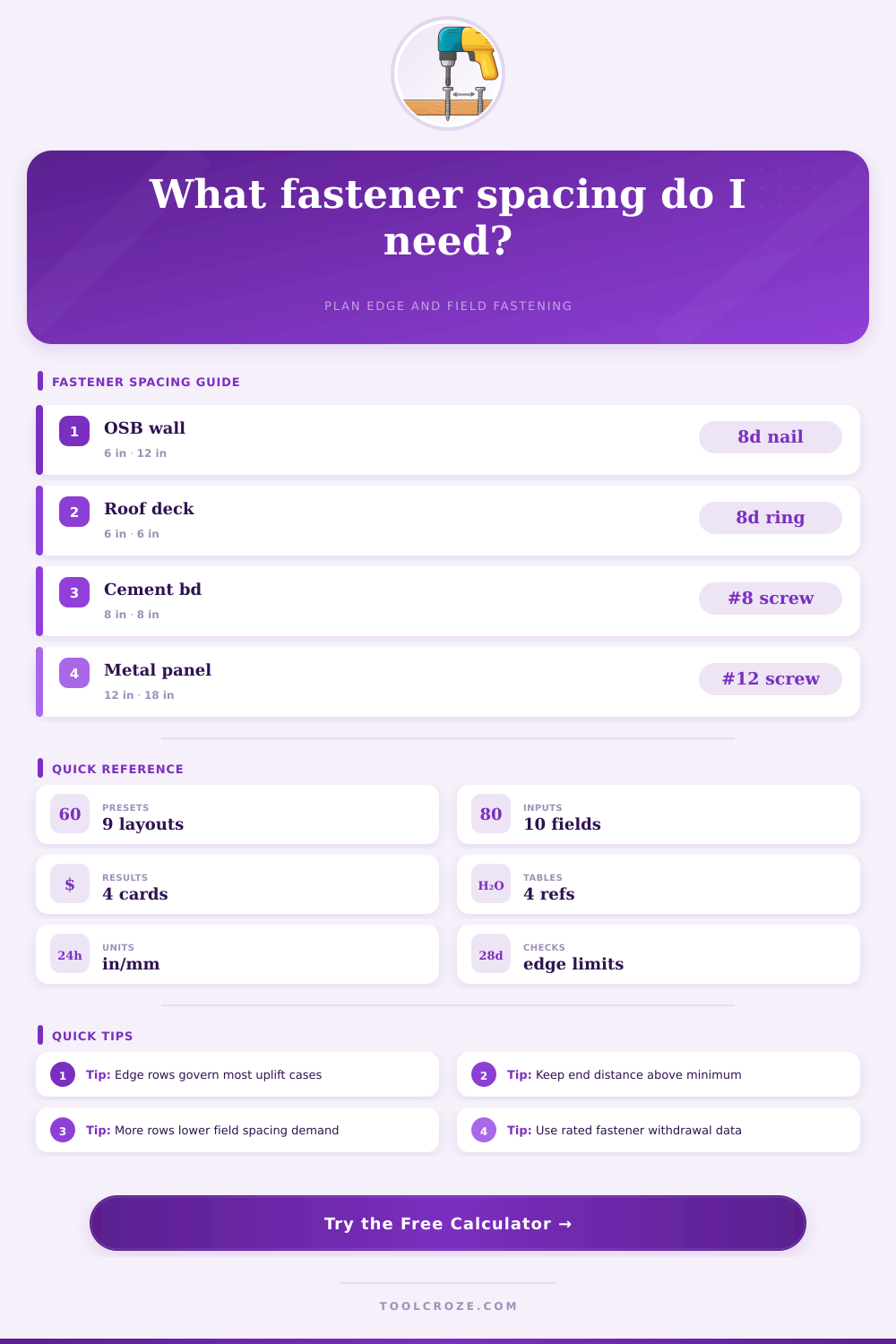
| 7/16 OSB wall panel | 6 in OC | 12 in OC | 8d common nail |
| 1/2 roof sheathing | 6 in OC | 6 in OC | 8d ring shank |
| 23/32 subfloor | 6 in OC | 12 in OC | #8 screw or 8d screw shank |
| Fiber cement siding | 8 in OC | Stud line only | #8 corrosion-resistant nail |
| Cement board wall | 8 in OC | 8 in OC | #8 backer-board screw |
| 29 ga steel cladding | 12 in OC | 18 in OC | #12 stitch screw |
📋 Fastener Capacity Table
| Fastener | Dia. | Allowable | Typical Use |
|---|---|---|---|
| 8d common nail | 0.131 in | 92 lb | Wall sheathing |
| 8d ring-shank nail | 0.113 in | 118 lb | Roof uplift |
| #8 wood screw | 0.164 in | 144 lb | Subfloor and plate |
| #8 cement-board screw | 0.158 in | 110 lb | Backer board |
| #10 fiber-cement screw | 0.190 in | 138 lb | Panel siding |
| #12 self-drill screw | 0.216 in | 176 lb | Steel cladding |
📐 Minimum Spacing and Distance Table
| Fastener Type | Min Spacing | Min Edge Dist. | Min End Dist. |
|---|---|---|---|
| Wood nail | 3d | 10d | 15d |
| Wood screw | 4d | 7d | 10d |
| Cement-board screw | 1 in | 3/8 in | 2 in |
| Fiber-cement nail | 1-1/4 in | 3/4 in | 2 in |
| Self-drill metal screw | 1 in | 1/2 in | 1 in |
| Deck clip screw | 1-1/2 in | Hidden clip | Joist line |
📈 Project Layout Reference
| Project | Panel Size | Support Spacing | Starting Layout |
|---|---|---|---|
| Garage shear wall | 48 × 96 in | 16 in OC | 6/12 nailing |
| Coastal roof edge zone | 48 × 96 in | 24 in OC | 4/6 nailing |
| Tile backer shower wall | 36 × 60 in | 16 in OC | 8 in grid |
| Corrugated shed sidewall | 36 × 120 in | 24 in OC | 12/18 screws |
| Composite deck board | 5.5 × 192 in | 16 in OC | 1 clip per joist |
| Ledger side plate | 3 × 18 in | 6 in pitch | Staggered 2-row |
💡 Tips
This calculator estimates edge and field fastener spacing from line load, tributary width, and allowable fastener resistance so panel and cladding layouts can be checked before installation.
Fastener spacing is a method of determining where to place nails or screw on a building panel. The use of fastener spacing is necessary to ensure the panels stays attached to the structure during extreme weather events. If a person places fasteners on a panel that is too far apart from each other along the edges of that panel, the panel may become detached from the structure.
Additionally, if a person place the fasteners too close together on the panel, the person may waste fasteners and lumber. Fastener spacing is a mathematical process that accounts for the type of load that the panels will experience and the strength of the fasteners that will be used to secure those panels. The load of wind pressure does not distribute equal across a panel.
How to Space Nails and Screws on Building Panels
Instead, the wind will place the most pressure on the edges of the panel. As such, the fasteners placed along the edges of the panel must be placed in closer proximity to one another than fasteners that are placed along the interior of the panel. The fasteners along the interior of the panel are referred to as field fasteners.
Additionally, a person must adjust the spacing of the fasteners according to the width of the panel, the distance between the supports along the panel, and the pull-out strength of the fasteners that is to be used in the structure. Failure to make these adjustments may lead to the structural failure of the building. The loads that act upon a building can be of many different types.
Some of these loads include uplift, shear, and gravity. Uplift loads often act upon roof panels and can pull on the roof components with a force that acts in the opposite direction of the gravitational force. Shear loads act upon the walls of a structure and work in a direction that is lateral relative to the gravity force.
Gravity loads act upon the subfloors of a building and exert a force that pulls the subfloors downward. For instance, if a person is installing OSB planks that are 48 inches in width and the studs is 16 inches apart, the plank will have to distribute a certain amount of weight along the edges. That amount of weight can be calculated by dividing the rated capacity of a nail by the design pressure of the environment.
Additionally, if the plank includes more rows of fasteners than the number of studs on which the plank will rest, the rows of fasteners will help to distribute the load of the plank. As such, there will be less need for spacing between the field fasteners. The type of fasteners that are used can impact the strength of the assembly.
For instance, the builder often installs nails quickly. However, the loads that act upon the structure can pull nails out of the planks. Ring-shank nails have barbs that provide more securing strength than common nails.
Additionally, people often use screws along the subfloors of a building because these fasteners are effective at resisting shear forces created by the movement of individuals walking on the subfloor. Additionally, metal cladding requires the use of self-drilling screws with washers to seal the gaps between the cladding. The capacity of the fasteners will also depend on the density of the wood from which the panels are made.
For instance, a fastener will hold in soft oriented strand board (OSB) differently than it will hold in fiber cement. Some of the most common layouts for fasteners include the application of fasteners every six inches on roofs in areas that are exposed to high winds. These fasteners can be applied to both the edges and the field areas of the roof panels.
For walls, the fasteners can be placed every six inches on the edges of the wall panels but every twelve inches in the field. For siding, the fasteners can be placed in a single row along the studs, but they should be placed at least 3/4 of an inch from the edge of the siding. These common layout designs are guidelines, though.
In areas that experience high snow or seismic activity, the frequency of fasteners should be increased to provide a safety margin for the structure. To ensure the integrity of the wood panels, there are minimum requirements for the placement of fasteners. The nails or screws should be placed at least ten diameters away from the edge of the panel.
Additionally, the fasteners should not be placed closer than this distance from the end of the panel. If they are, the last fastener will be able to secure the panel less effectively. Furthermore, there are also maximum distance requirements for fasteners.
For example, fasteners should not be placed further than twelve inches apart on a wall but no further than six inches on a roof. These specifications allow for the building to follow the codes that were established for building integrity and to reflect the physical loads on the building. Mistakes in the placement of fasteners can lead to the failure of a buildings structural integrity.
For instance, if a person does not take the width of the panels into consideration when placing the field fasteners, the field fasteners may be placed too far apart from each other. Additionally, if end distances are not considered when placing the fasteners on the panels, the final fastener may be crowded and will not secure the panel as effectively. The minimum requirements for fasteners may be overlooked in some cases.
For instance, code requirements for fasteners dont take into consideration the moisture content of the wood. Fasteners will hold less effectively in saturated spruce wood than in dry Douglas fir. Therefore, fastener capacity should be tested in the same type of wood that will be used in the construction project.
A calculator can assist in establishing the correct number of fasteners for a building project. Calculators can consider the type of wood, the type of building, the type of load that will act upon the building, and how often the fasteners will be required along the structure. Using a calculator can help to ensure that the fastener placements for a project do not violate any rules regarding edge distances or uplift limits.
Additionally, besides calculating the number of fasteners to be used along a structure, there are other considerations for building strength. For instance, someone can install blocking along the edges of the panels to increase the strength of the panels. Additionally, different types of fasteners can be used along different sections of a project.
For instance, galvanized or stainless steel fasteners should be used along wet areas of a building. Finally, fastener spacing is a matter of finding the balance between cost and safety. Too many fasteners can increase the cost of the project, but too few can compromise the safety and integrity of the building.
A person must use the science and math behind fastener calculations to determine the proper number of fasteners and the distance at which they should be placed for the project.