🔩 Bolt Thread Calculator
Calculate basic thread geometry, tensile stress area, preload target, and stripping capacity for unified and metric bolt threads with material-specific proof and shear data.
📌 Presets
⚙ Thread Setup
🎯 Results
🗂 Material And Spec Grid
📊 Reference Tables
| Common thread | Pitch | Tensile area | Typical use |
|---|---|---|---|
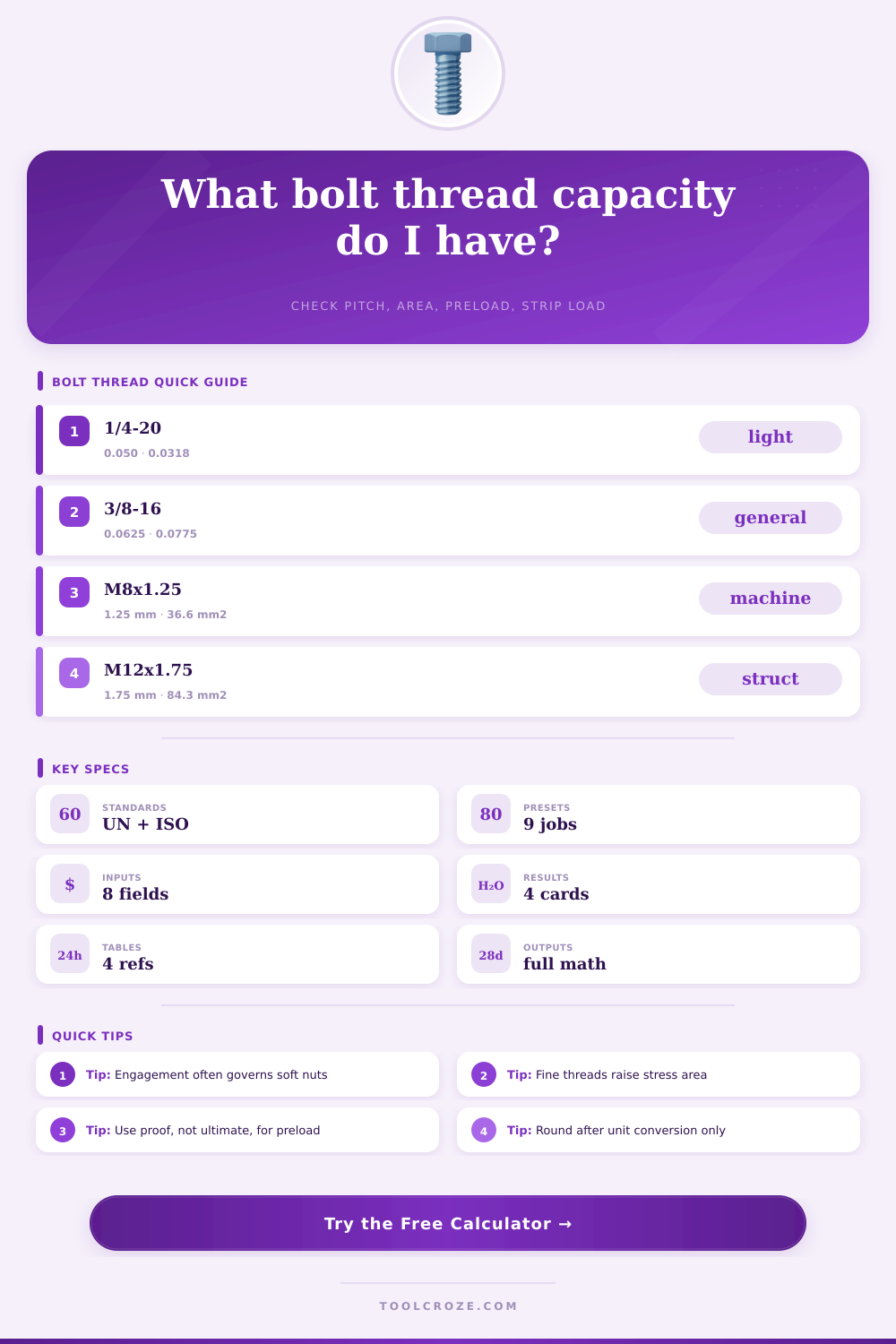
| 1/4-20 UNC | 0.0500 in | 0.0318 in² | Covers, brackets |
| 3/8-16 UNC | 0.0625 in | 0.0775 in² | General machine joints |
| M8 × 1.25 | 1.25 mm | 36.6 mm² | Machinery, guards |
| M12 × 1.75 | 1.75 mm | 84.3 mm² | Frames, fixtures |
| Bolt grade | Proof strength | Approx shear | Notes |
|---|---|---|---|
| ASTM A307 | 36 ksi | 21.6 ksi | Low-carbon anchor and utility bolts |
| SAE Grade 5 | 85 ksi | 51 ksi | General machinery and automotive joints |
| SAE Grade 8 | 120 ksi | 72 ksi | High clamp, hardened alloy bolts |
| Class 10.9 | 830 MPa | 498 MPa | Metric high-strength machine bolts |
| Engagement ratio | Description | Soft member | Steel member |
|---|---|---|---|
| 0.5D | Very short engagement | Usually strip-limited | Check carefully |
| 0.75D | Compact thread length | Borderline in aluminum | Often acceptable |
| 1.0D | Common machine design | Good starting point | Typically robust |
| 1.5D | Heavy engagement | Improves strip margin | Usually bolt-governed |
| Thread form | Pitch diameter | External minor | Internal minor |
|---|---|---|---|
| 60° unified / metric | D - 0.6495P | D - 1.2269P | D - 1.0825P |
| Stress area | As = π/4 (D - 0.9382P)² | ||
| Shear area | Astrip = π × D2 × Le × 0.5 × thread fraction | ||
| Preload | F = As × proof strength × preload factor | ||
💡 Thread Tips
This bolt thread calculator estimates thread geometry, tensile area, preload, and strip capacity so you can compare unified and metric fastener setups before selecting bolt size, pitch, and engagement length.
Bolt thread are the feature that allow the bolt to hold the joint together. The threads help to manage the force that act upon the bolt. If a person dont calculate the correct amount of thread engagement or the bolt preload, the bolt could either snap under the given load, or it could become loose under that load.
Thus, an understanding of these aspect of bolt threads is required to ensure that the bolt maintains its clamp upon the joint. The geometry of bolt threads include several dimension. For example, the threads has a pitch diameter, a major diameter, and a minor diameter.
Bolt Threads and How to Keep Bolts Strong
The pitch diameter is the middle diameter between the major and minor diameter. For standard bolt with a 60 degree angle for the threads, one calculates the pitch diameter by taking the diameter of the bolt and subtracting 0.65 times the pitch of the bolt. The minor diameter is the smallest diameter of the bolt.
The minor diameter create the tensile stress area of the bolt. The tensile strength area is the area of the bolt that is exposed to tensile loads, and the strength of this area dictate the strength of the bolt in relation to tensile loads. Preload is the initial stretch of the bolt to hold the joint in a compressed state.
It is necessary to apply preload to the bolt to ensure that the joint remain in that compressed state despite any vibration or temperature change that may act upon the bolt. Preload should be between 60% and 85% of the proof strength of the bolt. Proof strength is the amount of stress that the bolt can endure without permanent deformation of the bolt.
Ultimate strength should never be targeted for bolt preload. Instead, you should target the proof strength of the bolt because it includes a safety margin for unexpected variable that may act upon the bolt during operation. Bolts can fail due to the tensile load upon the bolt, but they can also fail due to stripping of the nut.
Stripping occur when the shear strength of the nut is less than the load placed upon the bolt. The engagement length of the bolt is the depth that the bolt’s threads enter the nut. The engagement length of bolts should be the same as the bolt’s diameter for steel component.
For nut made of a softer metal, such as aluminum, the engagement length should be deeper into the nut. For instance, you should use 1.5 times the diameter of the bolt for softer nut material. Additionally, the percent of height of the threads also have an impact upon how the bolt and nut engage and transfer force to one another.
Most production bolt have taps that remove 65% to 75% of the total height of the threads rather than removing none of that height. The pitch of the bolt threads and the grade of the metal of the bolt also have an impact upon bolt performance. Coarse thread are often used for light bracket.
Coarse threads allow for fast assembly of the bolt. Fine thread have a higher tensile stress area than coarse threads and, therefore, are used in application where the bolt must maintain its preload. The metal grade of the bolt has a direct impact upon the strength of that bolt.
For example, Grade 8 bolt have 120 ksi of proof strength while stainless steel bolt have 65 ksi of proof strength. The metal of the nut also matter. For instance, aluminum nut have a lower shear strength than steel nut.
Thus, longer engagement length are required for aluminum nut to prevent stripping. Bolt preload can be affected by environmental and physical aspect of the bolt. For instance, change in temperature will change the preload of the bolt.
The preload may change by 1% for every 100 degree change in temperature. Vibration can cause bolt to become loose over time. However, coarse threads will naturaly provide some resistance against vibration.
The finish of the bolt and nut can also impact bolt performance. For instance, if you plate bolts, or have a certain surface treatment for corrosion resistance, it could lead to galling of the thread. Galling is a process in which two metal begin to seize due to frictional force between the metal surfaces.
Finally, depending upon the type of failure that is to be avoided, bolts can be managed in various way. For instance, if the concern is that the bolt may become loose, fine threads can be utilized because fine threads are better able to maintain preload under vibration. If the concern is that the nut may strip, you can increase the engagement length of the bolt or the nut can be made of a harder metal.
If the concern is that the bolt may break, it is necessary to ensure that the preload is maintained within the proof strength of the bolt. Thus, by managing the pitch diameter of the threads, the preload of the bolt, and the engagement length of the bolt threads, one can ensure that the bolt perform its function. Its important to remember that you should of checked all measurements twice.
Youll find that most errors come from bad dimensioning. The bolt’s performance depends on the quality of the metal and its thickness.