🔩 Bolt Clamping Force Calculator
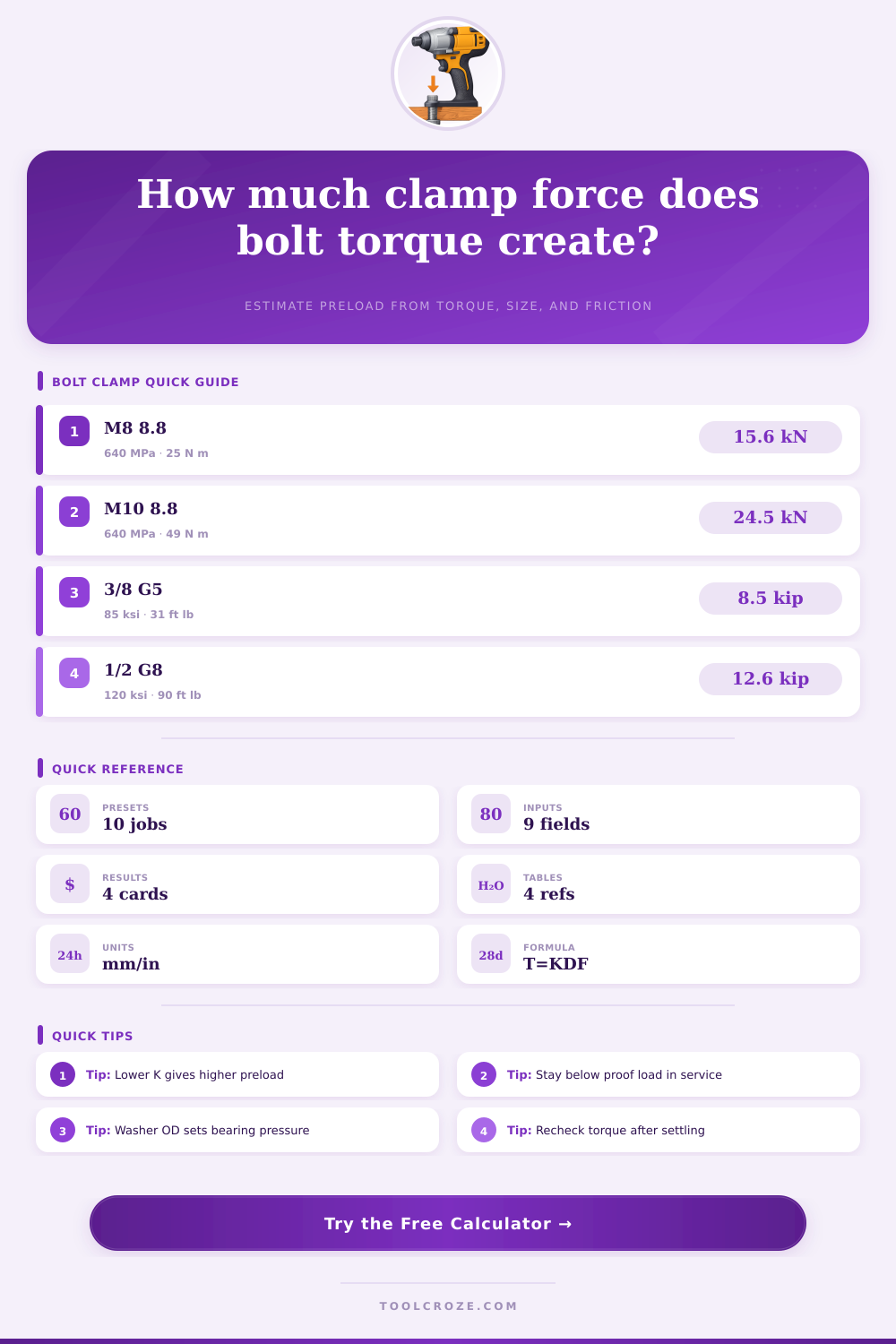
Estimate bolt preload from tightening torque, thread geometry, proof strength, friction, washer face diameter, and bolt count for flanged joints, machine bases, covers, and structural clamps.
📌 Presets
⚙ Joint Inputs
📊 Results
🧱 Material and Spec Comparison
Good for guards and bases
Higher clamp at same size
Common die and fixture choice
Corrosion resistant, lower preload
📋 Reference Tables
| Bolt spec | Proof strength | Typical preload | Use case |
|---|---|---|---|
| ISO 8.8 | 640 MPa | 70% proof | General machinery |
| ISO 10.9 | 830 MPa | 75% proof | Compact high load joints |
| SAE Grade 5 | 85 ksi | 70% proof | Brackets and frames |
| SAE Grade 8 | 120 ksi | 75% proof | Tooling and dies |
| Finish condition | Typical K | Friction state | Clamp effect |
|---|---|---|---|
| Cadmium or waxed | 0.12 to 0.15 | Low friction | Highest preload |
| Oiled black oxide | 0.16 to 0.18 | Controlled | Stable torque scatter |
| Plain zinc dry | 0.20 to 0.22 | Medium | Typical shop value |
| Rough dry threads | 0.24 to 0.28 | High friction | Lower preload |
| Bolt size | Thread pitch | Tensile area | Common washer OD |
|---|---|---|---|
| M8 | 1.25 mm | 36.6 mm2 | 16 mm |
| M10 | 1.50 mm | 58.0 mm2 | 20 mm |
| 3/8 in | 0.0625 in | 0.0775 in2 | 0.875 in |
| 1/2 in | 0.0769 in | 0.1419 in2 | 1.062 in |
| Joint type | Typical preload goal | Pressure concern | Note |
|---|---|---|---|
| Steel flange | 70 to 80% | Gasket crush | Watch seating losses |
| Machine base | 60 to 70% | Cast surface | Use hardened washers |
| Structural splice | 70 to 85% | Plate slip | Turn-of-nut may govern |
| Aluminum cover | 50 to 65% | Bearing embedment | Increase clamp diameter |
💡 Practical Notes
This calculator converts tightening torque into bolt preload, total clamp force, proof-load percentage, and contact pressure so you can compare grades, diameters, lubrication states, and washer sizes before assembly.
Torque is the rotational force that is applied to teh bolt. Torque are used to create tension within the bolt. Tension is the force that pulls the shank of the bolt.
Tension is the force that creates the clamp that holds the two parts of the assembly together. Many people believes that torque and clamp force are the same. However, it is important to understand the difference between torque, clamping force, and the factor that contribute to each.
How Torque, Friction, and Nut Factor Change Bolt Tightness
Friction consumes a large portion of the torque that is provided to the bolt. Friction act upon the threads of the bolt and the underside of the bolt head. Friction consumes between 80 and 90 percent of the torque that are applied.
The remaining portion of the torque must create the preload of the bolt. Preload is the tension of the bolt. The bolt creates the clamp force.
The nut factor, also known as the K-factor, is a value that represents the amount of friction that is present between the bolt and the bolt hole in the part that is being assembled. A high nut factor indicates that there is much friction between the bolt and the bolt hole. A high nut factor will result in less torque being converted to preload.
For example, if the threads are dry or rough, there will be a high nut factor. A high nut factor require more torque to create the same amount of preload as a bolt with a low nut factor. Lubricated threads will have a low nut factor.
A low nut factor will result in more torque being converted to preload. Therefore, if you lubricate a bolt, the nut factor will decrease. A decreased nut factor will allow for a higher preload with the same amount of torque that a wrench applies.
It is important to account for the nut factor when applying torque to a bolt because the nut factor will determine how much of the effort of the wrench will actualy stretch the bolt shank. The proof strength of a bolt is a limit to the tension that a bolt should be designed to handle. The proof strength should not be exceeded when installing or tightening bolts.
The proof strength is the maximum amount of tension that a bolt can be tightened to before the bolt begin to deform. For bolts with a grade of ISO 8.8, the proof strength is 640 megapascals. For bolts of this grade, the tension should only be 70 percent of the proof strength.
If the proof strength of the bolt is exceeded, the bolt will stretch permanently. If the bolt permanently stretch, the clamp force of the bolt will decrease. The use of a target ratio will help to ensure that the bolt does not exceed it’s proof strength.
The type of joint that is being assembled with the bolt will have an effect upon the clamp force and the bearing pressure of that joint. For instance, steel-to-steelpart joints will allow for high preload because steel is a strong metal. For aluminum joints, however, the preload will have to be lower because aluminum joints are a softer metal.
The metal can embed under the washer. If the clamp force is embedded into the part, the clamp force will decrease. Gasketed joints will also have a decrease in clamp force over time due to the relaxation of the gasket.
Bearing pressure is another consideration in the clamping force of the joint. The bearing pressure is the force that is distributed between the bolt head or washer and the part. The bearing pressure should not exceed the yield strength of the part.
The thread geometry of a bolt will also have an effect upon the bolt’s tensile stress area. The tensile stress area is the portion of the bolt that is capable of distributing the tensile load of the bolt. The thread pitch of the bolt will determine the tensile stress area of the bolt.
The finer the threads of the bolt, the larger the tensile stress area of the bolt. A larger tensile stress area allow for more load to be distributed over the same diameter of the bolt. Coarser threads are easier to install into a bolt hole.
When assembling a bolted joint, it is important to always consider the effects of relaxation. Relaxation of the clamp force is common in both bolted assemblies and threaded joints. The clamp force may become less due to embedment of the joint or due to creep of the joint materials.
It is important to recheck the torque of a joint after it has been installed and after the bolted assembly have undergone a run-in cycle. Rechecking the bolt torque will help to compensate for the loss in clamp force due to relaxation. Finally, considerations should be made for fatigue and vibration of the joint that is being assembled with bolts of various sizes.
One important reason for the clamp force that the bolt creates is to prevent the bolt from loosening due to vibration. If the clamp force of the bolt drops to 40 percent of the proof strength, microscopic slips will begin to occur within the joint that are a sign of fatigue damage to the bolt. These microscopic slips can eventually lead to fatigue cracks in the bolt.
It is also important to calculate the effect of thermal expansion upon the bolts and the clamp force that they create. Calculating the clamp force and accounting for the nut factor will help to ensure that the bolts provides the necessary clamp force to the joint.