🔩 Fastener Torque Calculator
Calculate the correct tightening torque for bolts & screws — imperial & metric
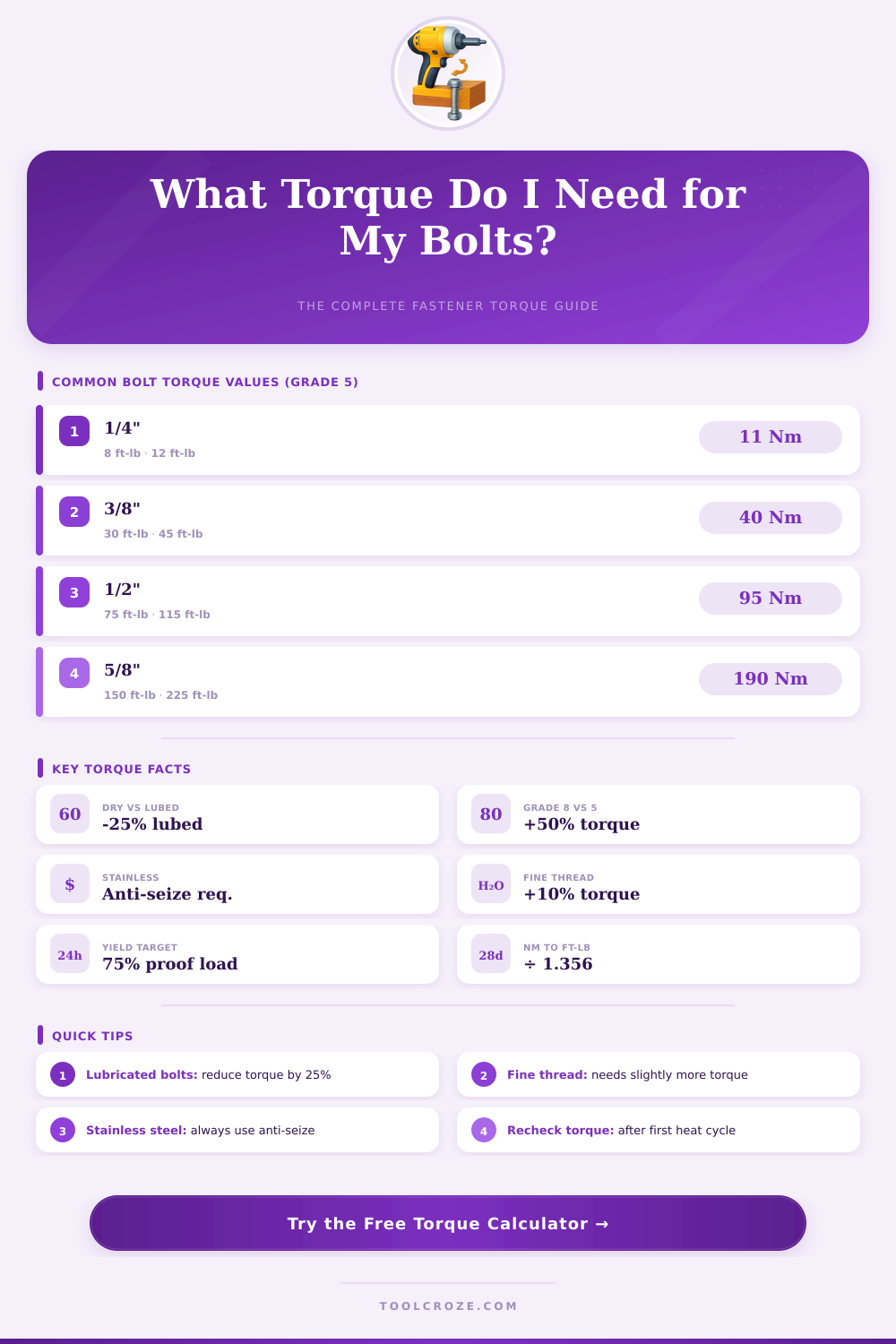
| Bolt Size | Grade 2 | Grade 5 (Dry) | Grade 5 (Lubed) | Grade 8 (Dry) | Grade 8 (Lubed) |
|---|---|---|---|---|---|
| 1/4" | 4 | 8 | 6 | 12 | 9 |
| 5/16" | 8 | 17 | 13 | 24 | 18 |
| 3/8" | 15 | 31 | 23 | 44 | 33 |
| 7/16" | 24 | 50 | 37 | 70 | 52 |
| 1/2" | 37 | 75 | 56 | 110 | 82 |
| 5/8" | 72 | 150 | 112 | 220 | 165 |
| 3/4" | 125 | 265 | 199 | 380 | 285 |
| 7/8" | 190 | 430 | 322 | 600 | 450 |
| 1" | 285 | 640 | 480 | 900 | 675 |
| Size | Class 4.6 | Class 8.8 Dry | Class 8.8 Lubed | Class 10.9 Dry | Class 12.9 Dry |
|---|---|---|---|---|---|
| M4 | 1.2 | 2.9 | 2.2 | 4.1 | 4.8 |
| M5 | 2.4 | 5.8 | 4.4 | 8.1 | 9.5 |
| M6 | 4.1 | 9.9 | 7.4 | 13.8 | 16.2 |
| M8 | 10 | 24 | 18 | 34 | 39 |
| M10 | 20 | 47 | 35 | 66 | 78 |
| M12 | 34 | 82 | 62 | 115 | 135 |
| M14 | 55 | 130 | 98 | 183 | 215 |
| M16 | 85 | 200 | 150 | 280 | 330 |
| M20 | 165 | 390 | 295 | 550 | 645 |
| M24 | 285 | 680 | 510 | 950 | 1120 |
| Condition | K Factor | Torque vs Dry | Notes |
|---|---|---|---|
| Dry / Unplated | 0.20 | Baseline | Clean, bare steel |
| Zinc / Cadmium Plated | 0.17 | –15% | Common hardware store bolts |
| Lubricated (oil/grease) | 0.15 | –25% | General lubricated assembly |
| Anti-Seize Compound | 0.13 | –35% | Required for stainless to stainless |
| Waxed / PTFE Coated | 0.10 | –50% | Very low friction coatings |
| From | To | Multiply By | Example |
|---|---|---|---|
| ft-lb | Nm | 1.35582 | 100 ft-lb = 135.6 Nm |
| Nm | ft-lb | 0.73756 | 100 Nm = 73.8 ft-lb |
| in-lb | Nm | 0.11298 | 100 in-lb = 11.3 Nm |
| Nm | in-lb | 8.85075 | 10 Nm = 88.5 in-lb |
| ft-lb | in-lb | 12 | 10 ft-lb = 120 in-lb |
| in-lb | ft-lb | 0.08333 | 120 in-lb = 10 ft-lb |
Torque is the measure of the rotational force that is applied to a bolt. Torque is used to create clamp force on the objects that is being fastened together with the bolt. Clamp force is the pressure that is placed on the objects that are being fastened together.
Clamp force is necessary to provide for scenario in which the objects may vibrate apart from one another. If the torque is too low, the fastener will remain loose and the vibrating objects may come apart from one another. If the torque is too high, however, the bolt may be stretched or even snap.
How Torque and Bolt Factors Affect Clamp Force
Thus, it is important for those who utilize bolts understand how each of these factor relates to one another in order to provide for the correct amount of clamp force. One factor that play a primary role in the factor of torque is the factor of friction. Friction is the force that resists the movement of one object against another; thus, in bolts, friction is the force that resists the movement of the bolt against the objects being fasten together.
When torque is applied to a bolt, approximately 90% of the torque is used to overcome friction between the threads of the bolt, and only approximately 10% of the torque is used to stretch the shank of the bolt. The amount of friction that is created between the threads of the bolt changes with the condition of the threads. For instance, dry steel threads will have a higher friction coefficient than lubricated steel threads.
Thus, if you place oil or grease on bolts, the friction between the threads will be decreased. As a result, the amount of torque that is applied to those bolts will have to be decreased, as well. The factor that is used to calculate the amount of torque that should be applied to bolts that are lubricated with oil and grease is the nut factor, or the “K” value.
Dry steel on steel will have a nut factor of 0.20, but oil or grease will reduce the nut factor to 0.15. Thus, changes in the lubrication of bolts will alter the friction between those bolts’ threads, and alterations in friction will alter the amount of torque that is required to sufficiently clamp the objects together. Another factor that alters the torque that is required to provide for the clamp force of bolts is the pitch of the threads of those bolts.
Coarse threads have larger gaps between the threads of the bolt than fine threads. As a result, bolts with coarse threads will require less torque than bolts with fine threads of the same diameter in order to provide the same amount of clamp force to the objects being fastened together. Fine threads have smaller gaps between the threads of the bolts than coarse threads; thus, approximately 10% more torque will be required for bolts with fine threads than for bolts with coarse threads of the same diameter.
Thus, it is important to know the type of threads of bolts prior to installation, as the type of threads will impact the amount of torque that is required to ensure the bolts remain secured. In addition to thread pitch, another factor that impacts the amount of torque that is applied to bolts is the grade of the bolt. The grade of the bolt indicates the strength of the bolt.
For instance, SAE Grade 2 bolts are of lower strength than SAE Grade 8 bolts. Thus, the amount of torque that is applied to SAE Grade 2 bolts must be less than the amount of torque applied to SAE Grade 8 bolts. Metric bolts also contain grades, such as class 8.8 and class 10.9 bolts.
A class 8.8 bolt has the same strength as a Grade 5 bolt; a class 10.9 bolt has the same strength as a Grade 8 bolt. Thus, the same relationship apply to metric bolts as to the SAE bolts; bolts of higher grades will require more torque to achieve the same clamp force as bolts of lower grades, and any torque calculations that were calculated for bolts of a high grade will be insufficient for bolts of a low grade. Another factor that impacts the amount of torque that is applied to bolts is the type of material from which the bolts are made.
Bolts made of stainless steel are prone to a phenomenon referred to as galling. Galling is the sticking together of the threads of the bolts that prevents them from being tightened or loose. To avoid galling, one should utilize anti-seize compounds on bolts made of stainless steel.
These anti-seize compounds will reduce the friction between the threads of the bolts. Thus, less torque will be required to apply to stainless steel bolts than to bolts of other materials. Aluminum is another material for which special considerations must be made when applying torque.
Aluminum is softer than steel. Thus, applying too much torque to bolts made of aluminum can result in the yielding of the aluminum bolts. To avoid yielding of these bolts, you should utilize washers on bolts made of aluminum; the washers will help to distribute the force of the clamp force of the bolt, preventing the aluminum components from cracking or yielding under the force.
Other considerations for the application of torque to bolts includes the engagement of the threads of the bolt with the materials being fastened together. Threads should engage with the materials being fastened with at least 1.5 times the diameter of the bolt; engaging the threads with less than this amount may lead to the stripping of the threads in those materials. Additionally, other factors include the fact that vibrations may act upon the bolts and loosen them over time, so prevailing torque nut or thread lockers can prevent the bolts from loosening over time.
Additionally, rechecking the torque that is applied to bolts after the application of heat to the assembled bolts is recommended, as heat may cause the materials to settle into their components; thus, the torque may need to be re-applied after heat exposure. Finally, when applying the torque to bolts, it is important for individuals to work within a specific tolerance. The specifications for bolts will include a band of torque that should be applied to the bolt; for instance, the specifications may state that the bolts should be tightened to within 10% of the specified torque.
This allows for errors in tightening of the bolts with the tools that are available; no tool is 100% precise in its measurements. Additionally, reference tables exist that indicate the appropriate amount of torque that should be applied to bolts of specific materials, thread sizes, grades, and other specifications. In order to ensure that bolts are properly secured to the objects that are to be fastened together, the specifications of the bolts should be accounted for prior to installing the bolts into the objects.
By accounting for each of the factors related to bolts, individuals will achieve the correct amount of clamp force to those objects, and ensure that the bolts will remain secured to those objects.