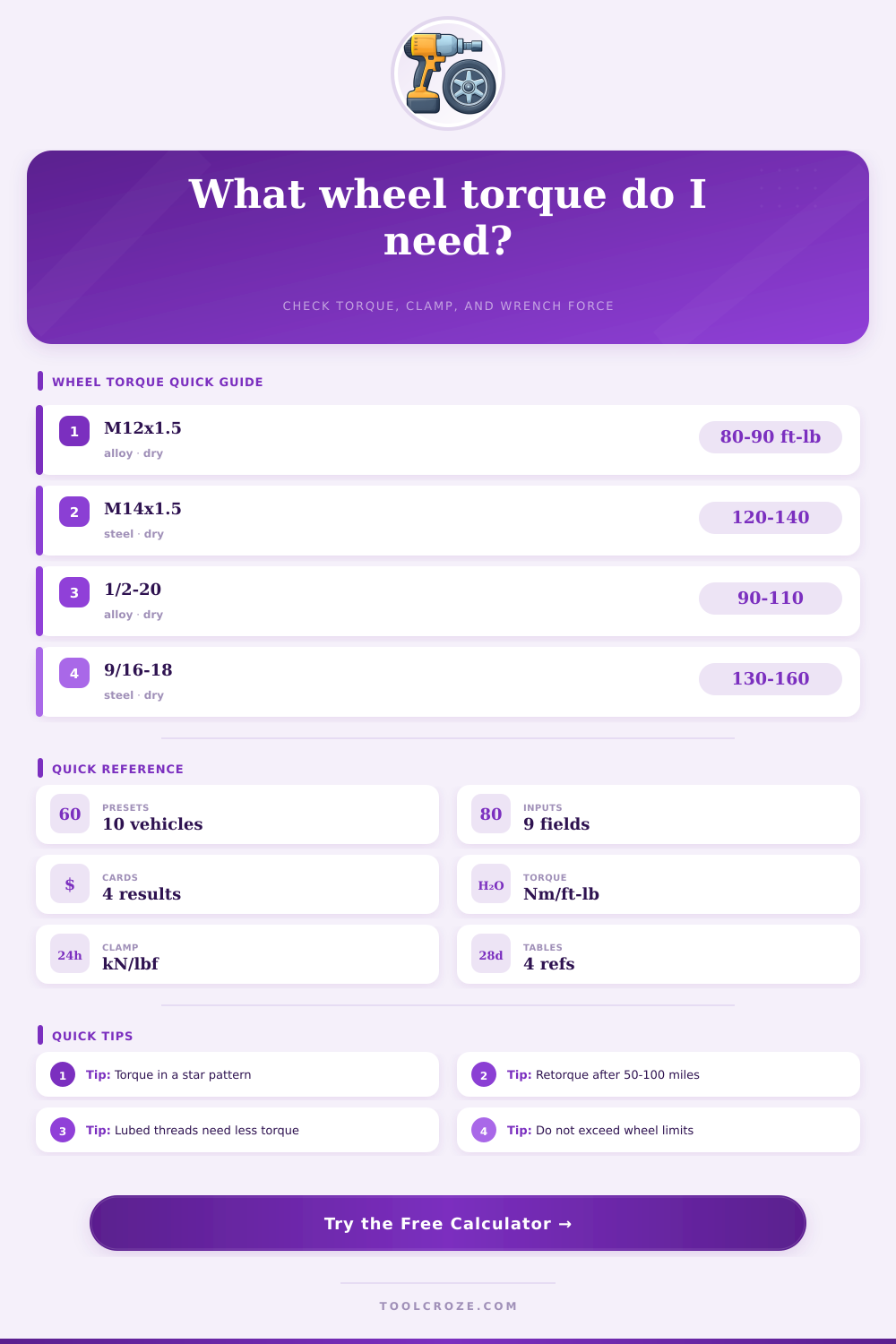
🛞 Wheel Torque Calculator
Estimate lug nut torque, clamp load, total wheel clamping force, and required wrench effort using stud size, wheel material, thread condition, and fastener grade.
📌 Presets
⚙ Torque Inputs
🎯 Results
📊 Stud and Material Comparison
📑 Reference Tables
| Stud Size | Wheel Type | Dry Thread Range | Common Use |
|---|---|---|---|
| M12 × 1.25 | Alloy | 78–90 ft-lb | Compact and sport sedans |
| M12 × 1.5 | Steel | 82–95 ft-lb | Small SUVs and vans |
| M14 × 1.5 | Alloy | 115–130 ft-lb | Midsize SUV and EV crossover |
| M14 × 2.0 | Steel | 125–145 ft-lb | Half-ton truck and cargo van |
| 1/2‑20 | Alloy | 90–110 ft-lb | Classic truck and trailer hubs |
| 9/16‑18 | Steel | 135–160 ft-lb | HD truck, service body, trailer |
| Thread Condition | K Factor | Torque Change | Use Note |
|---|---|---|---|
| Dry and clean | 0.20 | Baseline | Most OEM wheel specs assume this |
| Light oil film | 0.17 | About 15% lower | Use only if service data allows |
| Nickel anti-seize | 0.15 | About 25% lower | High clamp risk if dry value is used |
| Dry with corrosion | 0.23 | About 15% higher | Clean hardware before final torque |
| Wrench Length | 90 ft-lb | 120 ft-lb | 150 ft-lb |
|---|---|---|---|
| 12 in / 305 mm | 90 lbf | 120 lbf | 150 lbf |
| 15 in / 381 mm | 72 lbf | 96 lbf | 120 lbf |
| 18 in / 457 mm | 60 lbf | 80 lbf | 100 lbf |
| 24 in / 610 mm | 45 lbf | 60 lbf | 75 lbf |
| Scenario | Stud / Seat | Target | Retorque |
|---|---|---|---|
| Compact sedan alloy | M12, conical | 80–90 ft-lb | 50 miles |
| Pickup steel wheel | M14, flat washer | 125–140 ft-lb | 100 miles |
| Trailer hub | 1/2‑20, conical | 90–105 ft-lb | 25–50 miles |
| Track stud conversion | M12, open nut | 85–95 ft-lb | Each session |
💡 Torque Tips
This wheel torque calculator estimates lug nut torque, clamp load, and wrench effort from stud size, thread friction, and wheel type so you can compare hardware setups before final assembly.
When installing wheel on a vehicle, it is important to ensure that you apply the correct amount of torque to the lug nut. If the amount of torque applied isnt correct, there is a risk that the lug nuts will become loose while the vehicle is being drove, which can result in one of the wheels becoming detached from the vehicle. Additionally, if you apply too much torque to the lug nuts, the aluminum seat that are present on the wheels may be damaged, or the wheel studs may be stretched.
In order to avoid these problems, it is important to understanding how torque creates clamp load on the wheels of the vehicle. The lug nuts create the clamp load that ensure that the wheel is securely attached to the hub of the vehicle. The application of torque to the lug nuts creates the clamp load, which forces the wheel to remain in place and allow it to resist the various forces that is experienced while the vehicle is being driven.
How to tighten wheel nuts the right way
The torque that is applied to the lug nuts is not the same than the clamp load that is created, however. Various factors influence the relationship between the torque that is applied to the lug nuts and the clamp load that is created. For instance, the clamp load that a clean and dry wheel stud creates will be more different than the clamp load that is created by a wheel stud that contains corrosion or anti-seize lubricant that is applied to the stud.
Additionally, the material that the wheel is made of may also impact how the wheel responds to the application of torque. For instance, cast aluminum wheels are common on passenger car, but cast aluminum wheels may settle after undergoing various heat cycles. Steel wheel are common on trucks, and the steel wheel studs are stiffer than aluminum, so they may require more torque to achieve the same level of clamp load as aluminum wheels.
Additionally, the seat style of the wheel may also impact the clamp load that is created by the lug nuts. For instance, conical wheel seats will distribute the clamp load through a narrowing cone, while flat wheel seats will distribute the clamp load over a broader area. Applying the incorrect amount of torque to a wheel with the wrong type of seat may lead to strip the seat.
Another factor to consider is the proof load of the wheel studs that are used in the vehicle. The tensile limit of the stud is the maximum amount of tension that the wheel stud will allow before it begins to permanently stretch. The proof load of the wheel studs can be calculated based off the stress area of the wheel stud.
For most applications, it is recommended that the lug nuts are tightened to between 65 and 85 percent of the proof stress of the wheel studs. Applying the recommended amount of torque to the lug nuts will help to ensure that the wheel studs will not stretch beyond their limit. If the tension of the lug nuts exceeds the proof stress of the wheel studs, the wheel stud will stretch beyond its limits, preventing the wheel from functioning correct.
Friction between the various components of the wheel and lug nut assembly is another important factor that influence the clamp load that is created. The formula for torque is torque equals the K factor multiply by the clamp force multiply by the diameter of the wheel stud. The K factor is a representation of the friction between the threads and the head of the lug nut.
If the lug nuts and wheel studs are dry and clean, the K factor will be approximately 0.20. If lubricant is used on the threads, the K factor will be 0.17 for oil, and 0.15 for anti-seize lubricants. Because lubricants reduce the friction between the studs and the lug nuts, the use of lubricants will increase the clamp load on the wheel studs.
Therefore, if lubricants are used for the studs, the amount of torque that is applied to the lug nuts will have to be adjusted to account for the increased clamp load on the wheel studs. Using the “dry torque” specification for lubricated wheel studs will over-tighten the lug nuts and could damage the component of the wheel. When installing the lug nuts, it is important to use a star pattern to ensure that the lug nuts are even.
If one lug nut is tightened to the proper torque before the other are tightened, the wheel may not be even with the hub. The lug nuts should be loosened to provide even torque on the wheel studs using a star pattern before tightening to the recommended torque. Finally, maintenance of the lug nuts is important to ensure that the wheels remain secure.
The lug nuts should be re-torqued after approximately 50 mile of driving the vehicle after installation of the wheels. When the aluminum wheels are driven, they may undergo a process of “creep,” wherein the metal relax and creates a 10 to 20 percent decrease in clamp load. Additionally, the lug nuts should be inspected and tightened after seasonal tire changes, after the vehicle has experienced heavy use on a track, or if the trailer has been exposed to road salt and grime.
By regularly maintaining the lug nuts to the correct amount of torque, the wheels will remain securely attach to the vehicle.