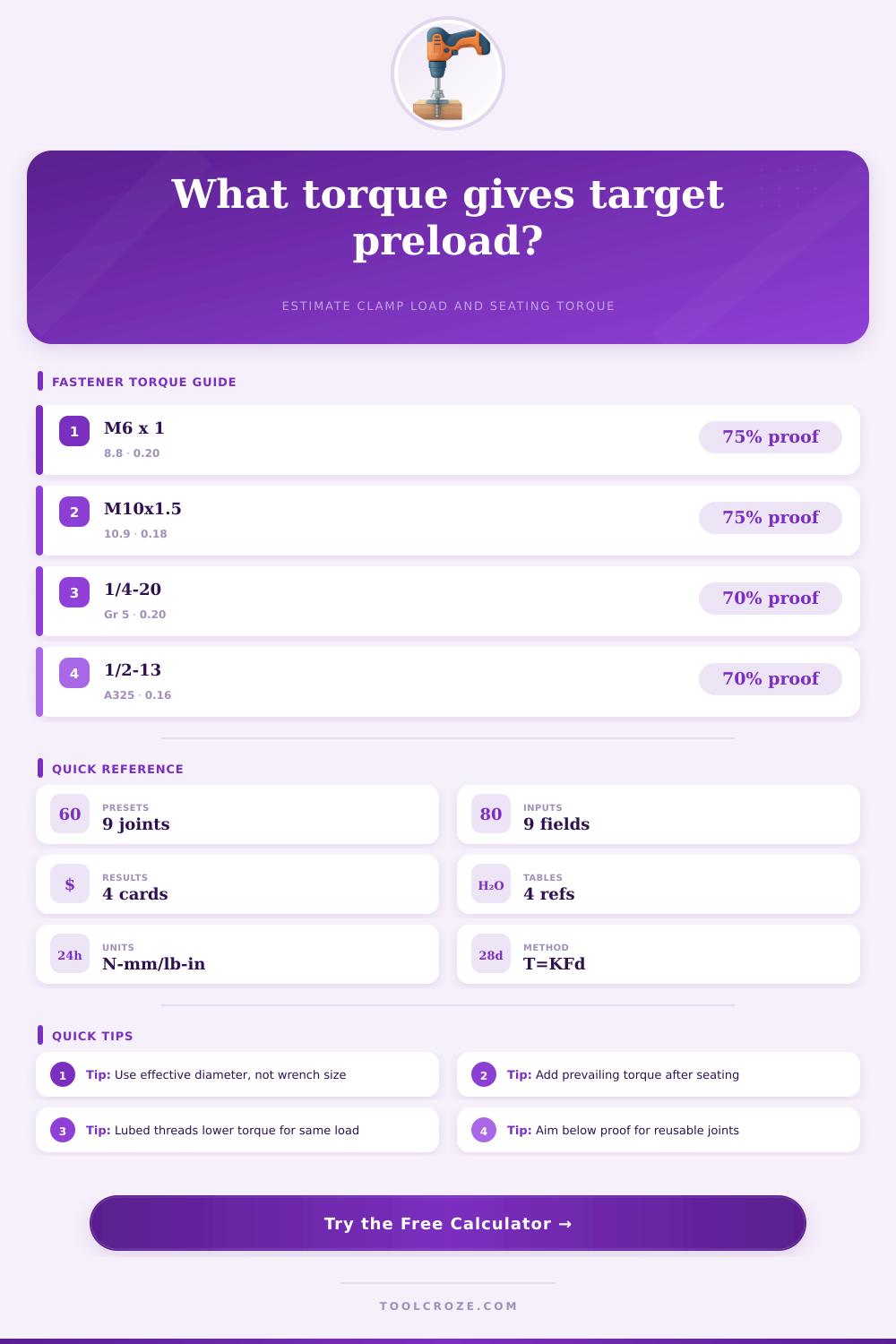
🔧 Torque Preload Calculator
Estimate assembly torque, clamp load, seating torque, and bolt stress from diameter, grade, friction condition, and preload target for common workshop and plant fasteners.
📌 Preset Joints
⚙ Joint Inputs
🎯 Preload Results
🗂 Fastener Spec Comparison
Typical target 70-75%
General machinery joints
Typical target 75-80%
Bearing caps, clamps, tooling
Typical target 75%
Heavy machine joints
Typical target 60-70%
Corrosion service
📊 Reference Tables
| Fastener spec | Proof strength | Default preload | Typical use |
|---|---|---|---|
| ISO Class 8.8 | 600 MPa | 70-75% | General steel machine joints |
| ISO Class 10.9 | 830 MPa | 75-80% | Bearing caps, fixtures, clamps |
| SAE Grade 5 | 85 ksi | 70% | Brackets and automotive service |
| ASTM A325 | 92 ksi | 70% | Structural friction joints |
| Thread condition | Nut factor K | Torque effect | Common note |
|---|---|---|---|
| Dry zinc or phosphate | 0.20 | Highest seating torque | Baseline handbook assumption |
| Light oil | 0.18 | About 10% lower | Common calibrated assembly |
| Waxed structural bolt | 0.16 | Lower, tighter band | Typical A325 installation |
| Moly paste | 0.13 | Much lower torque | Watch for over-preload risk |
| Metric thread | Pitch | Stress area | Dry torque at 75% 8.8 |
|---|---|---|---|
| M6 | 1.0 mm | 20.1 mm² | 18 N·m |
| M8 | 1.25 mm | 36.6 mm² | 35 N·m |
| M10 | 1.5 mm | 58.0 mm² | 52 N·m |
| M12 | 1.75 mm | 84.3 mm² | 91 N·m |
| Imperial thread | TPI | Stress area | Dry torque at 70% Gr 5 |
|---|---|---|---|
| 1/4-20 | 20 | 0.0318 in² | 8.2 lb·ft |
| 5/16-18 | 18 | 0.0524 in² | 17.5 lb·ft |
| 3/8-16 | 16 | 0.0775 in² | 30.8 lb·ft |
| 1/2-13 | 13 | 0.1419 in² | 74.0 lb·ft |
💡 Practical Notes
📐 Formula Summary
Imperial mode: preload (lbf) = stress area (in²) × proof strength (psi) × preload fraction. Seating torque (lb·in) = K × preload × diameter (in).
Stress check: tensile stress = preload / stress area, which equals preload fraction of proof strength when the stress area is correct.
The concept of torque does not create an clamp force that keeps the parts from moving. The clamp force that keeps the parts from moving is called preload. Preload is the tension that exist in the bolt after the bolt has been tightened.
Most of the torque that is applied to the bolt is lost to friction. Only a fraction of that applied torque create the preload. Only 10 to 20 percent of the torque applied to a bolt is used to create the preload.
Bolt Preload and Torque
If the friction is not calculated correct when setting the torque specifications for a bolt, there is the potential for either underpreloading the joint or the bolt may be overstress. If the joint is underpreloaded, fatigue cracks can form due to the moving parts relative to each other. If the bolt is underpreloaded, it could lead to bolt failure due to the bolt yielding under the tensile loads.
In order to calculate the preload that is to be applied to a bolt, the nut factor of the bolt must be understood. The nut factor, represented by the letter K, is a value that mathematically represent the friction between the threads of the bolt and the part that the bolt is being tightened into. The lubricant that are used on the bolt will mathematically change the value of the nut factor.
For dry zinc-plated fasteners, the nut factor is 0.20. However, if you use molybdenum paste as the lubricant, the nut factor can mathematically drop to 0.13. This means that using molybdenum paste will allow for the reduction in the amount of torque that is applied to the bolt in order to achieve the same level of clamp force.
Since the nut factor change based on the type of lubrication used on the bolt, the bolt specifications will have to be changed to account for the change in nut factor. The target preload that is to be achieved for the bolt should be a percentage of the proof strength of the bolt metal. Proof strength is the tensile force that the metal can take before it begins to stretch permenantly.
For bolts made from ISO class 8.8 steel, the proof strength is 600 MPa. For reusable machine joints, the percentage of the proof strength that is targeted for the preload is 70 to 75 percent. Room must be left for embedment.
During embedment, the irregularities in the metallic surface of the bolt and component that it is being tightened into become even, leading to a loss of clamp force. This loss of clamp force can be anywhere from 5 to 10 percent of the total clamp force. For vibration-prone components, a preload of 80 percent of the proof strength can be used in order to provide enough clamp force to allow for strong grip on the component that is being fastened.
For reusable covers, the preload should be 65 percent of the proof strength to prevent galling of the bolt threads during removal. The variables that must be accounted for when calculating the preload that should be applied to a bolt include the prevailing torque, the diameter of the bolt, the stress area of the bolt, the condition of the threads of the bolt, and the type of lubricant that is used on the bolt threads. The prevailing torque that must be overcome with the bolt being turned is the resistance that is provided by locknuts or deformed threads of the bolt.
The diameter of the bolt is used to calculate the mean radius of the threads of the bolt. The stress area of the bolt is the area of the narrowest part of the threads of the bolt. The stress area is usually calculated from bolt handbooks because the values that is published in these handbooks are more accurate then approximate values.
The condition of the threads can change the amount of friction of the threads of the bolt. For instance, using light oil on threads will reduce the torque that is required to seat the bolt into place by 10 percent. Using anti-seize lubricants is helpful in environments that are known to be corrosive to metallic components but can cause overpreloading of the components.
The formula T = K * F * D can be used to calculate the amount of torque that should be applied to the bolt. In this equation, the variable T represents the amount of torque that is applied to the bolt. The variable K is the nut factor of the bolt, F is the preload force, and D is the diameter of the bolt.
This equation is applicable to both metric and imperial measuring units of length. In most real-world applications, the clamp force that is created by the preload will be different than when using the formula to calculate the preload. For bolted connections with gaskets, the preload will be lower than calculated because excessive preload could crush the gasket.
For bolts that connect steel components to aluminum components, care must be taken to ensure that the preload is set correctly because the aluminum may fail before the steel component. Most steel-to-aluminum brackets will have a preload that is 10 percent lower than calculated to account for the scatter in the performance of bolts during the manufacturing process. Most bolt installation shop should allow for 10 percent scatter in the performance of bolts.
Finally, the engagement of the threads must be ensured to be at least 1.5 times the diameter of the bolt to prevent the threads of the bolt from stripping during normal operation.