🔧 Socket Size Converter
Convert between SAE (imperial) and metric socket sizes — find exact matches and closest fits instantly
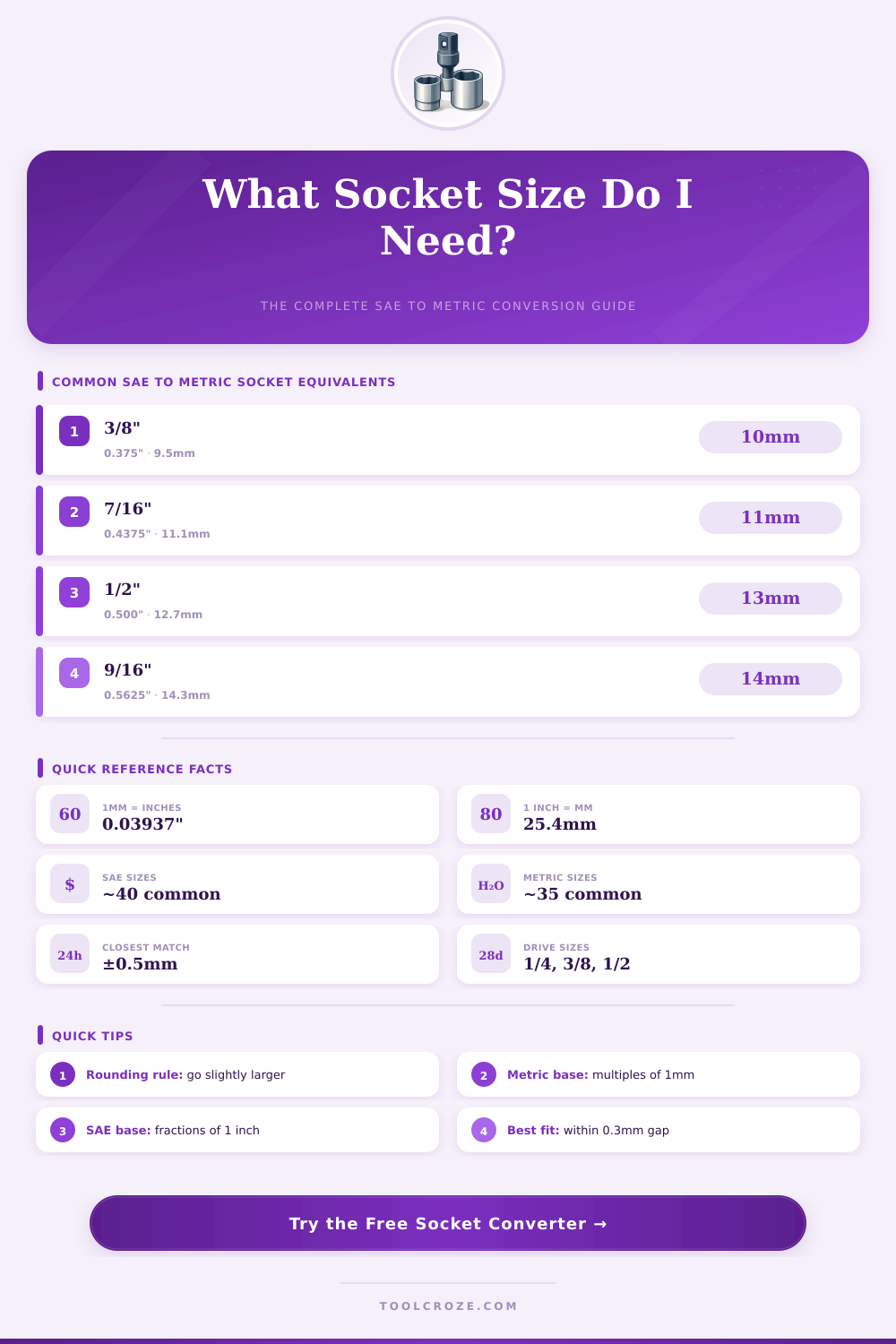
| SAE Size | Decimal (in) | Exact mm | Nearest Metric | Difference | Fit Quality |
|---|---|---|---|---|---|
| 1/4" | 0.250" | 6.35mm | 6mm | +0.35mm | Close |
| 5/16" | 0.3125" | 7.94mm | 8mm | –0.06mm | Excellent |
| 3/8" | 0.375" | 9.53mm | 10mm | –0.47mm | Close |
| 7/16" | 0.4375" | 11.11mm | 11mm | +0.11mm | Excellent |
| 1/2" | 0.500" | 12.70mm | 13mm | –0.30mm | Excellent |
| 9/16" | 0.5625" | 14.29mm | 14mm | +0.29mm | Excellent |
| 5/8" | 0.625" | 15.88mm | 16mm | –0.12mm | Excellent |
| 11/16" | 0.6875" | 17.46mm | 17mm | +0.46mm | Close |
| 3/4" | 0.750" | 19.05mm | 19mm | +0.05mm | Excellent |
| 13/16" | 0.8125" | 20.64mm | 21mm | –0.36mm | Excellent |
| 7/8" | 0.875" | 22.23mm | 22mm | +0.23mm | Excellent |
| 15/16" | 0.9375" | 23.81mm | 24mm | –0.19mm | Excellent |
| 1" | 1.000" | 25.40mm | 25mm | +0.40mm | Close |
| 1-1/16" | 1.0625" | 26.99mm | 27mm | –0.01mm | Excellent |
| 1-1/8" | 1.125" | 28.58mm | 29mm | –0.42mm | Close |
| Metric Size | Decimal (in) | Nearest SAE | SAE Decimal | Difference | Fit Quality |
|---|---|---|---|---|---|
| 6mm | 0.2362" | 1/4" | 0.250" | –0.35mm | Close |
| 7mm | 0.2756" | 9/32" | 0.281" | –0.14mm | Excellent |
| 8mm | 0.3150" | 5/16" | 0.3125" | +0.06mm | Excellent |
| 9mm | 0.3543" | 3/8" | 0.375" | –0.53mm | Close |
| 10mm | 0.3937" | 3/8" | 0.375" | +0.47mm | Close |
| 11mm | 0.4331" | 7/16" | 0.4375" | –0.11mm | Excellent |
| 12mm | 0.4724" | 1/2" | 0.500" | –0.70mm | Close |
| 13mm | 0.5118" | 1/2" | 0.500" | +0.30mm | Excellent |
| 14mm | 0.5512" | 9/16" | 0.5625" | –0.29mm | Excellent |
| 15mm | 0.5906" | 19/32" | 0.594" | –0.08mm | Excellent |
| 16mm | 0.6299" | 5/8" | 0.625" | +0.12mm | Excellent |
| 17mm | 0.6693" | 11/16" | 0.6875" | –0.46mm | Close |
| 18mm | 0.7087" | 11/16" | 0.6875" | +0.54mm | Close |
| 19mm | 0.7480" | 3/4" | 0.750" | –0.05mm | Excellent |
| 21mm | 0.8268" | 13/16" | 0.8125" | +0.36mm | Excellent |
| 22mm | 0.8661" | 7/8" | 0.875" | –0.23mm | Excellent |
| 24mm | 0.9449" | 15/16" | 0.9375" | +0.19mm | Excellent |
| 27mm | 1.0630" | 1-1/16" | 1.0625" | +0.01mm | Excellent |
| 30mm | 1.1811" | 1-3/16" | 1.1875" | –0.17mm | Excellent |
| 32mm | 1.2598" | 1-1/4" | 1.250" | +0.25mm | Excellent |
| Drive Size | Common SAE Range | Common Metric Range | Typical Use |
|---|---|---|---|
| 1/4" Drive | 3/16" – 9/16" | 4mm – 14mm | Small fasteners, electronics |
| 3/8" Drive | 1/4" – 7/8" | 6mm – 22mm | General automotive, most repairs |
| 1/2" Drive | 3/8" – 1-1/2" | 10mm – 38mm | Heavy automotive, large fasteners |
| 3/4" Drive | 3/4" – 2" | 19mm – 50mm | Industrial, heavy equipment |
| 1" Drive | 1" – 3" | 25mm – 75mm | Heavy-duty industrial |
When you attempt to remove a bolt, you must make sure that the socket that you use match the dimensions of the bolt. Sockets come in various sizes and is only designed to fit bolts of specific dimensions. You must choose sockets based off the units used to measure the bolts.
Imperial units, also known as SAE units, use fractions of an inch as there units of measurement. Metric units use whole numbers in the unit of measurement of millimeter. Because these two unit dont align with each other perfectly, it is common for imperial sockets to not fit metric bolts and for metric sockets to not fit imperial bolts.
How to Choose the Right Socket for a Bolt
Due to the differences between these two unit systems, there is gaps in the sizing of both types of bolts. For instance, a 3/8-inch bolt is 9.53mm. Therefore, there is a gap between a 9mm bolt and a 10mm bolt.
If you use a socket that is too large for a bolt, the socket will slip inside the bolt’s head and round the corner of the bolt head. Using a socket that is too small will prevent the socket from fitting the bolt at all. Thus, understanding the gaps between imperial bolts and metric bolts will allow you to choose a proper socket for the job without damaging the bolt.
Another factor to consider is the drive size of the socket. The drive size of the socket is the size of the square portion of the socket that engage with a ratchet. A 1/4-inch drive size is the smallest drive size and is used for small tasks.
A 1/4-inch drive size is not intended to be used in locations that require high torque. A 3/8-inch drive size is of medium size and used for general tasks. A 3/8-inch drive size provides a balance between the size of the socket and the torque that it can handle.
A 1/2-inch drive size is the largest and used for heavy automotive tasks. A 1/2-inch drive size can handle many amounts of torque. Using a drive size that is not appropriate for the bolt may result in the socket breaking away from the ratchet or the socket being too bulky to engage with the bolt.
The type of socket that you use will also have an effect on the bolts. A 6-point socket has six sides to it and will engage with the flat side of the bolt. A 6-point socket is less likely to slip on the bolt than a 12-point socket.
A 12-point socket has twelve sides and will allow for the socket to engage with the bolt more quick but is more likely to round the corners of the bolt head. There are two types of sockets: standard sockets and impact sockets. Manual ratchets often use standard sockets which are made of chrome.
Using chrome sockets with an impact wrench can result in the sockets shattering. Impact sockets are made of a softer metal and can take the heavy flexing that is created with an impact wrench, so impact sockets are safer to use with power tool. Using the wrong type of socket for a bolt is a common mistake.
Using the wrong size of socket for a bolt can damage the bolt head. For instance, using a 17mm socket for an 11/16-inch bolt will result in a mismatched fit. For bolts made of aluminum, which are softer metals, you must take care not to use a socket that is too loose fitted to the bolt.
Steel bolts are harder than aluminum bolts, so they are more likely to be stripped when the socket does not match the bolt correctly. Finally, you should consider a few other factors before using a socket on a bolt. Both heat and cold temperature can change the dimensions of a bolt.
Heat will make the metal of the bolt expand. Cold temperatures will make the metal of the bolt contract. These changes will alter the way that a socket fit with the bolt.
Thus, it is important to test the fit of a socket before applying heavy force to the bolt. Using a caliper to measure the size of the fastener will ensure that you have the correct size socket. Finally, organizing your sockets by the drive size and by bolt measurement will allow you to quickly find the correct socket for the bolt and to avoid using the wrong socket on a bolt.