🧪 Casting Resin Calculator
Calculate exactly how much resin you need for any mold or casting project
| Depth | Area Covered (sq in) | Area Covered (cm²) | Volume (cu in) |
|---|---|---|---|
| 1/4 in (6mm) | 7.22 sq in | 46.6 cm² | 1.80 cu in |
| 1/2 in (13mm) | 3.61 sq in | 23.3 cm² | 1.80 cu in |
| 1 in (25mm) | 1.80 sq in | 11.6 cm² | 1.80 cu in |
| 2 in (51mm) | 0.90 sq in | 5.8 cm² | 1.80 cu in |
| 3 in (76mm) | 0.60 sq in | 3.9 cm² | 1.80 cu in |
| 4 in (102mm) | 0.45 sq in | 2.9 cm² | 1.80 cu in |
| 6 in (152mm) | 0.30 sq in | 1.94 cm² | 1.80 cu in |
| Package Size | Volume (fl oz) | Volume (mL) | Approx. Cu In |
|---|---|---|---|
| Mini Kit | 4 fl oz | 118 mL | 7.2 cu in |
| Small Kit | 8 fl oz | 237 mL | 14.4 cu in |
| Medium Kit | 16 fl oz | 473 mL | 28.9 cu in |
| Large Kit | 32 fl oz | 946 mL | 57.8 cu in |
| Gallon Kit | 128 fl oz | 3,785 mL | 231 cu in |
| 2-Gallon Kit | 256 fl oz | 7,571 mL | 462 cu in |
| Project | Dimensions | Volume (fl oz) | Volume (mL) |
|---|---|---|---|
| Coaster (1/2 in) | 4 x 4 x 0.5 in | 4.4 fl oz | 131 mL |
| Round Pendant (1 in) | ⌀ 2 in x 1 in | 1.7 fl oz | 52 mL |
| Serving Tray (1 in) | 12 x 6 x 1 in | 39.8 fl oz | 1,177 mL |
| River Table (2 in) | 24 x 12 x 2 in | 319 fl oz | 9,440 mL |
| Paperweight (2 in) | 3 x 3 x 2 in | 9.0 fl oz | 266 mL |
| Art Panel (0.25 in) | 18 x 18 x 0.25 in | 45.1 fl oz | 1,334 mL |
| Jewelry Block (4 in) | 8 x 8 x 4 in | 285 fl oz | 8,432 mL |
Calculating the resin volume are necessary in the process because if there isnt enough resin, the resin will leave the mold without create the casts that are necessary for the projects. If there is not enough resin in the molds, then there will be wasted time and wasted material. In order to avoid these problems, a person must understand how to measure the resin that will be needed for the molds.
In measuring resin for molds, a person must consider the dimension of the mold, as well as the depth and the shape of the mold. The shape of the mold will impact the amount of resin that is required to fill it. For instance, molds that is in the shape of a rectangle is easy to calculate the amount of resin that is required for that mold.
How to Measure Resin for Molds
The length, width, and depth of the mold can easily be calculated. However, molds in the shape of a circle will require different math to calculate the amount of resin that will be needed for that mold. For example, the area of a circle is not more same as the area of a square of the same diameter.
The radius of the circle molds must be accounted for in calculating the amount of resin that is required to fill those molds. Additionally, molds in the shape of triangles have a smaller area than square molds, so there will be less resin that is required for triangular molds then for square molds. In both cases, the use of a resin calculator will help a person to make these calculations.
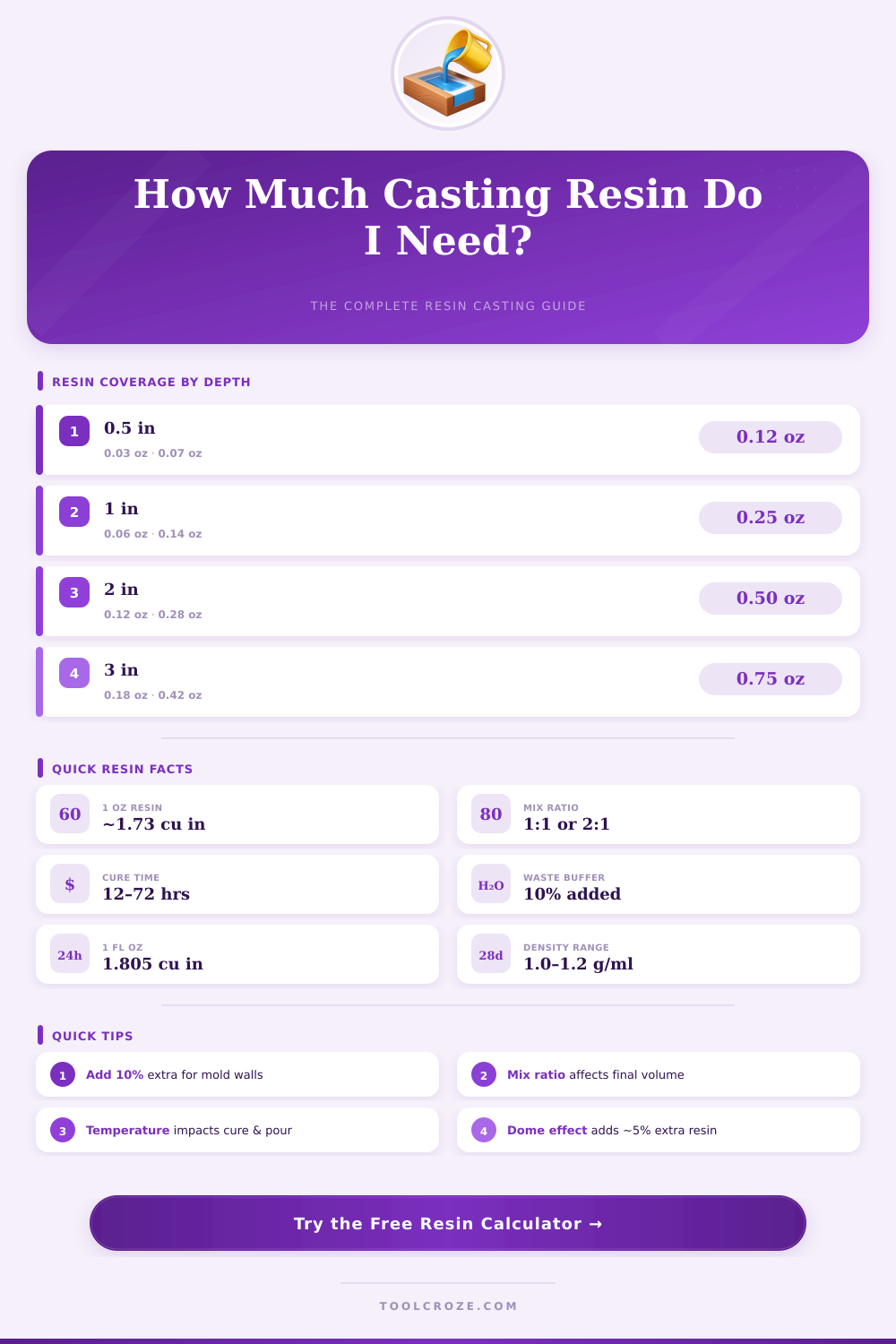
The depth of the molds also will impact the amount of resin that is required for those molds. For instance, if a person pours a mold with resin that is only a quarter inch in depth, a relatively large amount of resin will be required to cover the molds area. However, if the molds are poured with resin that is four inches in depth, a relatively small amount of resin will cover the molds area.
The deeper the molds are poured with resin, the more the resin may crack. The resin will release heat while curing, and if the resin is poured deep into molds, it may crack if it sets too quickly. Another factor in calculating the resin that will be required for molds is the type of resin that will be poured into the molds.
For instance, epoxy resin is different than polyurethane resin or polyester resin in that the density of each type of resin are different. The density of epoxy resin is 1.1 grams per milliliter, while the density of polyester resin is 1.2 grams per milliliter. The difference in the densities of each type of resin means that each type of resin will have a different weight.
The density of the resin must be accounted for in order to calculate how many grams or ounces of resin will be required for the molds. In addition to resin density, the amount of each part of the resin that is to be mixed together is another calculation that must be made. For instance, a resin that requires a 1:1 ratio of part A and part B resin means that a person must calculate how much of each part to mix together.
In calculating the resin that will be poured into molds, it is also important to include a buffer. A buffer means that a person will add a little extra resin to the total calculations to ensure that there is enough resin to fill the mold. While a ten percent buffer is often used in most projects, it is also possible that a larger buffer will be needed for molds of complex shapes.
Additionally, molds often have lips where resin can pool, or may require the creation of a domed surface on top of the poured resin. In either of these instances, resin will be required for these additions to the molds. If a buffer is not included in the calculations, it is possible that a person may use up all of the resin that was poured into the molds before the molds are completely fill.
In order to ensure that the calculations are the most accurate as possible, one test that can be performed is the water test. A person can fill the mold with water, and then pour that water into a graduated cylinder to measure how many milliliters of resin is required to fill the mold. This test will account for the exact shape of the mold.
By using the measurements of water that can fill the mold, a person can calculate the amount of resin that will be required for that mold. In order to successfully pour the resin into the molds, it is important that the resin is mixed correctly. The resin should be mixed according to the ratio indicated for that type of resin.
The resin should also be stirred slowly when mixed; if the resin is stirred too quickly, air bubble will be introduced into the resin. Air bubbles within the resin can lead to holes in the poured resin. After mixing the resin, the resin should be slowly poured into the molds.
The temperature of the resin impacts the resin, so it is best to pour the resin in an area of stable temperature. Finally, the resin should be allowed to fully cure according to the time that is required for that type of resin. You should of checked the density first to avoid mistakes.
It can be a lot of work but it makes the process more comfortabley.