🔧 Torque to Force Calculator
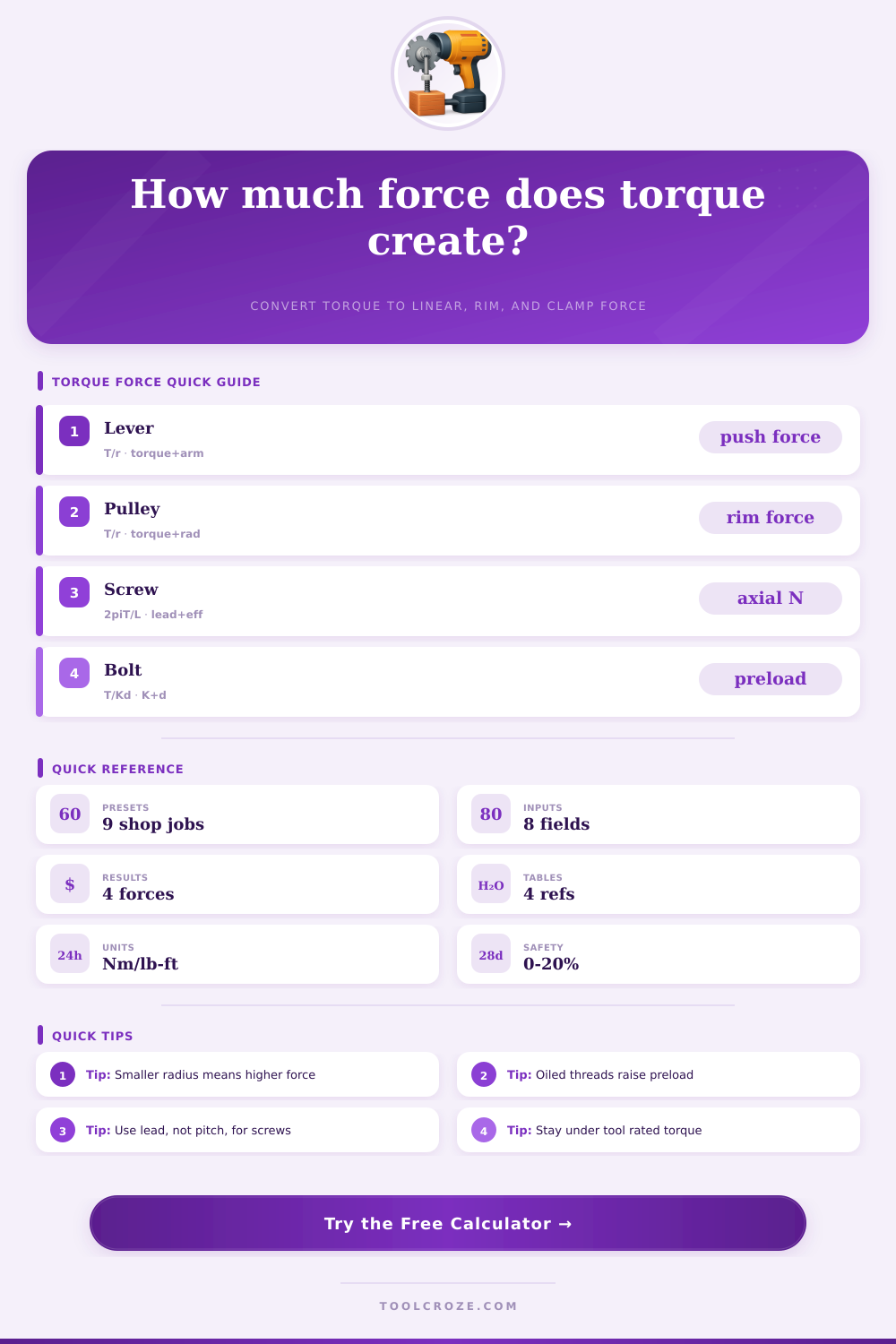
Convert applied torque into hand force, tangential rim force, lead screw thrust, and bolt preload using real workshop and mechanical formulas.
📌 Real Shop Presets
⚙ Calculator Setup
🎯 Force Results
🧱 Condition and Material Comparison Grid
📊 Reference Tables
| Conversion mode | Formula | Inputs needed | Best for |
|---|---|---|---|
| Lever hand force | F = T / r | Torque, handle arm | Wrenches and bars |
| Rim or drum force | F = T / r | Torque, pitch radius | Pulleys and drums |
| Lead screw thrust | F = 2pi eta T / L | Torque, lead, efficiency | Vises and jacks |
| Bolt preload | F = T / (K x d) | Torque, K, diameter | Threaded joints |
| Fastener condition | Typical K | Clamp trend | Use note |
|---|---|---|---|
| Dry steel | 0.20 | Baseline | Common service work |
| Oiled steel | 0.18 | Higher preload | Use if torque spec assumes oil |
| Stainless + anti-seize | 0.17 | Higher preload | Helps prevent thread galling |
| Dry aluminum | 0.22 | Lower preload | Watch thread strip risk |
| Lead screw setup | Lead per rev | Efficiency | Typical use |
|---|---|---|---|
| Vise ACME screw | 0.100 in | 25-35% | Bench vise jaws |
| Jack screw bronze nut | 5 mm | 35-45% | Lifts and presses |
| Ball screw stage | 10 mm | 85-92% | Linear motion systems |
| Wood lag thread | 0.167 in | 15-25% | Timber clamping |
| Common job | Typical torque | Key dimension | Approx force |
|---|---|---|---|
| 8 in wrench pull | 35 lb-ft | 8 in arm | 52.5 lbf |
| 18 in breaker bar | 160 lb-ft | 18 in arm | 106.7 lbf |
| 250 Nm lug nut | 250 N-m | 450 mm arm | 556 N |
| 30 lb-ft winch drum | 30 lb-ft | 1.5 in radius | 240 lbf |
💡 Practical Notes
Torque are a measurement of rotational force and is used to turn objects like bolts or shafts. Although torque is a rotational measurement, it also creates linear force, which is the force that a person feel when using a tool. It is important to understand the relationship between torque and force because the two behave different than the length of the tool being used.
The distance from the center of rotation to the point in which the force are applied is the radius. The longer the radius of a tool, the less force that is required to create a certain amount of torque. Using a long wrench, also referred to as a wrench with high leverage, will allow the individual to place high torque with less force into the tool.
How Torque, Wrench Length and Friction Affect Screws and Bolts
Using a short wrench will reduce the leverage that is allowed to the tool, requiring the individual to apply more force to achieve the same amount of torque. If 35 foot pounds of torque is to be applied using a wrench with an 8-inch radius, the person using the tool will have to apply 52 pounds of force; however, if the wrench is shortened, the force will have to increase because the radius of the tool are smaller. Friction is another factor that will impact the torque that are applied to a tool.
Friction will always reduce the torque that is applied to a tool. Friction split the torque into two different forces; one that is used for the desired task and the other that creates heat due to the friction between the two objects. For instance, if there is no lubrication on screws made out of dry steel, there will be high friction between the two objects, reducing the efficiency of the tool to 28%.
If lubrication are added to those screws, the efficiency of those tools will increase to 34%. Since efficiency is increased with lubrication, the joints that is lubricated will achieve a higher preload with the same amount of torque that is applied. However, you should take care with the type of lubrication that is used because using the wrong lubrication can lead to galling.
Galling is the phenomenon of the threads of the screws beginning to weld to each other as they are rotated. Screw and bolt joints use torque to produce linear motion. The lead of the screw is the distance the screw will travel in one complete turn of the screw.
The lead is not the same than the thread pitch of the screw. If the lead of the screw is high, less force will be required to move the screw. However, if the lead is high, screws may require more precise control when they are being used.
In addition to the force that is applied to bolts, there is another factor that may affect the preload of the bolt; the nut factor, or the K factor. The nut factor is a coefficient that takes into account the friction between the threads of the bolt, wear of the bolt threads, and the pitch of the bolt. If either the material of the bolt is changed, or if the lubrication of the bolt is changed, the nut factor will change.
For instance, if dry steel screws are used, the nut factor will be.20 for the bolt; however, if aluminum screws is used instead, the nut factor will be.22. When calculating the amount of force or torque that is required to perform a task with a bolt or screw, it is important to include a safety margin in the calculations. A safety margin ensure that the torque that is applied to the bolt is sufficient for the task, even if the conditions of the task are not perfect.
For instance, if the calculations indicate that 550 Newtons of force is required, a safety margin can require the application of 600 Newtons of force. If the safety margin is not included in the calculation, its possible that the force will be underestimated. If the force that is required to complete the task is underestimated, then it is possible that the task will be unable to be completed.
Thus, in order to effective perform tasks with bolts, the amount of torque that must be applied to a bolt must be matched to the force that is created by the setup of the task; this includes considering the radius of the tool to be used, the friction between the components involved in the task, and the safety margin that should of been created for those tasks. Its a lot of variables to consider based off the setup.