🔧 Torque to Horsepower Calculator
Convert measured shaft torque and RPM into input horsepower, delivered horsepower, kilowatts, output torque, and sizing margin for PTO shafts, engines, motors, and reducers.
📌 Presets
⚙ Calculator Setup
🎯 Results
📊 Source Comparison Grid
📑 Reference Tables
| Torque | RPM | Horsepower | Common reading |
|---|---|---|---|
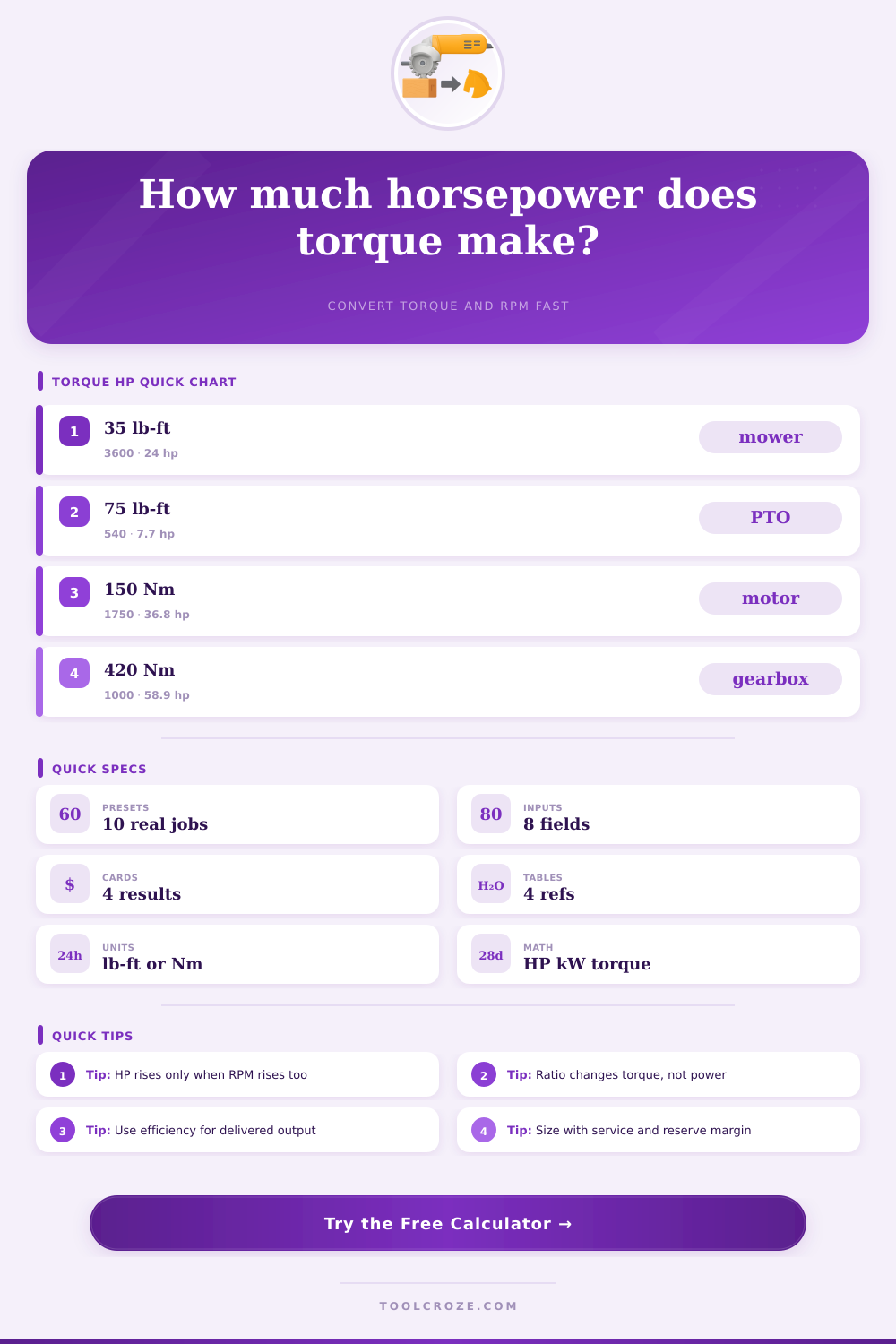
| 35 lb-ft | 3600 | 24.0 HP | Walk-behind mower engine |
| 75 lb-ft | 540 | 7.7 HP | Compact tractor PTO |
| 125 lb-ft | 1750 | 41.6 HP | Industrial motor drive |
| 220 lb-ft | 1000 | 41.9 HP | High-speed PTO shaft |
| 320 lb-ft | 2400 | 146.2 HP | Medium diesel peak torque |
| 420 Nm | 1000 | 58.9 HP | Reducer output in metric plants |
| Drive stage | Typical efficiency | Loss range | Use case |
|---|---|---|---|
| Direct coupling | 97-99% | 1-3% | Pump, fan, dyno shaft |
| V-belt | 93-96% | 4-7% | Compressors and deck drives |
| Roller chain | 95-98% | 2-5% | Conveyors and augers |
| Helical gearbox | 94-97% | 3-6% | Mixers and process lines |
| Worm reducer | 70-90% | 10-30% | Slow heavy reducers |
| Hydraulic loop | 80-88% | 12-20% | Skid steer attachments |
| Source type | Normal speed band | Torque behavior | Planning note |
|---|---|---|---|
| Gasoline engine | 2500-6500 RPM | Peaks near midrange | Use reserve for transient load spikes. |
| Diesel engine | 1200-2600 RPM | High low-end torque | Check rated and peak torque points separately. |
| Electric motor | 900-3600 RPM | Stable around nameplate | Efficiency is often the highest of the group. |
| Tractor PTO | 540 or 1000 RPM | Linked to engine load | Use actual PTO torque when possible. |
| Hydraulic motor | 100-3000 RPM | Strong at low speed | Losses across the loop matter more than ratio. |
| Marine shaft | 600-2400 RPM | Continuous duty | Favor extra reserve for prop load growth. |
| Target horsepower | 540 RPM torque | 1750 RPM torque | 3600 RPM torque |
|---|---|---|---|
| 10 HP | 97.3 lb-ft | 30.0 lb-ft | 14.6 lb-ft |
| 25 HP | 243.1 lb-ft | 75.0 lb-ft | 36.5 lb-ft |
| 50 HP | 486.3 lb-ft | 150.1 lb-ft | 73.0 lb-ft |
| 100 HP | 972.6 lb-ft | 300.1 lb-ft | 145.9 lb-ft |
| 150 HP | 1458.9 lb-ft | 450.2 lb-ft | 218.9 lb-ft |
💡 Powertrain Tips
This calculator converts torque and RPM into horsepower, kilowatts, and output torque while accounting for drivetrain efficiency, reduction ratio, and sizing margin for engines, PTO shafts, motors, and reducers.
Torque and horsepower is two different measurements of power. In order to determine the correct engine or motor for a specific task, it is essential to understand the difference between torque and horsepower. Torque measure the amount of twisting force that an engine produces.
The strength of the engines rotation at a specific distance from the center of the engines shaft are measured as torque. Horsepower measures how much work that an engine perform over a specific amount of time. Multiply the engines torque by the engines RPM (revolutions per minute) and dividing the resulting number by 5252 is how you calculate the horsepower of an engine.
What Are Torque and Horsepower
Since horsepower is a combination of the engines torque and RPM, it is possible for an engine to have high levels of torque but relatively low horsepower if the RPM of the engine is very lowly. The efficiency of the engine can also impact the amount of power that reaches the machine that the engine powers. In many case, engines use various components to move power from the engine to the tool that it powers.
These components, including gears, belts, and shafts, can lead to the loss of some of the engines energy as heat due to friction between its moving components. An example of such an efficiency loss is seen in the use of worm gear reducers. Worm gear reducers produce high levels of torque at low rotational speeds; however, because the worm gear reducer loses a significant amount of energy to friction, the efficiency of a worm gear reducer are low.
Consequently, the horsepower of the engine will always be more higher than the horsepower that is delivered to the tool at the end of the drivetrain. This energy loss is another factor that must be considered when determining the horsepower of an engine that will power a given machine. A third factor that influences the horsepower that an engine must produce is known as the service factor.
A service factor is an additional amount of horsepower that is added to calculations to protect the machine from sudden increase in the load that it must perform. The higher the load that the machine will perform, the higher the service factor that is needed. For instance, if a machine performs a steady task, the service factor will be relatively low.
However, if the machine must perform shock loads, such as an auger, a higher service factor will be required. Shock loads place an immediate and sudden strain on the machine that can lead to stalling or even breaking of the machines components. A service factor of 15 or 20 percent is generally added to the horsepower calculations for shock load.
Without a service factor, the machine may overheat or experience slipping of its clutches, both of which occur because the engine cant produce enough power to handle the additional load. Engines can produce the same amount of torque and horsepower in different ways. For example, diesel engines produce alot of torque at low RPM.
The high amount of torque that diesel engines can produce makes them ideal for tasks that require a lot of pulling power. Gasoline engines produce the most horsepower at higher RPMs. Consequently, gasoline engines can produce less torque at low RPMs than diesel engines.
Electric motors is capable of producing a lot of power at its rated speeds. Electric motors are often used in machines that require a constant load, such as pumps. The mechanical components that are used in the drivetrain can impact the horsepower that is transferred to the tool.
For example, V-belts can slip if the load that is being moved is too heavy. In this case, there will be a loss of power that is transferred to the tool. Roller chains is efficient in moving power from the engine to the tool, but only if the roller chains are properly aligned with one another.
Some energy is always lost to friction. Helical gears are generally efficient in transmitting power from the engine to the tool, but again, some energy are lost. All gears will lose some energy to friction.
By understanding these various factor, it is possible to ensure that the engine has the proper amount of horsepower necessary to complete the task that it performs without failing.