🔧 Torque Conversion Calculator
Convert torque units, estimate handle force, compare shaft power at RPM, and approximate fastener clamp load from one workshop-focused calculator.
📌 Shop Presets
⚙ Torque Inputs
🎯 Results
🗂️ Spec Comparison Grid
📊 Reference Tables
| Torque Unit | Equals 1 Nm | Typical Use | Conversion Note |
|---|---|---|---|
| Newton-meter | 1.000 Nm | Metric tools | Base engineering unit |
| Foot-pound | 0.7376 ft-lb | Automotive specs | 1 ft-lb = 1.3558 Nm |
| Inch-pound | 8.8507 in-lb | Small fasteners | 12 in-lb = 1 ft-lb |
| Kgf-m | 0.1020 kgf-m | Legacy manuals | 1 kgf-m = 9.8067 Nm |
| Kgf-cm | 10.1972 kgf-cm | Light assembly | 100 kgf-cm = 1 kgf-m |
| N-cm | 100.0 N-cm | Electronics hardware | 1 N-cm = 0.01 Nm |
| Oz-in | 141.61 oz-in | Small motor shafts | 16 oz-in = 1 lb-in |
| Meter-kilogram | 0.1020 mkg | Older machine plates | Same scale as kgf-m |
| Joint Condition | K Factor | Clamp Trend | Typical Use |
|---|---|---|---|
| Dry steel threads | 0.20 | Baseline clamp | General service bolts |
| Light oil on steel | 0.18 | Higher clamp at same torque | Engine and machine assembly |
| Zinc plated steel | 0.17 | Slightly reduced friction | Plated hardware packs |
| Nickel anti-seize | 0.15 | Strong clamp rise | Exhaust and hot service |
| Dry stainless steel | 0.23 | Lower clamp at same torque | Corrosion resistant joints |
| Aluminum insert thread | 0.25 | Conservative clamp | Soft parent material |
| Drive / Wrench | Practical Range | Common Unit | Best Fit |
|---|---|---|---|
| 1/4 in drive | 20-200 in-lb | in-lb | Trim, covers, electronics |
| 3/8 in drive | 10-80 ft-lb | ft-lb | Engine bay and bicycles |
| 1/2 in drive | 30-250 ft-lb | ft-lb | Lug nuts and suspension |
| 3/4 in drive | 100-600 ft-lb | ft-lb | Industrial flanges |
| Small metric torque driver | 0.5-10 Nm | Nm | Carbon bike and lab gear |
| Bench beam wrench | 5-150 Nm | Nm | Calibration spot checks |
| Workshop Scenario | Typical Torque | Preferred Tool | Comment |
|---|---|---|---|
| Bicycle stem faceplate | 4-6 Nm | Torque driver | Even cross pattern matters |
| Spark plug gasket seat | 15-22 ft-lb | 3/8 in wrench | Check head material note |
| Automotive lug nut | 80-140 ft-lb | 1/2 in wrench | Retorque after wheel service |
| Router collet nut | 18-25 Nm | Stub wrench | Avoid overtightening small collets |
| Hydraulic pump shaft | 200-300 Nm | Shaft calculation | Use RPM for power check |
| Grade 8 half-inch bolt | 80-100 ft-lb | 1/2 in wrench | Joint finish changes clamp load |
💡 Torque Tips
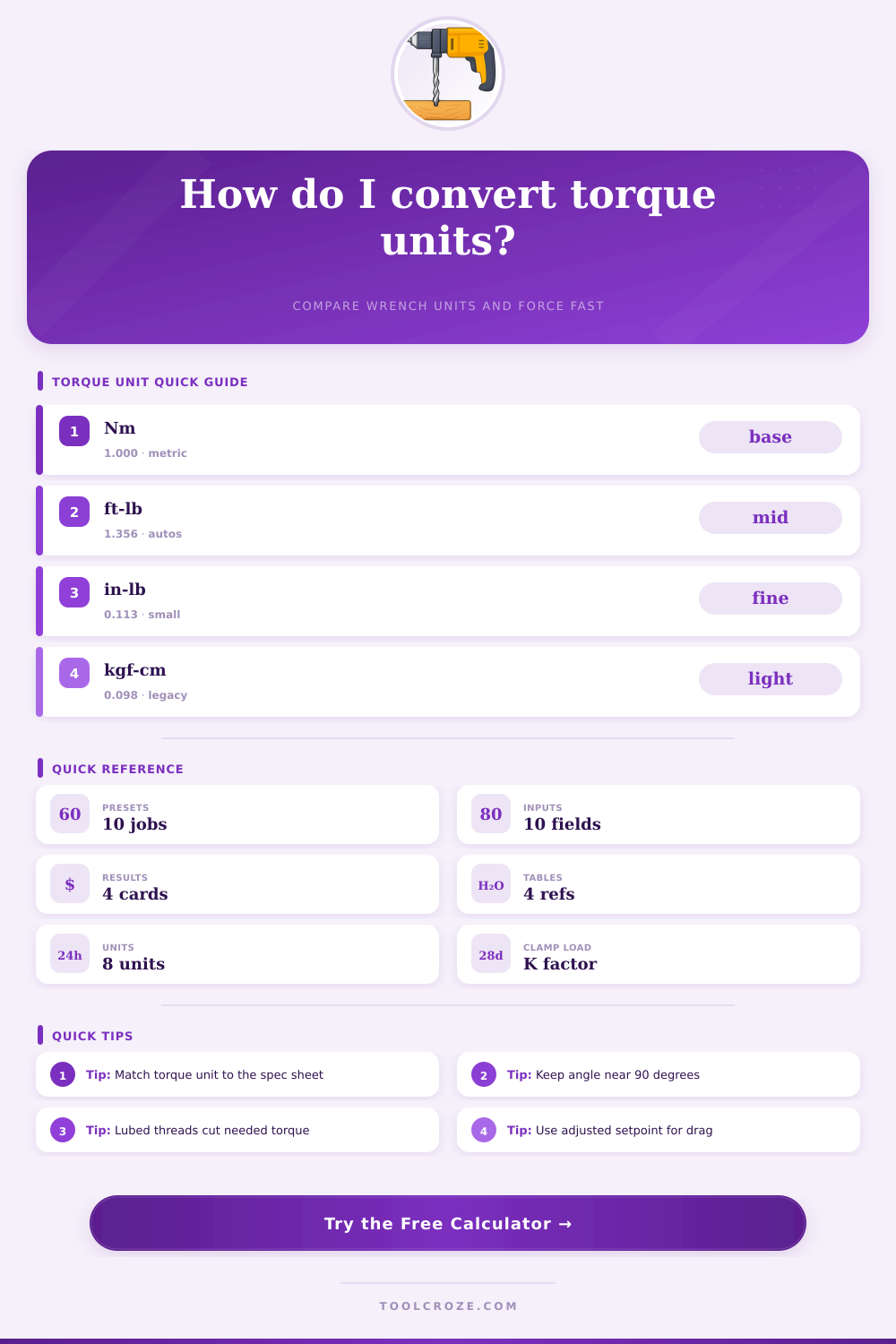
This calculator converts torque units and turns the same value into handle force, shaft power, and estimated clamp load so you can compare manual, motor, and fastener torque in one place.
Torque measure the amount of twisting forces applied to a bolt or nut. Using a wrong unit of measurement for torque can lead to various problems. Using too little torque may result in a joint that are too loose to perform it’s designated task.
Using too much torque can result in snap the fastener. There are many units of measurement for torque, and different unit are used in different parts of the world or for different types of machinery. For instance, Newton-meters is the standard unit for the International System of Units whereas the foot-pound is used in the United States.
Why Using the Right Torque and Units Is Important
A foot-pound is 35 percent more then the weight of a Newton-meter. The unit of measurement for torque also depend on how much force is applied to a tool to achieve the desired torque. If an individual pull a tool at a 90 degree angle, that individual will achieve the maximum leverage with that tool.
If, however, an individual pull on a tool at an angle that is less than 90 degree, the leverage will be less. Therefore, you must account for the angle at which an individual pulls on a tool when calculating how much force are required to achieve the desired amount of torque. Additionally, you must also consider the length of the handle on a tool because using a longer handle will produce more torque for a given amount of force.
Another factor relating to torque is the clamp load that an individual produce when they apply that amount of torque. The clamp load is create as a result of friction between the threads of the fastener. The condition of the fastener threads will impact the amount of friction between the threads, and that friction level will impact the K value (also known as the nut factor) of that fastener.
For instance, dry steel thread will have a K value of 0.20. If an individual apply oil to the threads of a fastener, that K value will drop to 0.18. If an individual applies anti-seize lubricant to the threads, the K value will drop to 0.15.
This drop in the K value mean that the clamp load will be higher because a lower K value means that a higher percentage of the applied torque will be converted into clamp load rather than overcome friction between the threads of the fastener. An individual must be careful when changing the lubrication of a bolt because this will change the clamp load of the bolt. Using the specification for a dry bolt on a bolt with oil on the threads will result in a clamp load that is too high for that bolt.
A clamp load that is too high can result in a bolt that is too tight, which can lead to the bolt break or the threads stripping. Additionally, different material require different amounts of torque to be properly secured in place. For instance, the heads make of aluminum will require a lower amount of torque to secure in place compared to steel heads.
Applying too much torque to an aluminum component can damage that component. An individual can also use torque to calculate the power of a rotating machinery. The power of a machinery is a function of the amount of torque that it apply and the rotational speed of the machinery.
If an individual know the amount of torque applied by a motor and the rotational speed of that motor, the individual can calculate the horsepower or the kilowatts of that motor. This information is helpful in determining whether or not the motor or pump are performing as it should according to the manufactures specifications. Finally, the unit of measurement for torque also relate to the grade of the fastener that is being used.
Fasteners come in a variety of grade and can handle different amounts of tension. For instance, Grade 8 bolt can take more load than Grade 5 bolts. If an individual apply the amount of torque required for a Grade 8 bolt to a Grade 5 bolt, the Grade 5 bolt will likely break.
In order to avoid such problems, you should of determine the grade of the bolt and the amount of torque that it requires before the bolt is begin to be tightened. Youll also need to check the bolts length. Its important to be careful with modern machinery.