🔧 Torque Wrench Extension 90 Degrees Calculator
Check true torque at a perpendicular crowfoot, see what happens when the adapter drifts away from 90°, and confirm the wrench setting before you pull.
📌 Service Presets
⚙ Calculator Setup
🎯 Torque Results
🗂 Adapter and Spec Comparison Grid
📊 Reference Tables
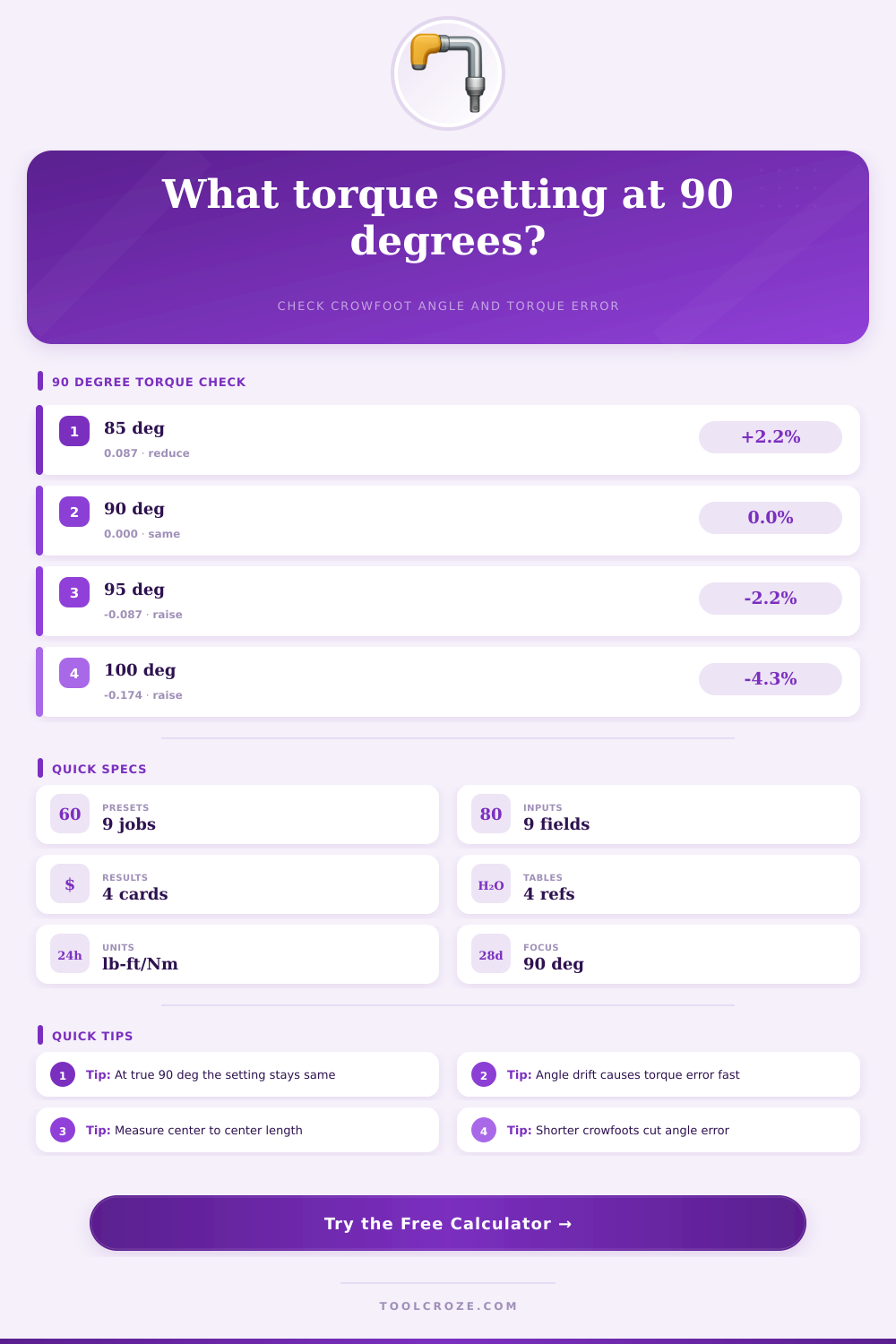
| Angle | cos(angle) | Effect with E/L=0.25 | Takeaway |
|---|---|---|---|
| 75° | 0.259 | +6.5% | Large overtorque if you keep the 90 degree setting |
| 80° | 0.174 | +4.3% | Correction starts to matter |
| 85° | 0.087 | +2.2% | Common service-bay drift |
| 90° | 0.000 | 0.0% | No torque length correction required |
| 95° | -0.087 | -2.2% | Slight undertorque if left uncorrected |
| 100° | -0.174 | -4.3% | Recalculate before tightening |
| Drive | Typical torque band | Common extension length | Best use |
|---|---|---|---|
| 1/4 in | 4-20 lb-ft | 1.0-1.5 in | Valve cores, AN-4, service stems |
| 3/8 in | 10-80 lb-ft | 1.4-2.0 in | Brake, banjo, steering, sensors |
| 1/2 in | 25-150 lb-ft | 1.7-2.5 in | Suspension and engine fittings |
| 3/4 in | 60-400 lb-ft | 2.2-3.5 in | Heavy diesel and industrial access |
| Thread condition | Torque factor | Typical reduction | Use note |
|---|---|---|---|
| Dry threads | 1.00 | 0% | Default service-manual assumption |
| Medium threadlocker | 0.95 | -5% | Wet threadlocker during pull |
| Light oil | 0.90 | -10% | Common on plated fittings |
| Moly lube | 0.85 | -15% | Review OEM note first |
| Anti-seize | 0.80 | -20% | Use carefully on hot exhaust hardware |
| Service job | Target torque | Typical 90 degree setup | Angle watchpoint |
|---|---|---|---|
| Brake bleeder crowfoot | 12 lb-ft | 1/4 or 3/8 drive, 1.3 in crowfoot | Even 5 degrees drift can crack a seat |
| O2 sensor socket | 33 lb-ft | 1/2 drive, 2.1 in slotted socket | Heat shield access usually causes drift |
| Fuel banjo fitting | 22 lb-ft | 3/8 drive, 1.7 in line crowfoot | Overtorque distorts copper washers |
| Strut top nut | 55 lb-ft | 1/2 drive, 2.4 in pass-through crowfoot | Long adapters exaggerate angle error |
| Cooler line fitting | 24 lb-ft | 1/2 drive, 1.9 in flare crowfoot | Seal crush changes fast near spec |
💡 Shop Notes
When using a torque wrench with a crowfoot extension, the angle of the crowfoot extension will alter the amount of torque that are delivered to the bolt or fastener. People may believe that the extension is meant to be positioned at a perfect 90-degree angle relative to the wrench. However, any error in the angle will result in an error in the measurement of the torque apply to that fastener.
Any deviation from the 90-degree angle will result in the application of either more high or too low of a torque to the fastener. This type of error can lead to issues with the fastener, such as leaking seals or damaged fasteners. The physics of torque relate to the length of the wrench or tool that is being utilized.
How to Get the Right Torque with a Crowfoot Extension
Torque wrenches measure the amount of force that is applied to a fastener multiplied by the distance from the pivot point of the wrench handle to the center of the drive of the fastener. When the crowfoot extension is utilize at a 90-degree angle, the length of the tool does not change. Thus, no mathematical adjustment are required to the torque specifications for the fastener.
However, if the angle of the crowfoot extension is not maintained at 90 degrees, the effective length of the tool will change. If the angle is less than 90 degrees, the effective length will be shortened, indicating that the torque wrench setting should be increase. However, if the angle is increased beyond 90 degrees, the effective length will be increased, indicating that too much torque will be applied to the fastener.
Many errors in applying torque to fasteners occur due to the fact that individuals dont accurately measure the length of their tools. Crowfoot extension come in a variety of lengths. Additionally, when utilizing thread lubricants to the fastener, the amount of torque will change as well.
As the lubricant reduces the friction between the fastener and the component to which it is to be secured, the amount of torque will have to be reduced as well. Finally, the drive size of the torque wrench also change the amount of torque that is applied to the fastener. For instance, quarter-inch drive wrenches are utilized in those applications that require relatively low amount of torque, while half-inch drive tools are used to apply higher amount of torque to a fastener.
To avoid applying the wrong amount of torque to the fastener, individuals can follow a few specific steps. First, ensure that the crowfoot extension is positioned at a true 90-degree angle relative to the torque wrench. This can be accomplished by marking the extension and the wrench with a paint mark.
Second, ensure that the length of the crowfoot extension is measure from the center of the drive to the center of the fastener. Third, the torque specifications must be decreased if the use of lubricant is require for the fastener. Finally, allow for a safety margin in the amount of torque that is applied.
Additionally, individuals can also take steps to prevent these types of error. For instance, many professional machine shop will mark each crowfoot extension with the length of the extension in the center. This allows the individual to correctly and quickly identify each extension.
Charts that indicates the amount of adjustment of the torque wrench in relation to the angle of the crowfoot extension can also be utilized. For example, if the angle to which the crowfoot extension is to be secured to the component is 85 degrees, the torque wrench can be adjusted to increase the amount of torque that is applied to the fastener by a percentage that is note on the chart. By measuring the angle of the extension, the length of the extension, and the friction between the threads of the fastener, the individual can calculate the amount of torque that should be applied to the fastener.
Following these steps will ensure that the amount of torque is correctly applied to that fastener.