🚤 Gel Coat Coverage Calculator
Estimate spray or brush-on gel coat coverage, purchase quantity, catalyst dose, and finished film build for hulls, decks, molds, plugs, and repair patches.
📌 Presets
⚙ Calculator Setup
🎯 Results
🧪 Material and Spec Comparison
📊 Reference Tables
| Method | Typical efficiency | Wet film target | Best fit |
|---|---|---|---|
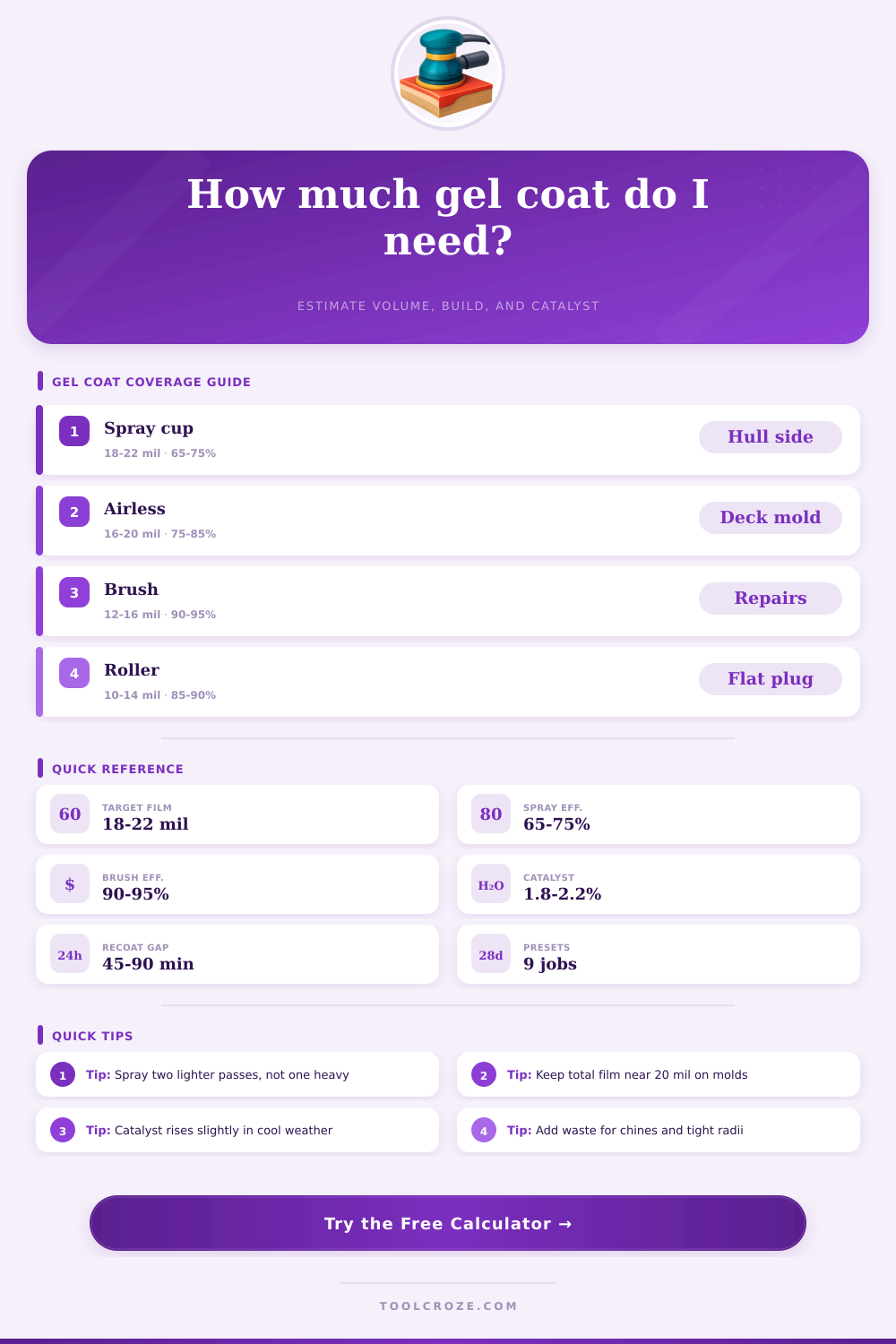
| Conventional spray cup | 65–75% | 18–22 mil | Colored hull and deck skins |
| Airless / assisted airless | 75–85% | 16–20 mil | Large molds and liner pans |
| Brush-on gel coat | 90–95% | 12–16 mil | Repairs, corners, and small parts |
| Short-nap roller | 85–90% | 10–14 mil | Flat plugs and simple mold faces |
| Surface type | Preferred total build | Extra waste cue | Notes |
|---|---|---|---|
| Production hull mold | 18–22 mil | +8 to 12% | Watch chines, strakes, and stems for overspray loss. |
| Deck mold or liner | 18–20 mil | +10 to 15% | Gutters, hatch lips, and non-skid pockets consume more material. |
| Tooling or plug face | 22–24 mil | +5 to 10% | Heavier tooling grades need close control to avoid pre-release cracks. |
| Localized repair patch | 12–18 mil | +12 to 20% | Blend margins and sanding allowance drive waste higher. |
| Specific gravity | Weight per gallon | Common grade | Coverage effect |
|---|---|---|---|
| 1.10 | 9.18 lb | Light color marine | Highest area per gallon |
| 1.18 | 9.85 lb | ISO/NPG white | Balanced output for hull skins |
| 1.25 | 10.43 lb | Tooling orange | More weight for the same area |
| 1.32 | 11.02 lb | Filled FR grade | Lower practical spread rate |
| Shop temperature | Typical catalyst | Tack-free guide | Practical note |
|---|---|---|---|
| 60°F / 16°C | 2.2% | 70–90 min | Warm material before spraying if data sheet allows. |
| 70°F / 21°C | 2.0% | 50–70 min | Most baseline estimates are built around this zone. |
| 80°F / 27°C | 1.8% | 35–50 min | Smaller pot life means shorter batch size is safer. |
| 90°F / 32°C | 1.5–1.8% | 20–35 min | Reduce batch volume and watch exotherm closely. |
💡 Shop Notes
This calculator estimates gel coat coverage from area, wet film build, transfer efficiency, and catalyst ratio so you can plan mixed volume, buy quantity, and practical shop batches more accurately.
Calculating the correct amount of gel coat that will be required for a boat building project is a necessary step in the boat building process because calculating the correct amount of gel coat will prevent a person from running out of the material that is necessary to coat the hull of the boat. If a person dont calculate the volume of the gel coat that is necessary to complete a project, a person may either run out of the material prior to completing the project, or may waste the material in attempting to apply the gel coat. By performing the calculations of how much gel coat will be necessary to cover the hull of a boat, a person can create a plan for the application of the gel coat.
Thus, the calculation will ensure that the application of the gel coat is efficient and does not waste any of the material. The theoretical coverage of gel coat is 1,604 square feet per gallon of gel coat when the thickness of the coat is one mil. The actual coverage of the boat hull will be less than the theoretical coverage due to the fact that boat hulls is not flat structures.
How to Calculate Gel Coat Needed for a Boat
Instead, hulls include chines and strakes, both of which require more application of the gel coat. In addition to the chines and strakes, the application of the gel coat with spray guns often lead to loss of the gel coat; the spray guns lose between 25 and 35 percent of the gel coat that is applied to the hull. Thus, people must account for these percentage when calculating the volume of the gel coat that will be needed for each boat hull.
The specific gravity of the gel coat will also impact the amount of gel coat that is needed for the boats. For instance, marine white gel coat has a specific gravity of 1.2. This means that the weight of the gel coat is 1.2 times the volume of the gel coat.
If the gel coat is applied with a brush instead of spray guns, the transfer efficiency change. If the brush is used, the transfer efficiency for the gel coat is 92%. However, with a brush application, the gel coat must be applied in thinner films to avoid brush marks on the gel coat.
Thus, the change in application method changes the volume of the gel coat that is purchase for each boat hull. The temperature in which the gel coat is applied to the hull will also impact the method in which the hulls are coated. For instance, if the temperature of the shop is 80 degrees, the tack free time for the gel coat is 35 minutes.
However, if the temperature of the shop is 60 degrees, the tack free time for the gel coat increase to 70 minutes. Thus, the temperature of the environment changes the time in which the gel coat may be recoated on the hulls. The catalyst, MEKP is added to the gel coat at a rate of 2% of the weight of the gel coat.
If too much catalyst is added to the gel coat, the gel will experience an early exotherm reaction. However, if too little catalyst is added to the gel coat, the gel will remain tacky. Depending upon the application tool that is used to apply the gel coat to the hulls of the boats, different calculations must be made in the determination of the amount of gel coat that will be needed.
For instance, conventional spray guns is used to apply the gel coat to the hull colors of the boats. However, conventional spray guns have lower transfer efficiency than other types of gel coat guns. Airless spray guns are often used to apply gel coat to the large molds for boat decks.
Airless spray guns have higher transfer efficiency than conventional spray guns; however, they require even passes to the gel coat to prevent the formation of orange peel on the hulls. Brushes are used in the repair of hulls. Brushes waste the least amount of the gel coat; however, finesse is required with the use of a brush to avoid the formation of ridges on the hull.
The weight of the gel coat will impact the amount of gel coat that is needed; the specific gravity of the gel coat will determine the weight of the gel coat. For instance, light marine gel coatings has a specific gravity of 1.18. However, the specific gravity of heavy gel coatings for tooling is 1.32.
Thus, five gallons of heavy gel will weigh more than five gallons of light marine gel. Calculators can be used to convert gallons of gel to pounds of that gel. Additionally, the calculator can be used to determine the weight of the catalyst that will be needed with that amount of gel coat.
Multiple errors can be avoided in the boat building process by considering each of the factors regarding the application of the gel coat. For instance, decks will have gutters and non-skid portions for the boats; these areas will waste 12 to 15 percent of the total amount of gel coat that is applied. Flat boat plugs will waste only eight percent of the gel coat.
Additionally, if the air in the shop is cool, the gel will cure more slow. Thus, the catalyst will have to be increased to 2.2% to ensure that each hull can be recoated with the gel coat. If one heavy coat of gel is applied to the hull to reach the desired 20 mil thickness, the gel may sag into the hulls.
Thus, two coats of 10 mil each will ensure that the gel coat sets evenly on the hull of the boat. Finally, the boat builders should manage the environment in which the boats are being constructed. For instance, if the humidity of the construction area is above 70%, the curing of the gel coat will be slowed.
Additionally, if there is wind in the open areas of the boat construction shop, the efficiency of the spray guns will be decreased. Thus, a calculator can be used to determine the net volume of the gel coat that must be applied to the boats; the efficiency of the guns that will apply the gel coat; and the amount of the gel coat that must be purchased for each boat. Thus, each of these calculations will help to ensure that each boat will have an even application of the gel coat that will successfully cover the areas of the boat hulls at the correct thickness.