🛠 Pipe Bevel Angle Calculator
Calculate pipe bevel setback, included groove angle, bevel face length, and estimated weld groove volume for common welding end preparations.
📌 Pipe End Presets
⚙ Bevel Geometry Setup
🎯 Bevel Results
🗂️ Material and Spec Comparison
📊 Reference Tables
| Service case | Bevel angle | Root face | Root gap |
|---|---|---|---|
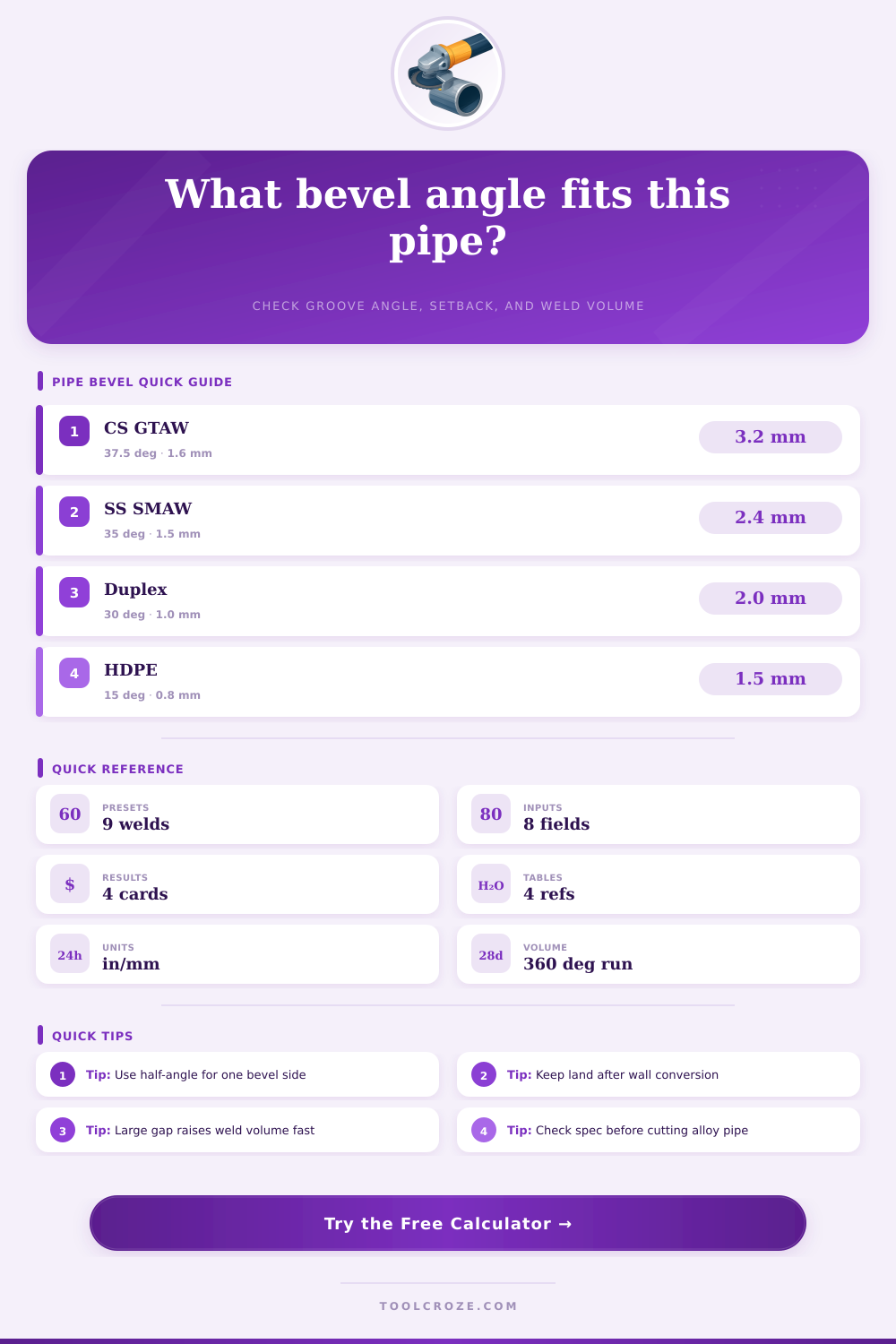
| Carbon steel GTAW or SMAW | 37.5 deg | 1.6 mm | 3.2 mm |
| 316L orbital weld | 35 deg | 1.5 mm | 2.4 mm |
| Duplex narrow groove | 30 deg | 1.0 mm | 2.0 mm |
| PVC or HDPE chamfer | 15-20 deg | 0.8 mm | 1.5 mm |
| Nominal line | Actual OD | Common wall | Typical use |
|---|---|---|---|
| 2 in Sch 80 | 2.375 in | 0.218 in | Cr-Mo high pressure |
| 4 in Sch 10 | 4.500 in | 0.120 in | Sanitary stainless |
| 6 in Sch 40 | 6.625 in | 0.280 in | Process carbon steel |
| 8 in Sch 40 | 8.625 in | 0.322 in | Duplex piping |
| Standard | Scope | What it controls | Use before cut |
|---|---|---|---|
| ASME B16.25 | Buttwelding ends | End prep dimensions | Fit-up baseline |
| ASME Section IX | Welder qualification | Procedure variables | WPS alignment |
| API 1104 | Pipeline welding | Root opening and profile | Field tie-ins |
| ASTM D2855 | PVC solvent weld | Socket chamfer fit | Plastic pipe prep |
| Material | Angle band | Land band | Why it changes |
|---|---|---|---|
| Carbon steel | 35-37.5 deg | 1.6-2.4 mm | Balances fusion and filler volume |
| Duplex 2205 | 30-35 deg | 1.0-1.5 mm | Lower heat input and less groove metal |
| Aluminum 6061 | 35-40 deg | 0.8-1.6 mm | Oxide removal and wider puddle support |
| HDPE | 15-20 deg | 0.5-1.0 mm | Ease insertion without thinning fusion zone |
💡 Fit-Up Notes
This calculator sizes pipe bevel geometry from wall thickness, land, angle, and root gap so you can compare groove width, face length, and weld volume before cutting pipe ends.
Pipe end preparation are the process of shaping the ends of pipes so that they can be welded together. Three different specifications must be set before welding the two ends of the pipes together: the bevel angle, the land thickness, and the root gap. If these three specifications is not set up properly prior to welding, the weld may fail inspection, or excess filler metal might be required to complete the weld.
The bevel angle are the angle at which the end of the pipe is cut. Angles that are steeply indicate that there will be an opening in the pipe for the weld metal to flow into the joint. Steep angles of 40 degrees or more require more metal to be added to the weld to fill that opening, and thus cost more for the welding job.
How to Prepare Pipe Ends for Welding
Angles that are shallow to the end of the pipe, such as angles of 30 degrees or less, allow for less metal to be added to the weld. Furthermore, shallow angles is beneficial when welding heat sensitive metals, since the welder will require less heat to complete the weld. The land is the thin piece of the pipe’s end that is not beveled.
Its job is to ensure that the weld remains in contact with the pipe. If the land is too thick, the weld may not fuse with the pipe ends. If the land is too thin, the pipes may slip relative to one another during welding.
The root gap is the space between the two ends of the pipes that are to be welded. This gap allows the metal to expand. Too large a root gap may result in porosity within the weld metal.
The thickness of the wall of the pipe will determine the various dimensions of the end preparation. For a specific thickness of pipe, you can calculate the height of the bevel by subtracting the thickness of the land from the thickness of the pipe wall. The setback is the distance that the bevel machine’s tool must travel horizontal to achieve the calculated height of the bevel, and that distance is calculated by dividing the height of the bevel by the tangent of the bevel angle.
The length of the face of the bevel is the hypotenuse of the triangle create by the cut of the bevel, and this dimension determines the depth to which the welding tool must plunge into the pipe. The groove volume is the total volume of the space within the bevel, which is calculated by multiplying the different dimensions of the bevel by the circumference of the pipe. The type of material from which the pipe is made will determine the angle of the bevel.
Metal pipes made of carbon steel, for instance, should be beveled at a 37.5 degree angle for each side of the pipe, according to ASME B16.25. Stainless steel pipes is often beveled at a 35 degree angle for orbital TIG welding. Duplex stainless steel pipes are often beveled at a 30 degree angle.
Aluminum pipes is often beveled at a 40 degree angle. Plastic pipes, such as HDPE or PVC pipes, only require a small chamfer of between 15 and 20 degree. Some common mistakes should be avoided during the fit-up of the pipes.
For instance, creating an oversized root gap will increase the amount of metal needed for the weld. Furthermore, increasing both the size of the root gap and the angle of the bevel will exponentially increase the amount of filler metal require to create the weld. Furthermore, when welding thick pipes, a double V preparation is often used for pipes thicker than 3/16 of an inch.
A double V preparation allows the reduction of the height of the bevel that has to be created on each side of the pipe end. Furthermore, you should always check the measurements of the pipe ends against the Welding Procedure Specification (WPS) for that particular pipe joint. Any deviation from the specifications within the WPS will result in a failed weld.
Standards and codes exist for weld preparation. For instance, ASME B16.25 contains the rules for the buttweld end profiles of pipes to ensure that the flanges and other pipe components fit together without requiring any force to be exerted upon them. API 1104 contains the rules for pipelines roots to ensure that the root gaps is of an appropriate size.
Section IX of the welding code states that the weld joint angles should match those prescribed in the welding procedure, or the weld qualification will be voided. When completed well, the joint will form a weld that is even in the tack portion of the weld, and filled with weld metal. If the land is too tight, the weld metal may crack as the pipe cools.
Furthermore, if the root gap is too wide, the weld may experience suck-back. By calculating the volume of the groove within the bevel, the amount of filler metal can be saved; if the groove volume is known, there will be no excess alloy wire added to the weld. Furthermore, the welding procedure must always be confirmed prior to cutting the alloy metal pipe, especially for materials such as duplex stainless steel that is sensitive to heat.