🔥 Stick Welding Amperage Calculator
Set SMAW amperage from rod class, diameter, weld position, polarity, joint geometry, thickness, and pass count to get a realistic starting current and production estimate.
📌 Welding Presets
⚙ Calculator Setup
🎯 Results
📊 Electrode Spec Grid
📑 Reference Tables
| Electrode | Diameter | Typical Amps | Common Use |
|---|---|---|---|
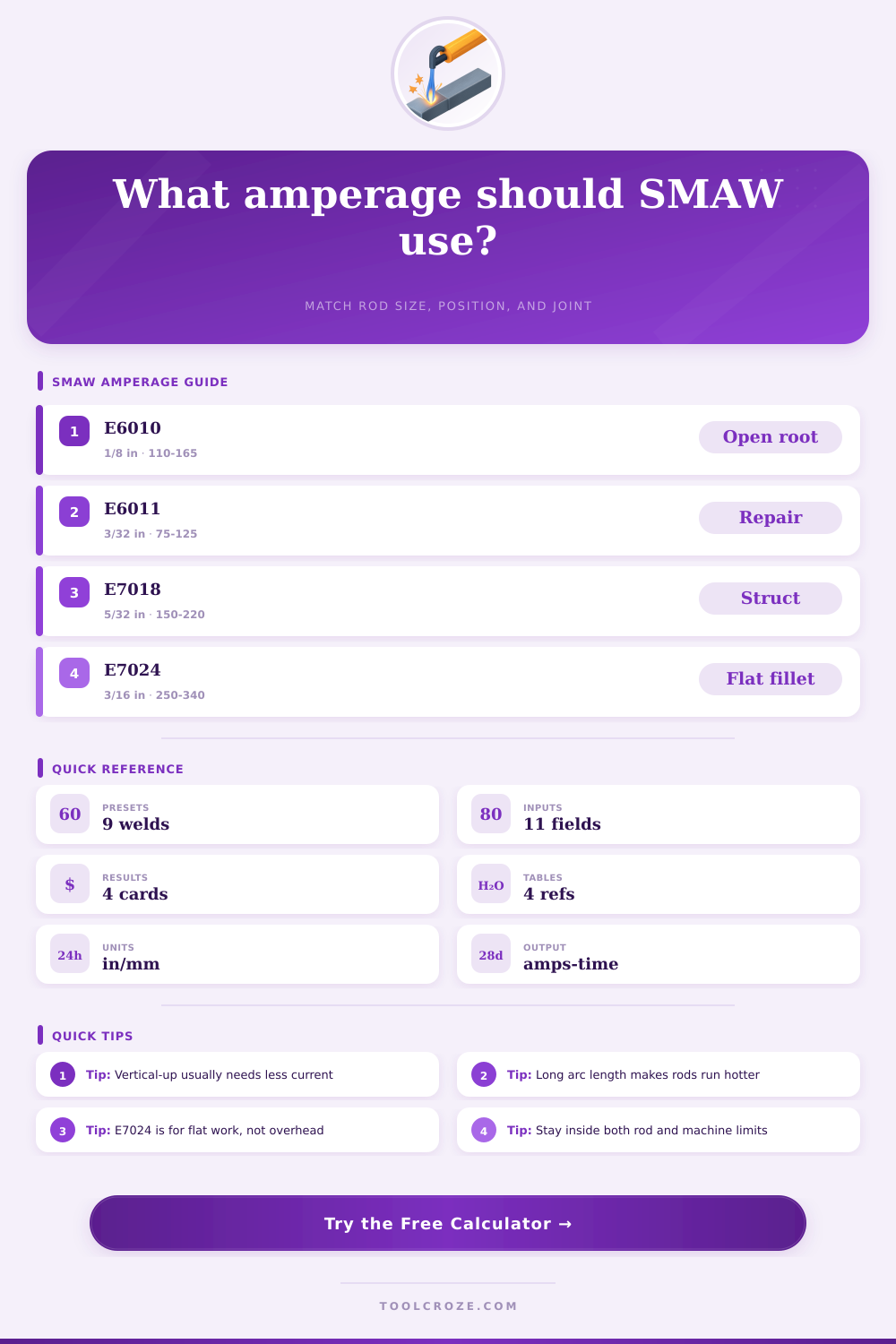
| E6010 | 3/32 in | 75-125 A | Open root pipe, root pass, rusty fit-up |
| E6011 | 1/8 in | 85-140 A | Field repair on painted or lightly rusted steel |
| E6013 | 3/32 in | 80-130 A | Thin plate, sheet, light brackets |
| E7018 | 5/32 in | 150-220 A | Structural groove and fillet welds |
| E7024 | 3/16 in | 250-340 A | Flat or horizontal high-deposit fillets |
| Condition | Multiplier | Effect On Amps | Reason |
|---|---|---|---|
| Flat | 1.00 | Baseline | Best puddle support for full rod range |
| Horizontal | 0.96 | About 4% lower | Controls puddle sag on the vertical member |
| Vertical up | 0.88 | About 12% lower | Helps maintain shelf and reduce undercut |
| Overhead | 0.84 | About 16% lower | Prevents excessive fluidity overhead |
| DCEN on E7018 | -12 A | Subtract current | Arc runs colder than the usual DCEP setup |
| Joint Style | Volume Formula | Multiplier | Typical Starting Use |
|---|---|---|---|
| Fillet | 0.5 x leg x leg | 1.00 | General T-joints and corner welds |
| Lap | 0.45 x leg x leg | 0.97 | Thinner work where overlap stores heat |
| Butt groove | t x (root + 0.35d) | 1.03 | Single-V or square groove fill passes |
| Pipe root | 0.8 x t x (root + 0.25d) | 0.92 | Pipe roots with keyhole control |
| Preset Job | Rod | Joint Size | Expected Starting Current |
|---|---|---|---|
| Pipe root on 3/8 wall | 1/8 E6010 | 1/8 root | 125 to 135 A |
| Vertical-up structural fillet | 3/32 E7018 | 1/4 leg | 88 to 98 A |
| Repair on weathered angle | 1/8 E6011 | 3/16 leg | 100 to 115 A |
| Flat production drag fillet | 5/32 E7024 | 5/16 leg | 210 to 235 A |
💡 Welding Tips
Amperage is the setting that controls the amount of heat that goes into the welding process. The amperage setting controls the penetration of the weld rod into the metal, the puddle’s flow, and the speed at which the weld metal deposits itself onto the metal piece being welded. Setting the amperage too low will result in cold laps where there is insufficient heat to fuse the two metal together.
On the other hand, using too high of an amperage setting will cause the welding rods to burn back very quickly, form traps of slag that will contain the metal inside the weld, and cause the molten metal to drip off of the metal piece. The welding position will alter the amperage setting that is to be used due to the effect of gravity on the molten puddle of metal. In the flat welding position, using the full range of amperage available from the welding rod will work best.
How to Set Amperage for Welding Rods
In the horizontal welding position, you will use slightly less current so the weld metal does not sag on the vertical leg of the weld. Vertical welds up from the workpiece will require even lower amperage settings as welds must be built up in a shelf shape using a short arc welding technique. Overhead welding positions will again require the lowest amperage setting as the high heat will make the metal too fluid to weld well.
Multiples of the amperage settings will be shown on the welding rod machines to make up for these different positions, reducing the amperage output by 12 to 16 percent from the baseline amperage settings to account for gravity. The welding rod will determine the amperage setting. Cellulosic welding rods such as the E6010 will be used to dig deep into the root of the weld, especially when there is gaps between the metal to be welded.
Low-hydrogen welding rods such as the E7018 will be used to make structural joints. However, the low-hydrogen welding rods will run cooler when used in the DCEN welding polarity. Iron powder welding rods such as the E7024 are used to quickly deposit weld metal into the weld, especially in flat fillets.
However, they will be difficult to use in overhead welding positions due to the heavy slag. The diameter of the welding rod will impact the amperage setting required for the weld. The thicker the welding rod, the more amperage that will be required for the metal in the weld rod’s center to melt.
Additionally, the thickness of the metal to be welded will determine the amperage setting. For thin metal, high amperage settings can result in the metal being burned through. For metals that are heavy in thickness, higher amperage settings can be used.
The geometry of the metal joint will impact the welding process. For fillet welds, the weld will have a triangular cross-section. For butt welds, the joint will have a root opening to the joint that creates a gap in the metal that must be filled by the weld.
For welded metal pipes, the root of the weld will have to be precisely heated or there will be a suck-back defect in the weld. Additionally, the polarity of the welding machine will alter the weld setting for specific welding rod and metal types. Using DCEP for most welding rod and metal types is standard.
However, the welding current can be altered to alternating current to soften the arc being made by the welding rod on certain welding machines. The efficiency with which welding machines can perform their welds depends on several factor. For instance, the length of the weld to be performed and the number of passes the welding rod will make into the metal piece will determine the amount of time that the welding rod will be on.
The total arc-on time is the length of the weld being made in inches multiplied by the number of passes being made into the metal and the number of inches per minute that the welding rod can travel. In a flat weld position, welders can use the drag welding technique to make 10 inches per minute. In vertical weld positions, half that rate will be used.
Another factor that will impact welding efficiency is the duty cycle of the welding machine. If the welding machine is set beyond 80 percent of its capacity, the welding duty cycle will be quickly consumed and the welding machine may stop in the middle of making the weld. There are several mistakes that welders should avoid when welding metal with welding rods.
Using too much amperage for the size of the welding rod’s diameter, or for the welding position, will overload the welding machine. In vertical welding positions, for instance, large diameter welding rods will overload the welding machine’s amperage capacity. In such situations, using a smaller welding rod diameter will reduce the load on the welding machine.
Many welders will use the amperage settings specified in the welding rod manufacturer’s catalog. However, these settings dont account for the welding position. A welder should start the amperage setting 10 to 15 percent lower than the catalog specifications for welds that are made in difficult welding positions.
Finally, welders should account for ambient heat in the welding shop. If the welding shop is very cold, the welder should increase the amperage setting by 5 percent to allow for heat to be transferred into the metal joints properly. In addition, if the metal to be welded is rusty, the welder should also increase the amperage setting of the welding rods so they can cut through the rust scale effective.
The technique that welders use when welding metal will impact the success of the weld. As with all metalworking processes, the length of the arc between the welding rod and the metal will impact the heat of the weld. Using a longer arc will allow the welding rod to reach higher temperatures in the weld than those that use a shorter arc.
For welding rods that use the push welding technique, welders should angle the welding rod 10 to 15 degrees from the metal being welded. For vertical welding positions, the welder will instead use a welding rod pull technique. Welders must remove the slag that forms between welding passes to avoid introducing hydrogen cracks into the weld.
Additionally, weld metal must be clean of mill scale that will consume the amperage of the welding rod without melting with the metal of the metal piece being welded. Welders who experience issues with the welding metal should be able to troubleshoot for the issues. For issues in which welding rods stick to metal, the welder may need to adjust the amperage to a lower setting or the arc length to a longer length.
Porosity in the weld may indicate the welding rod contains moisture or the shielding gas for flux rods is inadequate. Undercut metal indicates either the welding rod is traveling at too high a speed or the welding current is too high. If the weld metal’s puddle does not wet into the metal joint, the welder should reduce the amperage and clean the joint prior to welding.