🧴 Caulk Coverage Calculator
Estimate linear coverage, cartridge count, bead volume, and practical waste for trim joints, wet area seals, expansion joints, and glazing beads.
📌 Presets
⚙ Calculator Setup
🎯 Results
🗂️ Sealant Comparison Grid
📊 Reference Tables
| Bead size | Profile | 10.1 oz yield | 20 oz yield |
|---|---|---|---|
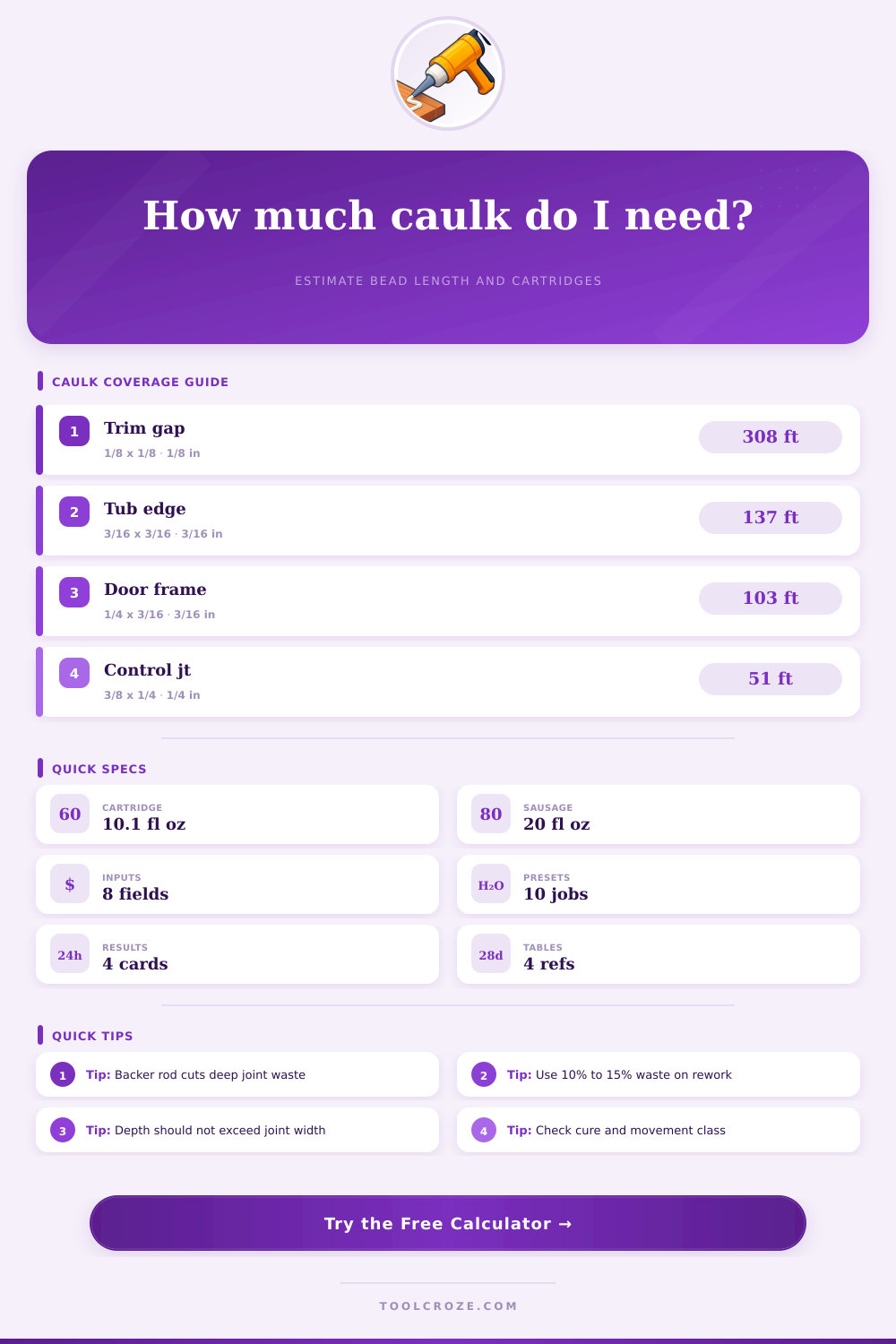
| 1/8 x 1/8 in | Rectangular | 308 ft | 610 ft |
| 3/16 x 3/16 in | Rectangular | 137 ft | 271 ft |
| 1/4 x 3/16 in | Rectangular | 103 ft | 203 ft |
| 3/8 x 1/4 in | Hourglass | 51 ft | 101 ft |
| Sealant | Movement | Paintable | Typical use |
|---|---|---|---|
| Acrylic latex | Low | Yes | Trim and drywall gaps |
| 100% silicone | High | No | Bath, glazing, wet zones |
| Polyurethane | High | Often | Concrete and facade joints |
| Firestop | Code based | Varies | Rated penetrations |
| Joint width | Recommended depth | Backer rod | Notes |
|---|---|---|---|
| 1/8 in | 1/8 in | No | Small trim and cabinet work |
| 1/4 in | 1/4 to 3/16 in | Optional | Common window perimeter |
| 3/8 in | 1/4 in | Yes | Facade and slab joints |
| 1/2 in | 1/4 in | Yes | Keep width about 2x depth |
| Project | Typical bead | Sealant | Waste guide |
|---|---|---|---|
| Baseboard room | 1/8 x 1/8 in | Latex | 5% to 10% |
| Tub surround | 3/16 x 3/16 in | Silicone | 10% to 15% |
| Storefront glazing | 1/4 x 1/4 in | Silicone | 10% to 20% |
| Control joint | 3/8 x 1/4 in | Self-leveling | 8% to 12% |
💡 Practical Notes
This calculator estimates caulk coverage from joint geometry, package size, and field waste so you can plan sealant runs, compare bead profiles, and avoid running short mid-application.
To estimate an amount of caulk needed for a project, it is essential to consider the factor that affect the amount of caulk used. These factors includes the width and depth of the caulk joint and the length of the joint. Additionally, you should also consider the amount of waste that may occur while use the caulk.
If the width and depth of the joint are not accounted for when purchasing the caulk, it is possible that the caulk will run out before the project are complete. The volume of caulk that will be used for a joint can be calculate by multiplying the width of the joint by the depth of the joint and the length of the joint. However, the shape of the joint will also determine the amount of caulk used for the project.
How to Tell How Much Caulk You Need
For example, a triangular bead of caulk used under baseboard trim will use a specific volume of caulk then a joint filled with another shape. Additionally, the type of caulk that will be used will also have an impact on the project. For instance, acrylic latex caulk may move more differently than polyurethane caulk, which will impact the amount of caulk needed for the joint.
The joints that will be caulked may not all be the same size. Many deep joints will require the use of a backer rod to ensure that the depth of the caulk are manageable. A backer rod is a foam rod that is placed within deep joints to minimize the amount of caulk needed to fill the joint.
These deep joints may include corner within showers. These rods allow the caulk to flex without cracking, which could otherwise happen if the depth of the caulk exceed the width of the caulk. The type of sealant that is used for the project will dictate the coverage of the caulk and the way in which the sealant will perform within the project.
For instance, acrylic latex caulk is often used for interior trim since it is easy to paint, but it does not handle high movement as well. For areas that may become wet, such as a bathtub, 100 percent silicone caulk can be used since it is water resistant, although it is difficult to paint and tool. Polyurethane is commonly used for exterior masonry since it is very durable but cures more slow than other types of caulk.
It is essential to ensure that the sealant that is selected match the movement class of the joint in which it will be used. Otherwise, the caulk will fail. Waste in the amount of caulk used for a project is often significant and often under-estimated.
Waste can be 5% on a project with only straight trim but can reach 20% for jobs involving textured surfaces. This waste can be the result of having to purge the nozzle of the caulk tubes between different section of a project. Additionally, touch-ups may be needed on the project to even out the application of the caulk.
A percentage for waste should be added to the total amount of caulk that will be used on the project to ensure that there is an adequate supply for the job. A table exist with the expected yield of caulk for specific sizes of joints. For example, a standard 10.1-ounce cartridge of caulk will have a specific theoretical yield in linear feet, although that amount may be less when waste is taken into consideration.
You can make a calculation for the total feet of caulk needed if the width and depth of the joint to be caulked are known. For long, continuous joints, large 29-ounce tube of caulk are used. For small projects or tasks, small squeeze tube can be used.
Some of the mistakes that can be made when using caulk include overfilling deep joints without using a backer rod. Overfilling a joint will result in the caulk take longer to cure or may crack. Another mistake is to not consider the movement requirement of the joint, which will result in the caulk cracking.
The temperature in which the caulk is applied will impact the project. Caulk will be thicker when it is cold and will expand at higher temperatures. One last mistake is to not properly prepare the substrate to be sealed.
If the substrate is greasy or dirty, the caulk will not bond to the substrate.