🔥 Welding Heat Input Calculator | J/mm Guide
Plan arc energy, travel speed, and pass heat for MIG, TIG, stick, flux core, and submerged arc welding with process-aware windows.
📌 Presets
⚙ Calculator Setup
🎯 Results
🧰 Material Heat Windows
📊 Reference Tables
| Process | Eff | Speed | Note |
|---|---|---|---|
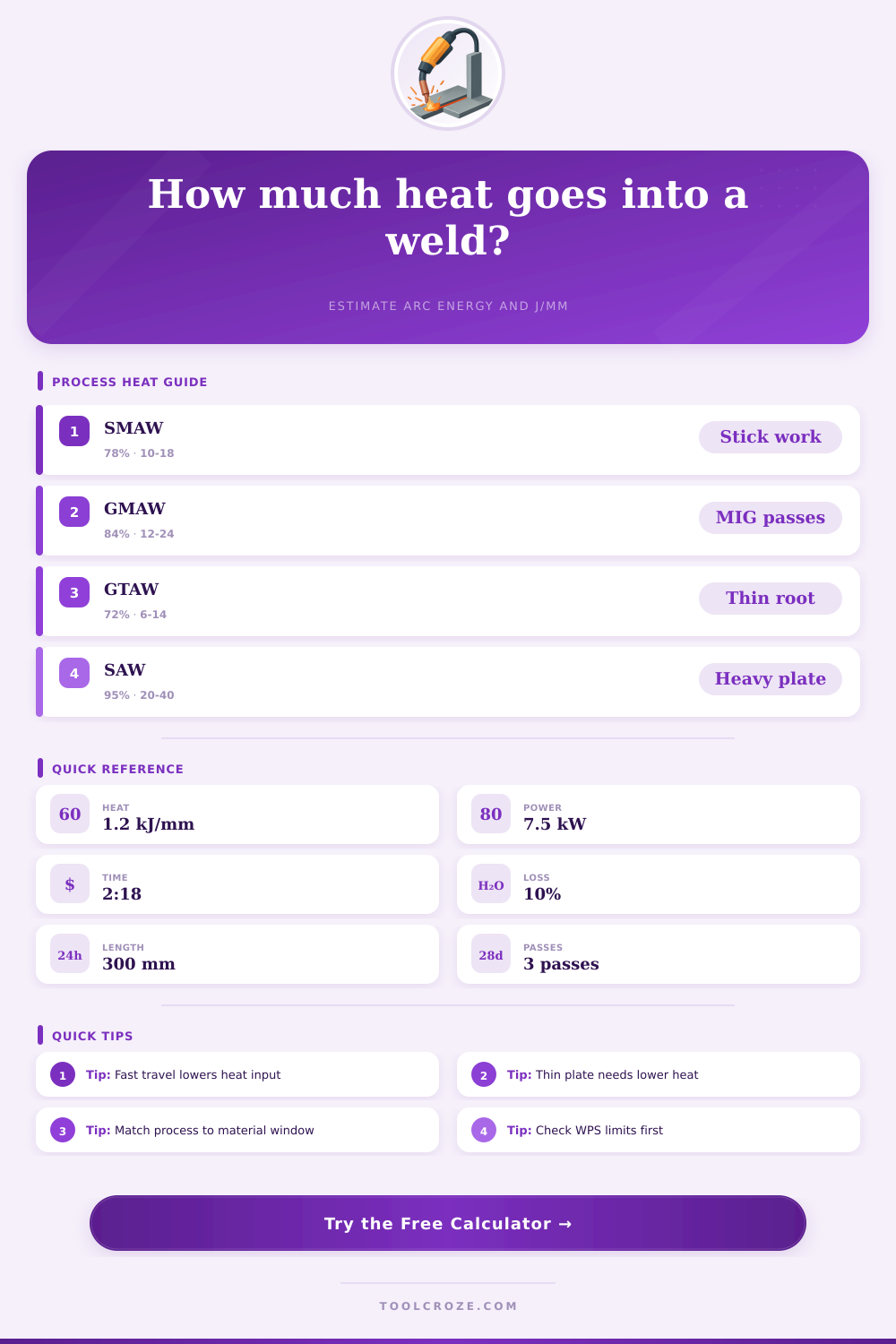
| GMAW | 0.84 | 12-24 | General use |
| GTAW | 0.72 | 6-14 | Thin root |
| SMAW | 0.78 | 10-18 | Repair work |
| SAW | 0.95 | 20-40 | Deep fill |
| Material | Window | Risk | Use |
|---|---|---|---|
| Mild steel | 0.8-1.8 | Low | Plate |
| 304 stainless | 0.4-0.9 | Distort | Tube |
| 6061 aluminum | 0.7-1.6 | Oxide | Clean weld |
| Cast iron | 0.3-0.7 | Crack | Repair |
| Speed | Heat | Arc look | Action |
|---|---|---|---|
| Slow | High | Wide | Raise speed |
| Nominal | Mid | Stable | Hold setting |
| Fast | Low | Narrow | Watch fusion |
| Very fast | Very low | Cold | Add energy |
| Pass | Length | Window | Result |
|---|---|---|---|
| Root | Short | Low | Penetration |
| Fill | Med | Mid | Balance |
| Cap | Long | Mid | Finish |
| Multi | Any | Sum | Heat build |
💡 Practical Tips
This calculator turns voltage, current, travel speed, and pass count into weld heat input, total energy, and material fit so you can tune the bead with confidence.
Heat input is an measurement of the thermal energy that is provided to the weld per unit of lengths. Heat input is an important measurement for welders because it can have an impact upon the strength of the weld, the distortions of the metal, and the longevity of that weld. If the heat input are too high for the metal that is being welded, the metal can warp or even crack.
If the heat input is too low for the metal that is being welded, the weld may suffer from lack of fusion or cold lapping. In order to calculate the heat input for a particular welding job, the welder can multiply the current and the voltage that is used for welding together, and the travel speed of the welder and the arc efficiency can be factored in. Heat input is typicaly measure in units of kilojoules per millimeter.
What Is Heat Input in Welding
Heat input can vary for different metal. Metals like 304 stainless steel tend to have low thermal conductivity, meaning they tend to retain the heat and cause the metal to distort. Metals like aluminum, in contrast, have high thermal conductivity, meaning they tend to quick dissipation the heat from the weld.
Because of this, aluminum welds require higher amount of heat input to allow for the metals to melt the layers of oxide that exists on the metal surfaces. Travel speed is one of the primary means of controlling heat input. If the welder increases the travel speed, the amount of heat input will decrease.
Conversely, if the welder decreases their travel speed, the heat input will increase. The welder can also adjust current and voltage to increase the heat input of a weld without changing the travel speed. Not all metals requires the same amount of heat input.
For instance, mild steel can tolerate high level of heat input, and typically requires an input of between 0.8 and 1.8 kJ/mm. 304 stainless steel, however, requires less heat input, typically between 0.4 and 0.9 kJ/mm. Aluminum requires a heat input between 0.7 and 1.6 kJ/mm.
Finally, cast iron requires the most lowest heat input of the metals discussed, less than 0.7 kJ/mm. The welding process will also impact the efficiency of the heat input. For instance, TIG welding has an arc efficiency of approximately 72 percent, while MIG welding has an efficiency of approximately 84 percent.
Stick welding has an efficiency of 78 percent, and submerged arc welding reach 95 percent efficiency. These values must be factored in to determine the amount of heat that will actualy be provided to the metal. The heat input for each welding pass will accumulate over the total number of welding passes.
Each welding pass may have a low input of heat that is provided to the metal. However, the more welding passes that occur, the more heat that will be provided to that metal. This total heat will impact the interpass temperature of the metal.
It is important to monitor the interpass temperature of the metal, since extreme temperature can impact the metals properties. Allowing the metal to cool prior to welding can allow for the welder to control the amount of heat input that each welding pass will have. Aside from the metal that is being welded and the welders process, there are other factors that will impact the heat input in the metal.
For instance, wind can impact the metals’ ability to retain heat, especially when welding outdoor. Preheating the metal will allow for different setting of heat input to be used for welding. Finally, the welder must follow the Welding Procedure Specification (WPS) for the metal being welded.
The WPS will detail the specifications for heat input, current, voltage, and travel speed.