
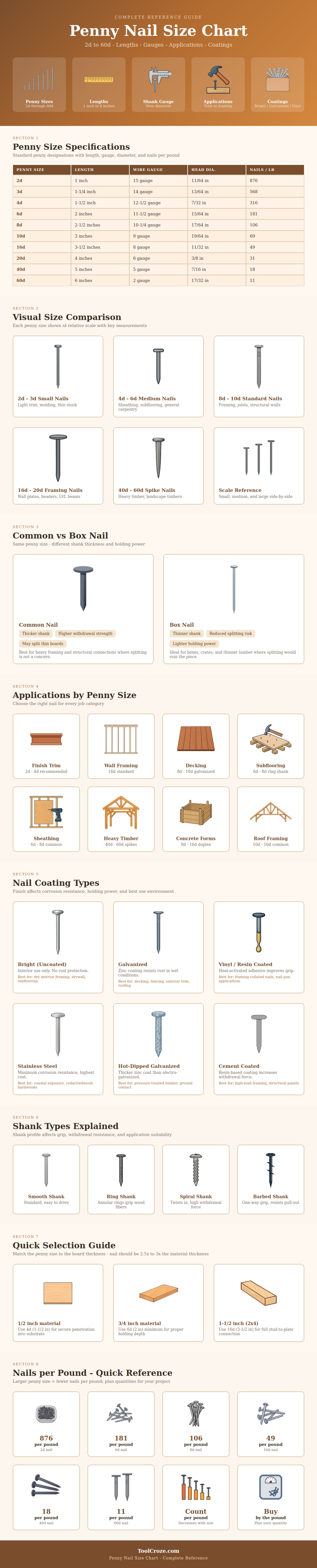
The penny nail system are a system that measures the lengths and thickness of the nails. The “d” in the “d” designation refer to denier, which is an unit of measurement of one hundred nails. The “d” designation allow people to understand the dimensions of a nail.
In order to understand the penny nail system, people must understanding that this system will determine whether a nail is appropriate for the construction task that is to be performed. Using a nail that is too small will not allow the nail to perform it’s function of securing the object together proper. However, using a nail that is too large for the construction task can cause the wood to split.
How to Choose Nails Using the Penny System
Nails comes in a variety of sizes due to the different tasks that needs to be performed in construction. Small nails are used for delicate tasks in the construction site while large nails are used for constructing large timber. By understanding the task that is to be performed, people can ensure that the nail that is used will have an appropriate size for the type of wood that is to be secured.
For instance, a 16d nail is three and a half inches in length and has an 8-gauge shank. These dimensions of the nail make it appropriate for use in framing walls. A 4d nail, on the other hand, is only one and a half inches in length and have a more slender shank.
These attributes makes it appropriate for use in sheathing or subfloors. Within the penny nail system, there are different types of nails based off their use in construction. Common nails have thick shanks to help them gain holding power while they are being used in construction.
These types of nails is ideal for nailing joists. Box nails have thinner shanks than common nails. These nails are used in situations where the wood should not crack.
You can choose between common nails and box nails depending on whether you require nails with great holding power or those that will not split the wood fibers. Many types of coating can be used for nails to protect them from the environment. For instance, bright finish nails are used for indoor construction works because the bright finish does not protect the nail from rust.
Galvanized nails are treated with a zinc layer that protects the nails from moisture; hence, they are used outdoors. Vinyl-coated nails provide a grip on the wood fibers making them suitable for framing guns. The type of coating that is used on nails must be chosen carefuly because using the wrong type of coated nails can cause the wooden structure to rot due to the rusting of the nails.
The shanks of nails can also vary as there are different types of shanks with varying degree of resistance. Smooth shanks easily penetrate wood and are used in finish work on wood projects. Ring shanks have grooved band around the shanks to gain a grip on the wood fibers while spiral shanks are twisted around the wood in a screw fashion.
Both the ring and spiral shanks has resistance to the wood from being pulled out of the wood. The type of shank that is used in a nail can be determined by the stress that the nail will need to endure while performing its work. The length of the nail need to be calculated according to the thickness of the wood that will be used.
The length of the nail should of be two and a half to three times the thickness of the top board of the wood. For instance, for half-inch plywood, 4d nails should be used. For three-quarter inch wood, at least 6d nails should be used.
Using nails that are too short will make the wood wobble while using nails that are too long may cause the nails to poke through the wood. People makes many mistakes when choosing nails. People may choose a nail that is too small for the task, which the shear force of the wooden materials will eventually rip out.
Choosing a nail that is too large can split the wood or waste money on nails that are too large for the task. In addition to the size of the nails, the environment where the wood will be used and the type of wood that will be nailed must also be considered. Bright nails will rust in rain while wooden materials that are difficult to penetrate require nails that have more holding power than soft wood.
Thus, the penny nail system can guide people to the correct type of nails for the construction tasks that is to be performed.
