📦 Plywood Weight Capacity Calculator
Estimate safe plywood shelf and panel load capacity by span, thickness, grade, and support before you stack, store, or build.
📌Presets
⚙️Inputs
🎯Results
Calculation breakdown
🧰Material Properties
📊Reference Tables
| Grade | Density | MOE | MOR |
|---|---|---|---|
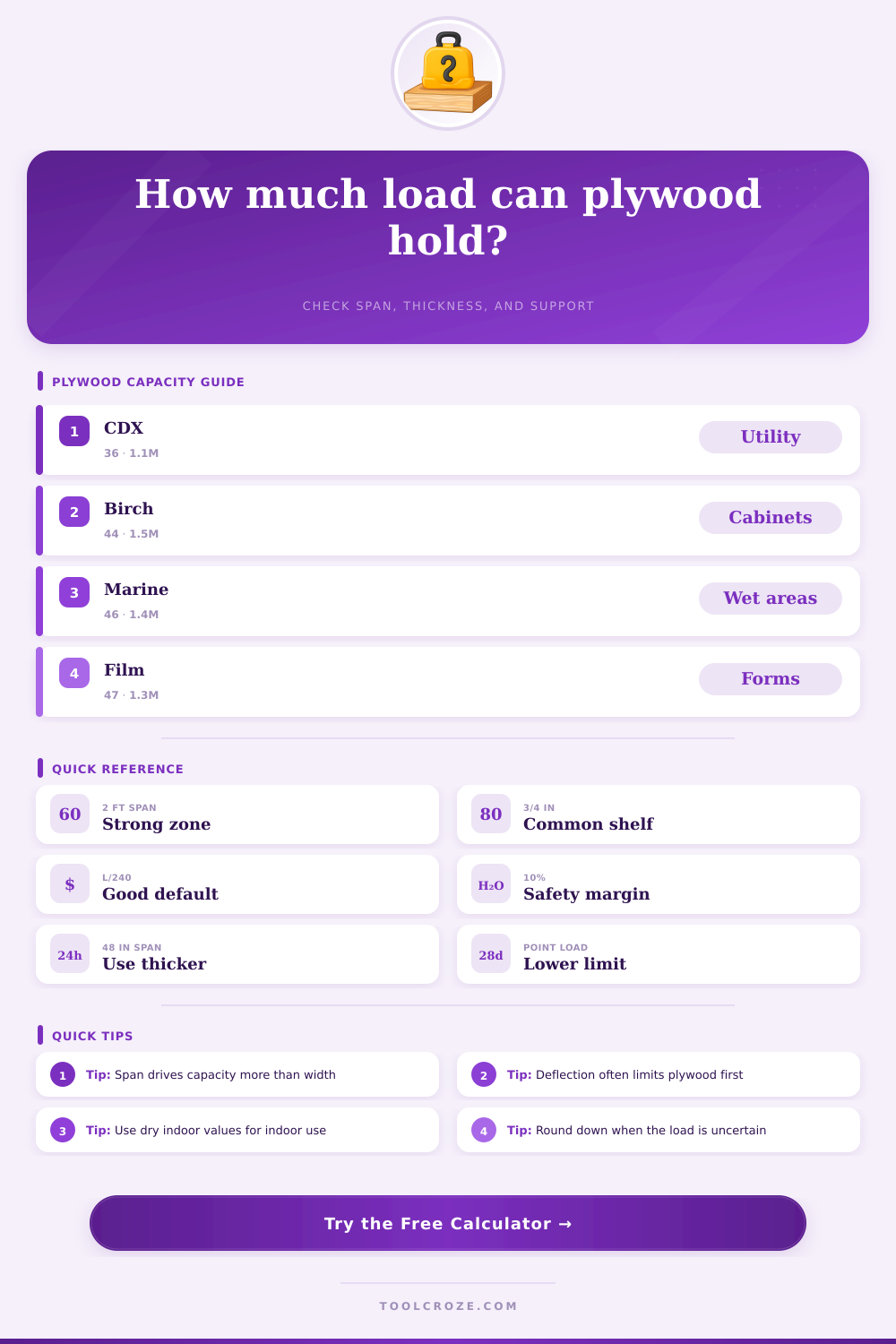
| Structural sheathing | 36 lb/ft3 | 1.10 Mpsi | 4.0 ksi |
| Cabinet plywood | 40 lb/ft3 | 1.30 Mpsi | 5.0 ksi |
| Baltic birch | 44 lb/ft3 | 1.50 Mpsi | 6.5 ksi |
| Marine plywood | 46 lb/ft3 | 1.40 Mpsi | 5.5 ksi |
| Thickness | 24 in span | 32 in span | 48 in span |
|---|---|---|---|
| 1/2 in | 60 lb | 40 lb | 25 lb |
| 5/8 in | 90 lb | 60 lb | 35 lb |
| 3/4 in | 130 lb | 90 lb | 55 lb |
| 1 in | 190 lb | 130 lb | 80 lb |
| Support | Best use | Load style | Note |
|---|---|---|---|
| Two-edge | Shelves | Uniform | Simple beam case |
| Three-edge | Recessed panels | Uniform | Some plate action |
| Four-edge | Frames | Uniform | Stiffer panel support |
| Cantilever | Brackets | Point | Lowest capacity case |
💡Tips
⚠️Safety Note
Estimate safe plywood shelf and panel capacity from span, thickness, support, and grade. Compare bending and deflection limits, then use the lower value for planning.
Plywood strength depend on several specific physical factor that you must understand to ensure the plywood can support the intended weight. These factors include the span of the plywood, the thickness of the plywood, the support conditions on the plywood, and the grade of the plywood. If you dont take these factors into account, the plywood may sag or even fail under a weight that you place on it.
The span of the plywood is the distance between the two point that support the plywood. The span is a critical factor in plywood strength because the longer the span, the more likely the plywood is to bend. The shorter the span, the more strength the plywood will have.
What Affects Plywood Strength
A shorter span will allow the plywood to support more weight then if it had a long span. A 24-inch span will allow the plywood to support more weight than if it were a 48-inch span. Another physical factor that will affect the strength of the plywood is the depth of the plywood.
The deeper the plywood, the more strength that it will have. Deep plywood will resist bending more better than narrow plywood. The thickness of the plywood is another major factor in the strength of the plywood.
The greater the thickness of the plywood, the more weight that the plywood can support. However, the strength of plywood dont increase in a linear fashion with its thickness. If you go from one-half inch plywood to three-quarters of an inch plywood, you will have more than doubled the strength of the plywood.
However, you must measure the thickness of the plywood that you are using with a tool. The nominal thickness of plywood will be thicker than the actual thickness due to sanding of the plywood before the manufacturing process. Another factor that will impact the strength of the plywood is the support condition on the plywood.
Support conditions will determine how the weight is distributed on the plywood. If the plywood rests on only two edges, it is acting as a basic plank or beam. However, if it rests on three or four edges, it will be stronger because the supports will better distribute the load.
Plywood that is cantilevered, meaning it stick out from its support on only one side, will be much weaker than plywood that is supported on multiple edges. Therefore, a cantilevered beam will experience more stress on its free end than supported plywood. The grade of the plywood will impact the plywoods strength and stiffness.
For instance, CDX plywood is a utility-grade plywood and is used in dry storage areas. However, plywood of this grade will have less stiffness than plywood of higher grades. Baltic birch plywood is very dense and will have a high modulus of elasticity.
Marine-grade plywood can withstand exposure to moisture. This plywood is used in damp areas because the glue is specifically designed to resist the moist environment and the plywood layers will not split. Deflection is another physical factor to consider.
Deflection is the amount that the plywood bend when loaded. Even if the plywood does not break, deflection can be a problem. You want to monitor the deflection so that the plywood does not sag too much under the load.
A standard measure for deflection is L/240; however, for applications like workbenches, you may want to use L/360. In addition to deflection, moisture is another physical factor to consider. Moisture can make plywood sag more than if it were dry plywood. Another factor to consider is the weight of the plywood itself.
This is a load that the supports must bear. The heavier the plywood, the less load that can be placed on it. Another physical factor is the type of load that is placed on the plywood.
A uniform load will be even across the plywood, while a point load will be concentrated in one spot on the plywood. The point load will exert more stress on the plywood in the middle of the plank. Finally, fasteners and environmental factor affect the strength of the plywood.
If the screws are too far apart on the plywood, the edges of the plywood will lift. Plywood edges lifting will reduce the strength of the plank. Wood can expand or contract due to changes in humidity.
Changes in humidity levels will affect the plywoods stability. By measuring the span, the thickness, and the grade of the plywood that you will use in your project, you can ensure the plywood is strong enough to handle your projects demands.