🏗 Valley Rafter Angle Calculator
Work out the valley pitch, plumb cut, and member length for a standard 90 degree roof valley before you cut the framing lumber.
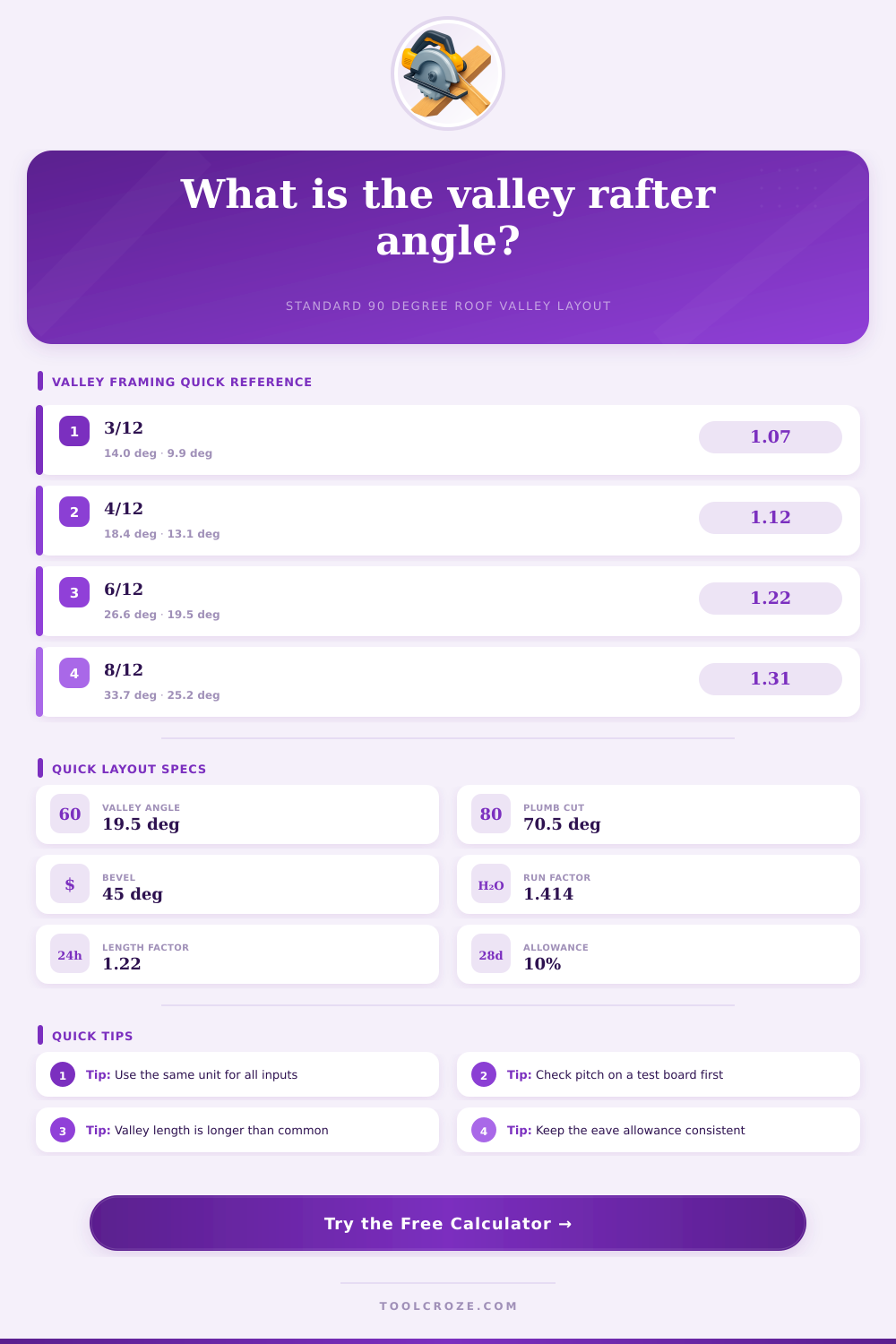
| Pitch | Common angle | Valley angle | Factor |
|---|
| Run | Common length | Valley length | Extra |
|---|
| Item | Formula | Use | Note |
|---|
Valley rafters is the structural component that form at the intersection of two roof planes. Valley rafters run diagonally from the ridge of the roof to the eave of the roof. Valley rafters have to bear the load of both roof planes that intersect.
Thus, valley rafters are a critical component of the roof structure. It is essential to ensure that valley rafters is installed correctly to allow the roof sheathing to remain flat and to allow the roof to drain water corectly. The geometry of valley rafters are significantly different than that of common rafters.
Valley Rafters Basics
While common rafters will follow the pitch of the roof, valley rafters will diagonally traverse the two roof planes. Consequently, valley rafters will always be more longer than common rafters. For square valleys, the diagonal run factor is 1.4, meaning that valley rafters are 40% longer than common rafters with the same horizontal run.
Additionally, as the pitch of the rafters becomes steeper, the length of the valley rafter will increase. To cut valley rafters correctly, you must calculate the lengths of the rafters corectly. You need to take into account the slope of the rafters, the horizontal run that common rafters will have, the thickness of the ridge boards, and the eave overhang of the roof.
If you dont take the thickness of the ridge boards into account when calculating the length of the valley rafters, the rafters will be too long to fit against the ridge of the roof. Additionally, you need to calculate the length of the plumb cut at the top of the valley rafter and the length of the birdsmouth cut at the bottom of the valley rafter. Valley rafters require a side bevel, also known as a cheek cut.
If the roof is constructed in such a way that the two planes of the rafters are square to each other, the side bevel will be 45 degrees. If the planes are not square to each other, then the side bevel will not be 45 degrees. It is essential to use a speed square to mark out the side bevel of the rafters.
Additionally, you should of test the measurements on a scrap piece of lumber prior to cutting the lumber for the valley rafters. The lumber for valley rafters has to be of significant size because valley rafters will carry more weight than common rafters. 2×10 and 2×12 lumber is commonly used for valley rafters because it is strong enough to bear the load.
If the valley rafter has to span more than 14 feet, it may require intermediate supports so that it does not sag under its own weight. Additionally, because water collects in the valley rafter, it is subjected to high moisture loads. Thus, it is essential that valley rafters are structurally sound to bear both the weight of the roofing materials and the weight of the snow that accumulates on the rafters.
The eaves of both roof planes have to be of the same height. If they are not of the same height, the valley rafters will not fit against the fascia. Before installing valley rafters, it is essential to inspect the ridge boards for warping.
If the ridge boards are warped, the angle of the valley rafters will be different than what is calculated, resulting in valley rafters that do not fit correctly against the ridge boards. If you install valley rafters correctly, the jack rafters will easily fit into the valley formed by the valley rafters. Additionally, the roof sheathing will be flat across the valley rafters.