🏗️ Steel Stair Stringer Calculator | Layout and Weight
Size steel stair geometry, stringer blank length, cut angle, support spacing, and fabrication load in one shop-friendly layout.
| Rise | Tread | Angle | Use |
|---|
| Type | Shape | Best For | Note |
|---|
| Span | Support | Bracket | Action |
|---|
| Member | Angle | Allowance | Note |
|---|
Steel stringer are the components of the staircase that support the treads and the riser of the staircase. The steel stringers has to be calculated correctly so that the stringers will fit the rise of the stairs. If the person who is setting up the staircase calculates the length of the steel stringer incorrect, the person will waste material or use shims to fix the crooked staircase that is built.
To calculate the length of the steel stringer correct, the person must calculate the rise of the staircase from the floor to the landing and the height of the riser. The height of the riser is crucial to how comfortable the individual will find the staircase. If the height of the riser is too low, the individual will tire they legs when climbing the staircase.
Measure and Choose Steel Stair Stringers
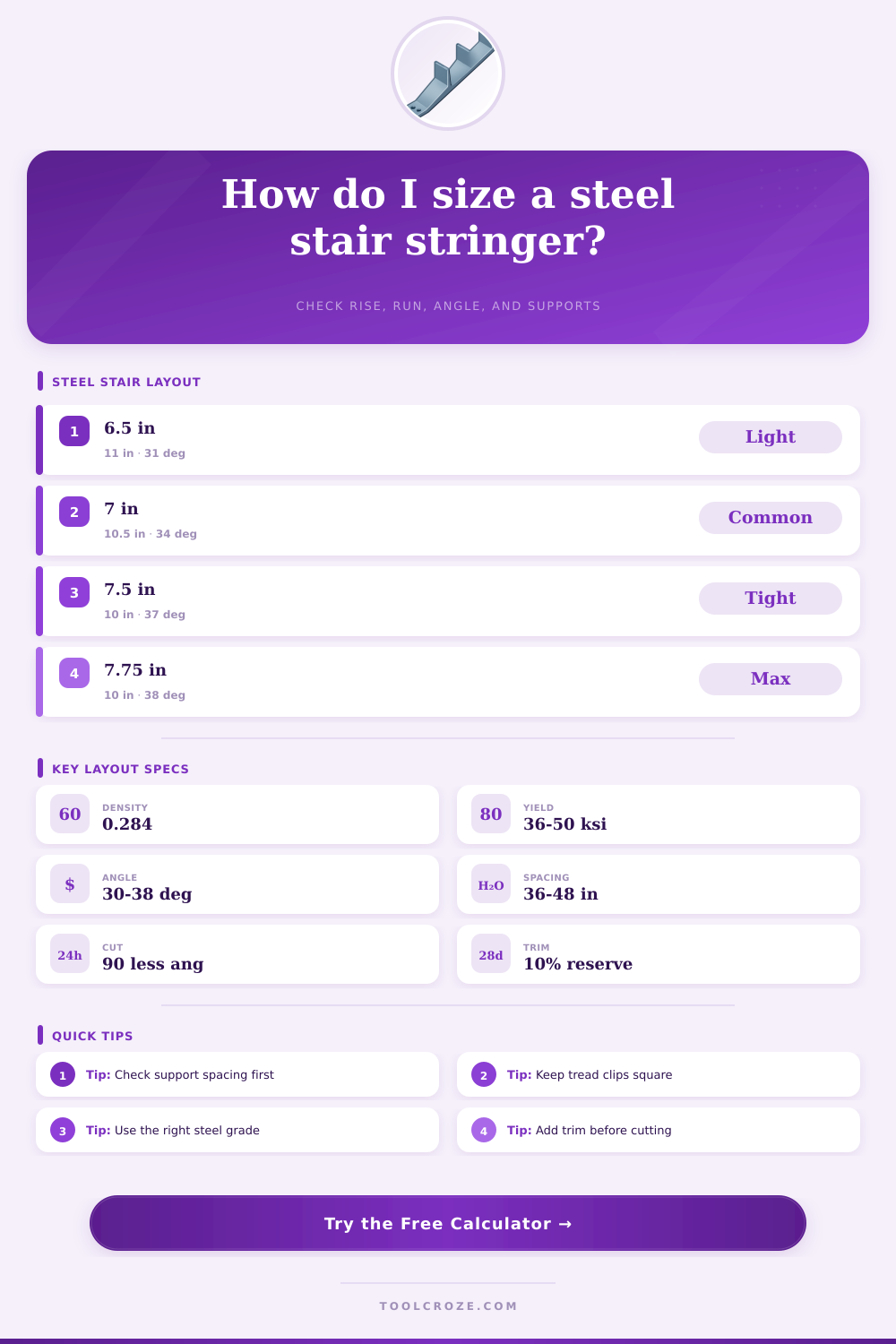
If the riser height is too high, the toes of the person may catch on the staircase when descending the staircase. The ideal riser height for indoor staircase is seven inches with a tread depth of ten and a half inches. This rise and run will create a staircase with a slope between thirty and thirty-eight degrees, which building code requires for staircases.
The person will determine the slope of the staircase by subtracting the slope of the staircase from ninety degree to find the cut angle of the stringer. The type of steel stringer that is used for the staircase will change the performance of the stringer. Flat plate steel stringers are easy to weld but will twist if used on a staircase with a long span.
Channel steel stringer are more rigid on one edge of the steel stringer and are used for stairs that will be visible to the public. Box tube steel stringers has more stiffness and are able to resist torsion so they are used for outdoor stairs. Angle steel stringers are lightweight but not suited for stairs with heavy traffic.
The depth and thickness of the steel stringers will differ; a twelve-inch deep box tube can span four foot but a twelve-inch deep angle steel cannot span four feet. The support for the steel stringer is also important because the steel will bow under the live load. The live load is the weight of the individual that walks on the stairs.
Using only the top and bottom shoes for the support of the steel stringer will cause the steel to bow under the live loads of one hundred pounds per square foot. Depending on the section of the steel stringer, the supports will have to be placed thirty-six to forty-eight inches apart or intermediate hanger will have to be used. If not enough support is placed for the steel stringers, the steel stringers will deflect and the stairs may creak.
Another factor is the grade of the steel. A36 steel is the most common steel used for its ease in cutting and welding. However, for stairs with more span than a few foot, A572 grade fifty steel is preferred because of its higher yield strength.
A588 weathering steel is used for exterior stairs since it resists rust. Lastly, stainless steel is used for stairs in salt air environment since it resists corrosion from the salt in the air. The density of the steel is approximately 0.284 pounds per cubic inch of the steel so the heavier the steel stringer the more pounds of steel will be used.
The live load that will be placed on the staircase can range in weight depending on the location of the staircase. For example, stairs within an office will have a live load of one hundred pounds per square foot but docks or loading platforms may have to support a live load of one hundred twenty-five pounds per square foot. A person should always add a ten percent safety margin to these figures.
For example, if the live load is calculated to be one hundred pounds per square foot, it should be increased to one hundred ten pounds per square foot. The utilization of the steel section should not go over eighty-five percent of the maximum load of the steel. If it does, the depth of the steel stringer will have to increase or additional steel stringers can be added to support the same load.
The cut of the steel stringer will influence the length of the steel stringer. The person will have to leave two inches of extra length for the steel stringer so that it will fit the rise of the stairs at the site. The blank length of the steel stringer is the length of the hypotenuse of the slope of the stairs plus the allowance for the risers and landings.
The weight of the steel stringer will be the area of the cross section of the steel stringer times the density of the steel. A person should avoid making several mistake when installing the steel stringer. One mistake is not accounting for the setback of the top of the staircase.
The setback will reduce the run of the staircase which will make the angle of the staircase steeper. Another mistake is not rounding the height of the riser to the nearest whole number of step so that when the risers are constructed they will all be of even height. Finally, the support spacing of the stringer should not exceed the span of the specific stringer.
For example, box tube steel can span more distance per inch of depth than flat plate steel can span per inch of depth.