🔧 Reamer Drill Size Calculator
Set your finish diameter, then find the pre-ream drill size, stock allowance, and depth clearance for a cleaner bore.
📌 Presets
📝 Calculator
🎯 Results
🧰 Material Guide
📊 Stock Tables
| Dia band | Stock | Tool use | Note |
|---|
| Reamer type | Factor | Stock trend | Use |
|---|
| Fit class | Factor | Stock trend | Note |
|---|
| Example | Finish | Drill | Use |
|---|
💡 Tips
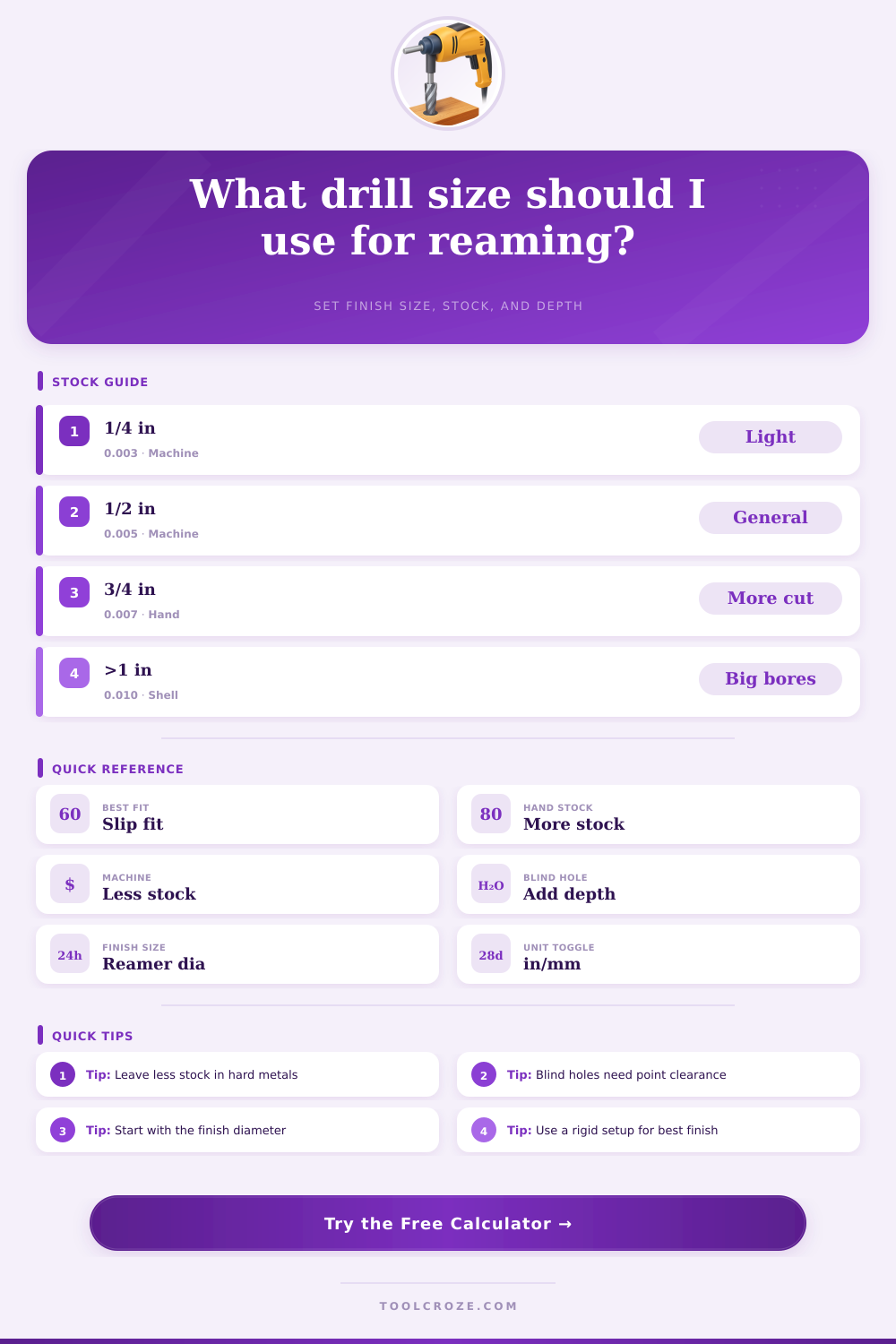
This reamer drill size calculator helps you choose the pre-ream diameter, stock allowance, and drill depth so the finished hole lands cleanly on size.
Reaming is an process of finishing a hole that has already been drilled. When a person drills a hole into a metal bracket, the drill bit may leave the hole in an inaccurate manner. To correct for inaccuracies that may be made during drilling, a reamer tool is used.
The reamer will allow the metal shaft to fit into the hole without any issue. Reaming isnt the process of drilling a hole, but rather of finishing a drilled hole to precise specification. To ream a hole, a person must leave a certain amount of material within the hole, the stock allowance.
How to Ream a Hole Correctly
If there is too much stock allowance, then the person may waste time and the reamer may wear out quick. If there is too little stock allowance, the reamer may chatter or burn the material being reamed. The amount of stock allowance that is needed to ream a hole depend on the size of the hole and the type of material that is being reamed.
Small holes that have a diameter that is under a quarter-inch will have a stock allowance of only a few thousandths of an inch. Small holes dont require much cleaning. Large holes that are over three-quarters of an inch in diameter will require a stock allowance of eight to ten thousandths of an inch.
The larger the bore, the more it will flex. The stock allowance must provide the reamer with enough force to shear the material cleanly. Finally, the type of material that is being reamed will also impact the stock allowance.
Metals like aluminum and brass is relatively easy to machine and do not gum up easily. Metals like stainless steel and alloy steels are more difficult to machine. Therefore, large stock allowances is required in these materials to ensure the reamer does not wander within the hole.
The type of reamer that a person will use will also impact the amount of stock allowance that is required to successfully ream the hole. If a person uses a chucking reamer, it will be used within a machine spindle and the chucking reamer will work best with a minimal stock allowance. The hand of the person operating the tool guides a hand reamer, so it will require about ten percent more stock allowance then a chucking reamer.
A shell reamer is used for large bores in components. The shell reamer will also require extra stock allowance for stability of the arbor. Finally, a carbide reamer is used to cut very tight.
Thus, the stock allowance will need to be set up in a precise manner. Lastly, the fit class of the component will also impact the stock allowance. A clearance hole require the least amount of stock allowance.
However, a precision locational fit will require the stock allowance to be adjust. Blind holes require different considerations than through holes. A blind hole does not extend as through the material as a through hole.
Blind holes are more difficult to ream. The drill bit will create a conical point in the blind hole. Therefore, fifteen percent extra depth will be required.
Otherwise, the reamer will hit the taper created by the drill bit. Through holes extend through the material complete. Through holes are easier to ream.
However, a small amount of extra depth will be added to ensure that the exit of the hole is smooth and does not contain a burr. To ream a hole correctly, a person can begin by determining the target diameter of the hole. The machinability of the material that is being reamed will factor into the considerations of a person preparing to ream a hole.
The type of reamer that a person will use will factor into the considerations of a person preparing to ream a hole. The type of fit that is required for the component that is being reamed will factor into the considerations of a person preparing to ream a hole. The type of hole (blind or through) will factor into the considerations of a person preparing to ream a hole.
Finally, the diameter of the drill bit that a person will use prior to reaming the hole can be calculate. When a person drills the hole to the calculated diameter, the reamer will glide through the hole to create a finished product with the correct specification for the component. Many people make mistake in the reaming process.
For instance, one of the most common mistakes is drilling a blind hole too shallow. Another of the most common mistakes is using insufficient stock allowance when reaming hard metals. Finally, vibration in the reaming process can create problems in the finished component.
All of these problem can be avoided by using proper clamping techniques, ensuring that the reamer tools are in good condition, adding the appropriate amount of coolant to the components being reamed, and using appropriate speeds and feed rate for the metals being machined. For instance, aluminum components may be machined at 400 surface feet per minute while stainless steel components should be machined at 40 surface feet per minute to avoid overheating the metal components to the point where their edge begin to turn blue. Reaming is the last process that is performed prior to the metal components are assembled.
If the reaming process is completed correctly, the shaft will fit into the component’s hole without any resistance. If the reaming process is completed incorrectly, the metal component will create issues when they are assembled. A person can ensure that the reaming process will be successful by testing metal component for their fits and by using plug gauges to measure the holes in the component.
Thus, if a person calculates the correct amount of stock allowance, and uses the proper cutting tool, the component will have a true bore that is ready to be utilized.