Cabinet Door Weight Calculator
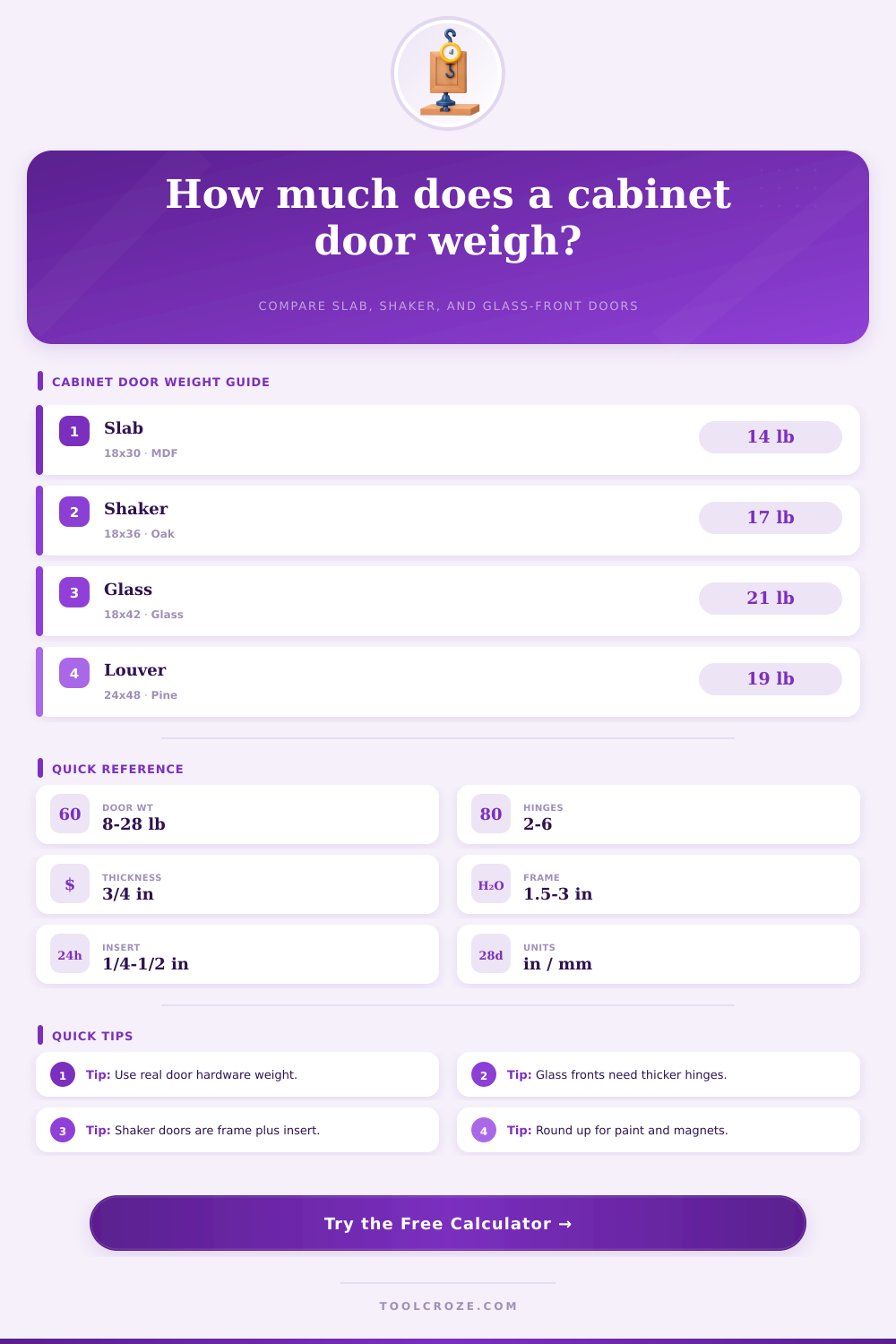
Estimate the weight of slab, shaker, glass-front, raised-panel, or louvered cabinet doors from size, construction, and material before you pick hinges.
1Door presets
2Calculator inputs
3Cabinet material reference
4Density and construction tables
| Material | lb/ft3 | kg/m3 | Cabinet note |
|---|---|---|---|
| Poplar | 31 | 497 | Paint-grade, light |
| Cherry | 38 | 609 | Mid-weight, stable |
| Hard maple | 44 | 705 | Dense slab choice |
| Red oak | 45 | 721 | Common tall doors |
| Birch ply | 34 | 545 | Flat panels, stable |
| MDF | 48 | 769 | Heavier paint doors |
| HDF | 50 | 801 | Very dense, smooth |
| Glass | 156 | 2499 | Display door insert |
| Door type | Build rule | Typical thickness | Weight trait |
|---|---|---|---|
| Slab panel | Full rectangle | 3/4 in | Simple, direct |
| Shaker | Frame + insert | 3/4 in | Moderate weight |
| Raised panel | Frame + thick center | 3/4 in | Heavier center |
| Glass-front | Frame + glass | 3/4 in | Heaviest insert |
| Louvered | Frame + openings | 3/4 in | Airier, lighter |
| Inset slab | Flat door, tighter fit | 3/4 in | Weight same as slab |
| Door weight | Hinges | Typical height | Cabinet note |
|---|---|---|---|
| Under 10 lb | 2 | Up to 30 in | Short pantry or bath |
| 10-18 lb | 2-3 | 30-42 in | Most base doors |
| 18-28 lb | 3 | 42-54 in | Tall shaker doors |
| 28-40 lb | 4 | 54-72 in | Utility or pantry |
| 40-55 lb | 5 | 72-84 in | Large tall doors |
| Over 55 lb | 6 | 84 in+ | Use stronger hardware |
| Common size | Style | Material | Est weight |
|---|---|---|---|
| 12 x 30 | Slab | MDF | 10-14 lb |
| 15 x 36 | Shaker | Maple | 14-18 lb |
| 18 x 42 | Glass-front | Oak | 18-24 lb |
| 20 x 60 | Shaker | Birch ply | 20-27 lb |
| 24 x 48 | Louvered | Pine | 16-22 lb |
| 24 x 30 | Inset slab | Poplar | 12-16 lb |
5Practical notes
Cabinet doors get heavier fast when you switch from a simple slab to a framed or glass-front build. This calculator keeps the math cabinet-specific so hinge selection feels less like guessing.
Cabinet door weight is an important factor in the manufacture of cabinet doors. The weight of the cabinet door will determine how long the cabinet door will function corectly. If the cabinet door is to heavy for the hinges, the cabinet door may sag or the cabinet may pull out of alignment.
In order to understand cabinet door weight, one must understand the materials from which the cabinets is made, the style of the cabinet doors, the dimensions of the cabinet doors, the hardware for the cabinet doors, and the weight that each of these factor will add to the total weight of the cabinet door. The primary reason for the differences in cabinet door weight is the materials used to construct the cabinet doors. For example, hardwoods such as red oak and maple are some of the densest woods, with each measuring approximately 44 to 45 pounds per cubic foot.
What Makes a Cabinet Door Heavy and How It Affects the Hinges
Due to the density of these woods, cabinet doors made of maple and red oak will be heavy. Soft woods such as poplar are less dense than hardwoods, with poplar measuring approximately 31 pounds per cubic foot. Thus, cabinet doors made of poplar will be lighter than those made of red oak or maple.
Engineered wood products such as medium density fiberboard, or MDF, are very dense at approximately 48 pounds per cubic foot. Thus, cabinet doors made from MDF will be heavier than those made of wood. Finally, glass is a very heavy material at 156 pounds per cubic foot.
However, since the glass only fills a portion of the cabinet door frame, the total weight of the cabinet door will be less than that of solid glass. The style of the cabinet doors can also have an impact upon the weight of the cabinet doors. For instance, slab doors are made of a single piece of material.
Cabinet doors in the shaker style have a frame and panel, so the weight of the frame and the weight of the panel determine their weight. Finally, cabinet doors with louvers have small slats of wood and many empty spaces within the door. Thus, the cabinet door is lighter than a solid slab door.
Additionally, the dimensions of the cabinet doors will impact the weight of the cabinet doors. For instance, the taller the cabinet door, the more the cabinet door will weigh, as well as the more leverage the door will have upon the cabinet hinges. The width of the cabinet door will also impact the weight of the cabinet door.
The wider the cabinet door, the more wood it will use to construct the cabinet door, thus making the cabinet door heavier. Finally, the hardware for the cabinet door may add to the total weight of the cabinet door. For instance, hardware such as knobs or metal pulls will add to the total weight of the cabinet door.
Additionally, the number of layers of paint for the cabinet door will increase the weight of the cabinet door. The weight of the cabinet door will impact the number of hinges required for the cabinet door. For example, if the cabinet door weighs less than 10 pounds and is less than 30 inches in height, then two hinges will be sufficient.
If the cabinet door weighs 18 pounds or is 42 inches in height, three hinges will be required. Finally, if the cabinet door weighs 28 pounds and is 54 inches in height, four hinges will be required. It is important to ensure that the weight of each individual hinge is under 10 pounds with the cabinet doors.
There are a few common mistakes in calculating the weight of cabinet doors. For instance, one common mistake is to measure the opening of the cabinet rather than the cabinet door itself. Another common mistake is to forget that the paint that the worker will apply to the cabinet door will add to the total weight.
Additionally, people often forget that the hardware for the cabinet will add to the total weight of the cabinet door. Thus, it is a good idea to test the calculations of cabinet door weight using scrap materials. By testing the weight of the cabinet door with scrap materials, it is possible to determine if the cabinet will swing smooth and whether the cabinet door will sag when it is installed.
Thus, if the calculations are performed correctly, the cabinet will swing smooth and will not sag.