📋 Piano Hinge Load Calculator
Estimate safe load, screw demand, and hinge coverage for cabinets, doors, hatches, and long continuous edge runs.
| Type | Base load | Use | Note |
|---|---|---|---|
| Standard steel | 8.5 lb/in | Cabinet | Light duty |
| Commercial steel | 11.5 lb/in | Door | Balanced use |
| Heavy steel | 15.5 lb/in | Gate | More margin |
| Stainless steel | 10.5 lb/in | Marine | Corrosion safe |
| Mount | Factor | Fasteners | Note |
|---|---|---|---|
| Softwood | 0.82 | More | Use closer spacing |
| Plywood | 0.95 | Normal | Stable backer |
| Hardwood | 1.00 | Normal | Strong grip |
| MDF | 0.72 | More | Use inserts |
| Run | Spacing | Count | Use |
|---|---|---|---|
| 12-18 in | 4 in | 4-5 | Small lids |
| 24-36 in | 5-6 in | 6-8 | Panels |
| 48-60 in | 6 in | 9-11 | Doors |
| 72 in + | 4-5 in | 12+ | Heavier runs |
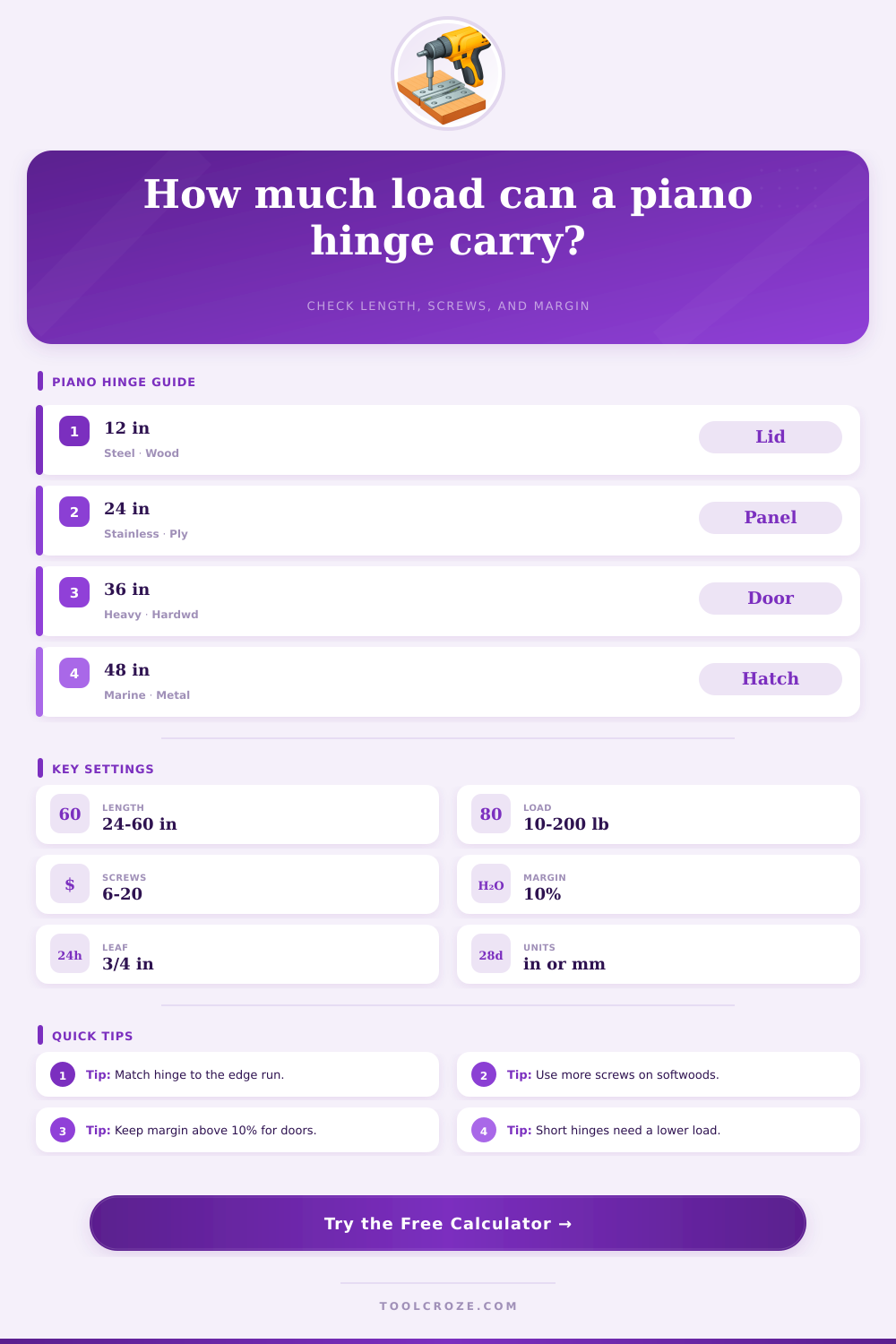
Plan piano hinge load, coverage, and fastener spacing before you cut or drill. Use the calculator as a quick sizing check, then confirm the final hardware.
Piano hinge are long and continuous hinges that offer support along the entire edge of a door or lid. A person may choose a piano hinge for its ability to preventing a door or lid from sagging, but the person must choose the correct length for the door or lid and the correct spacing for the screws on the door or lid. If a person picks the wrong length for the piano hinge or if the screw spacing are incorrect for the door or lid’s weight, then the piano hinge can fail and cause the door or lid to warp.
The weight of the door or lid is one of the most critical factors to consider when using a piano hinge. The piano hinge will help distribute the weights of the door or lid, but the weight isnt distributed even along the piano hinge. The ratio of the length of the piano hinge to the loaded edge of the door or lid is another consideration for the designer.
How to Choose and Install a Piano Hinge
Using a short piano hinge on a long loaded edge will create weak spot on that door or lid. These weak spots will create more increased torque on the piano hinge, causing the hinge to twist under the weight of the loaded door or lid. The manufacturer often rates the weight of the door or the lid in pounds per inch of the length of the piano hinge.
The actual capacity of the piano hinge may be less than the rated capacity if the leaf width of the piano hinge and the mounting of the door or lid are less than the standard for the rated capacity. Another important factor is the type of material on which the door or lid will be mounted to the piano hinge. The weight capacity of a piano hinge mounted to hardwood will be greater than a door or lid mount to softwood.
Hardwood will allow the piano hinge to reach its full weight capacity. Using a piano hinge mounted to medium density fiberboard (MDF) will decrease the weight capacity of the piano hinge by nearly 30 percent. Another mounting material is plywood.
Plywood is a great mounting material for a piano hinge, but the screw spacing must be closer together on plywood to prevent the screws from pulling out of the wood. A piano hinge calculator will provide the number of screws need for these specific mounting materials. Screw spacing determines the evenness of the torque on the piano hinge.
For even screw spacing on even door or lid panels, six-inch screw spacing is sufficient. However, on softwood or thin door or lid panels, four-inch screw spacing is necessary. If the screw spacing is too far apart on a door or lid, the piano hinge knuckles may not allow even torque to be distributed to the piano hinge, causing the piano hinge to bind when the door or lid open or closes.
A 10 or 20 percent safety margin will ensure the piano hinge can handle the weight of the loaded door or lid when it is in frequent use. The width of the piano hinge leaf and the thickness of the door or lid panels will affect the capacity of the piano hinge. Using a piano hinge leaf that is wider will better distribute the weight of the door or lid.
The thicker the door or lid panel, the better the resistance of the door or lid to sagging. The number of accessories on a door or lid will create point load on those ends of the door or lid, increasing the stress on the piano hinge. The type of metal of the piano hinge will affect the type of environment in which it is used.
The most common metal is steel, which can hold 8 to 15 pounds per inch of the length of the steel piano hinge. Another metal is stainless steel. This metal resists rusting and is more better suited for damp or wet environments.
Brass is another metal used in piano hinges for its appearance. However, the weight capacity for a brass piano hinge is less than that of a steel or stainless steel piano hinge. Using steel for a piano hinge in a wet environment will allow the hinge to rust.
However, using stainless steel for a piano hinge in a dry environment will allow the hinge to remain functional. To properly install a piano hinge, a person should follow these steps. First, measure the dimensions of the door or the lid to determine the length of the piano hinge need for that application.
Second, determine the type of material the door or lid will be mounted to. This will determine the weight capacity of the piano hinge. Third, determine the screw spacing based off the door or lid’s weight and the type of material it is mounted to.
Finally, add a safety margin of 10 or 20 percent to the total load the piano hinge will take to ensure that the piano hinge will not fail under the door or lid’s weight and with the frequency of that door or lid’s use. By following these steps, the person will have a piano hinge that will provide even support along the edge of a door or a lid that will open or close without any sagging.