🔩 Torque Hinge Calculator | Lid Hold and Balance
Size torque hinges for lids, flaps, and access panels using real panel weight, angle, and hinge count.
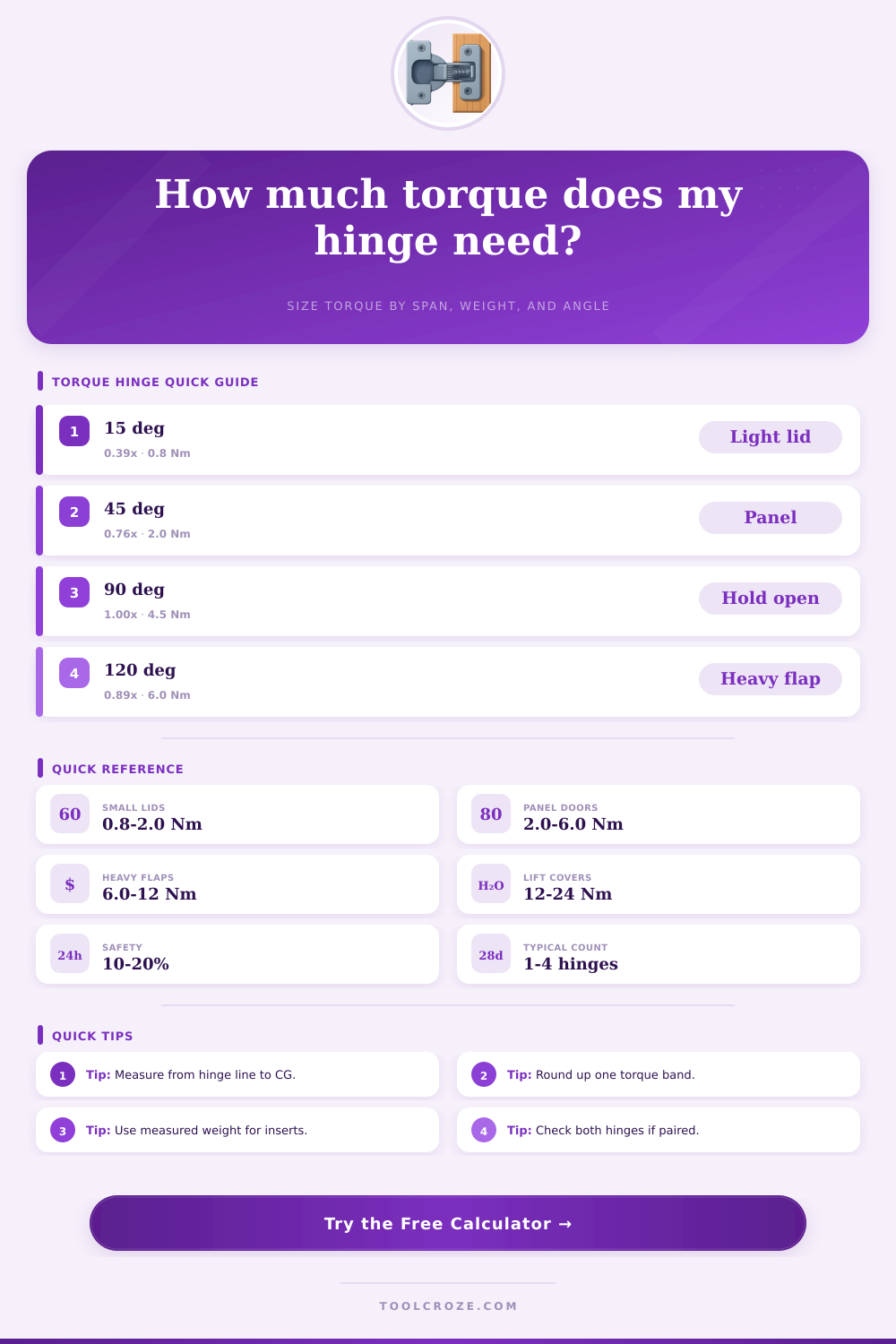
| Angle | Motion factor | Feel | Use |
|---|
| Band | Per hinge | Typical span | Application |
|---|
Torque hinges is used to hold a lid in a specific position because the torque hinges do not allow for the force of gravity to open or close the lids. The correct selection of a torque hinge will allow the hinge to hold the lid in place without it move on its own. If the incorrect type of torque hinge are selected, the lid may slam shut or it may fall open.
The moment arm of the torque hinge must be considered when choosing a torque hinge. The moment arm are the distance from the hinge to the center of gravity of the panel. The length of the moment arm has a direct relationship with the amount of torque that is require for the hinge to hold the lid in place.
How to Choose the Right Torque Hinge
While many people believe that the weight of the panel is all that must be considered when choosing a torque hinge, that is not true. A long and skinny panel will require more torque than a short and stubby panel of the same weights. Therefore, you must measure the distance from the panel to the hinge, not the weight of the panel.
The angle at which the panel opens will also impact the amount of torque that is required of the hinge. If the panel is held at a 90 degree angle to the hinge, the gravity torque on the panel will be the highest. If the panel is tilted to a 15 degree angle from horizontal, gravity will exert less torque on the panel.
If the panel is moved past 90 degrees to 120 degrees, the gravity torque will decrease again. However, it is important to make sure that the torque hinge chosen for the panel can handle this torque. If two torque hinges are used instead of one, the load will be divided between the two hinges.
However, the hinges must be mounted along the length of the panel. If the span of the panel is increased without increasing the number of torque hinges that is used, the amount of twist that each torque hinge experiences will increase. The backset of the torque hinge, which is the distance from the edge of the panel to the hinge, will also impact the amount of torque that the hinge must exert.
If the backset of the hinge is increased, the amount of torque that is required from the hinge will decrease. The material of the panel will impact the weight of the panel and it’s center of gravity. For instance, if the panel is made of Baltic birch plywood, one can easily estimate the weight of the panel.
Panels with honeycomb cores will weigh less than panels with solid wood inserts. Panels with glass inserts will have their center of gravity shift forward, which will increase the amount of torque that is required by 12%. Additionally, the environment in which the hinge will be used may require more torque to combat the negative effects of dust or water.
In these cases, the amount of torque that is required will be 10-20% more than calculated. A torque hinge calculator will ask the person who is calculating the amount of torque that is required for the hinge to input the weight of the panel, the length of the moment arm, and the angle of the panel. The calculator will output the amount of torque that each hinge must be rated for.
The hinge requirements can be increased by a certain percentage to allow for error. A 10% increase in torque is sufficient for a prototype. However, 25% of additional torque is required for access panels that may be exposed to humid environment.
It is not recommended that people attempt to estimate the amount of torque for a hinge by “eyeballing” it. The hinges exert constant friction, so they dont function in the same way as spring-loaded hinges. Therefore, the best way to calculate the torque requirements for a hinge is by using a hinge torque calculator.
However, it is also important to test torque hinges on scrap material first before installing them on the final project. The mathematical calculations of torque requirements are not always accurate due to the friction of the hinge or the weight of the panel that may be added with cables. In the case of warped panels, or if the center of gravity of the panel is different then calculated, the torque requirements will have to be recalculated.
In some cases, the easiest way to calculate the torque requirements for the hinge is to use the preset settings for certain types of projects. For instance, if a person is making a steel toolbox with a lid that is front heavy, the person can adjust the preset settings to indicate that it will be used in a heavy or marine (exposure to water) environment. The preset settings will ask for the weight of the panel, and the desired feel of the hinge.
Some individuals may prefer an easy glide feel for their hinges, while others want a firm, locked feel to the hinge. Additionally, reference tables can be used to determine the amount of torque that is required for a given project. Torque bands range from micro torques for small hardware and fixtures, to industrial torques for large project plans.
When selecting a torque rating, it is important to round up to the next torque band to ensure the longevity of the hinge. To select the correct torque hinges for a project, you must balance the weight of the panel with the length of the moment arm and the angle of the panel. Additionally, the material, backset, and environment of the torque hinge should also be considered.
By taking these factors into consideration, and through accurately calculating the torque requirements of the hinge, the torque hinges will hold the panels exactly where they are require to be.