🌲 Laminated Wood Beam Calculator
Estimate laminated beam span, deflection, and safe load for glulam or LVL members before you build.
| Use | Ratio | Feel | Best for |
|---|
| Nominal | Actual | I | Use |
|---|
| Case | Formula | Result | Use |
|---|
| Project | Span | Beam | Limit |
|---|
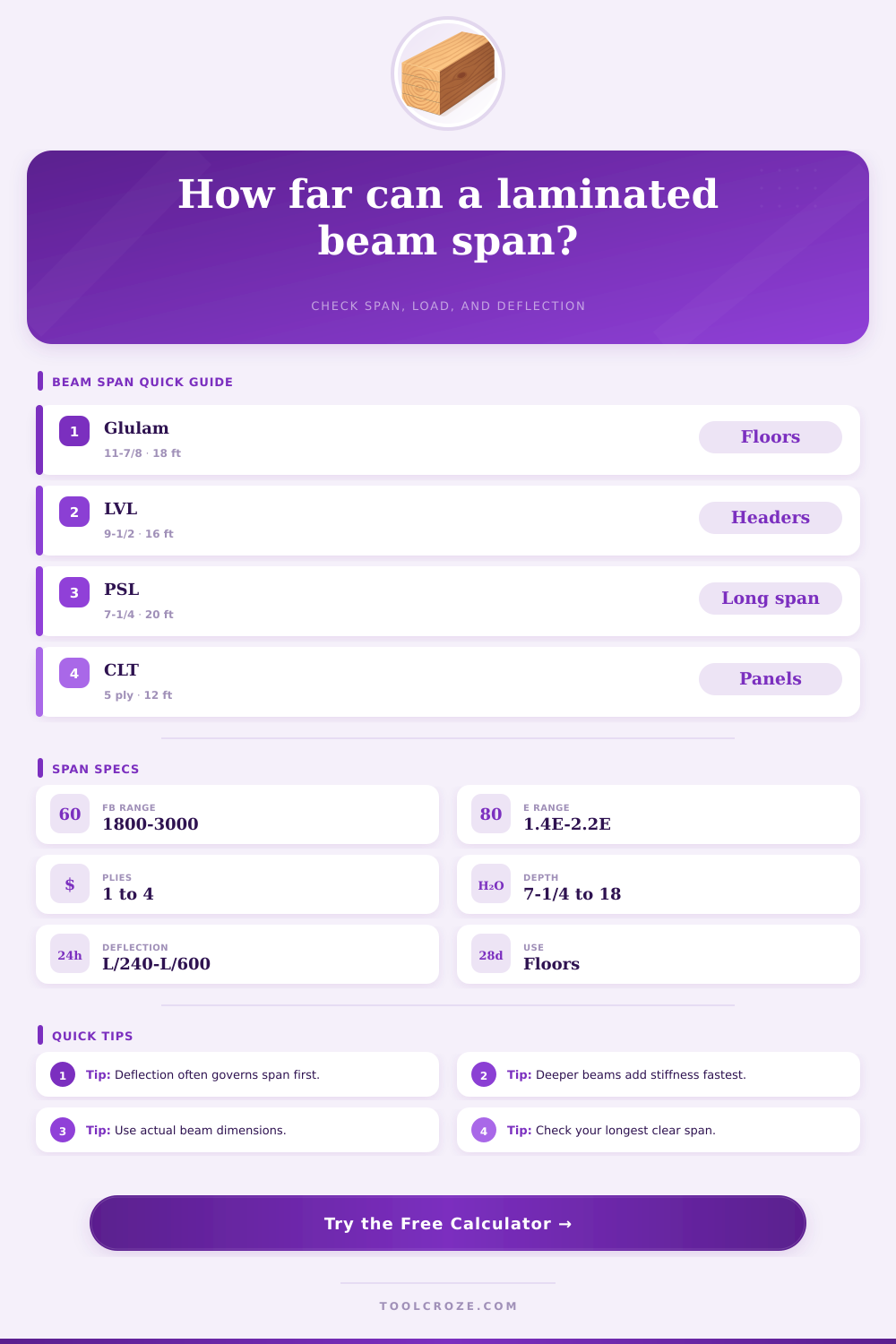
Laminated wood beams is beams that are used in construction. The manufacturer make laminated wood beams by gluing thin layer of wood together to create a beam that is both stronger and straighter than solid timber beams. Many of the reason that laminated wood beams are used in construction are that they are commonly used in spans as short as 12-foot or as long as 18-foot, and that laminated wood beams is less likely to twist or warp during use than sawn lumber beams.
Additionally, the laminated wood beams are more predictable in there structure than solid beams; the wood layers are all laid flat, allowing for defects in the wood to be moved away from the areas that provides the majority of the structural strength of the laminated wood beams. There are several different types of laminated wood beams, each of which has its own manufacturing method. Glulam beams, for instance, are made by stacking full lumber laminations under high amount of pressure in the manufacturing process.
All About Laminated Wood Beams
The machine make LVL beams by slicing logs into thin webs, which are later laminated together to even out imperfections in those logs. PSL beams are made by crushing the strands of wood into thin slivers to even out the quirks in the wood. As a result, laminated wood beams are able to span farther distances than dimensional lumber beams, and deflect less than dimensional lumber beams.
Because laminated wood beams are less likely to warp, they are often used in exposed areas of construction sites, such as exposed floors or garage headers. Another of the most important feature of laminated beams is the concept of deflection. Deflection is the amount that a beam sag under a load.
Thus, while a beam may be able to provide the necessary amount of strength to support the weight that is placed upon it, that beam may “bounce” under the weight of individuals that walk upon it. To prevent excessive sagging, there are limits to deflection; one common limit is L/360 (the deflection cannot be larger than the length of the beam divided by 360). For shelves that are used to hold books, an L/180 limit may be established.
However, for ceilings that are visible to individuals, an L/480 limit may be established. Additionally, the depth of the beam has a direct effect upon deflection; the deeper the beam, the more resistance the laminated wood beam will have to sagging under load. For example, if the depth of the beam is doubled, the resistance to sagging will be multiplied four-fold; a 12-inch deep laminated wood beam will have more resistance to sagging than a 7-inch deep laminated wood beam.
The last discussion of beams is related to the types of loads that can be placed upon beams. There are several different load types: point loads and uniform loads. Point loads are placed in a specific spot and often correspond to a specific object, such as a hot tub.
Uniform loads, in contrast, are even distributed across an even area, such as snow that lands on a patio cover. The placement of the load upon a beam is another important factor; placing a load close to the end of the beam will create different stress upon the beam than if the load is placed in the middle of the beam. Additionally, the choice of material to be used for the beam will depend upon the specific needs for that beam.
For instance, if maximum stiffness is required, PSL beams may be chosen. However, if cost is an issue, LSL beams may be selected. Finally, safety margins should of been applied to any calculation made for the beam.
Applying safety margins for the strength of the beam accounts for other unknown factors, such as the impact of wet wood upon the beams strength. You can use the preset jobs to help calculate the beams. These preset jobs will mimic the common structure of shelves or spans of a garage, for example.
If you input 14 feet as the header for a roof load and selected a glulam beam at an L/360 limit, the software would calculate the deflection of the beam, the load that the headroom can take, and whether or not it would be a good beam for that span. If the utilization of the beam is above 80%, then it may be necessary to review the design with a structural engineer. If the utilization is past 100%, then the beam design would have to beredesigned.
The outputs of these calculations can help to explain the benefits of using a wider beam to fight shear, but deflection is often the factor that determines the size of the beam. Often times, people will attempt to use the tables to calculate the beams for a structure without considering the context of that structure. For instance, a 16-foot glulam beam may be appropriate for a span that experiences uniform loads from the joists, but it may sag too much under point loads from heavy furniture.
Live loads can shift in the structure, but dead loads remains in one place. It is important to ensure that the longest span of beams will dictate the size and spacing of the beams for that structure. Additionally, the bearing capacity of the ends of the beams must be checked.
For beams that bear on supports, the bearing area must be at least 3 inches in the ends of the beams for even support of that structure. Some of the mistakes that can be made when installing laminated beams include using only a shallow beam depth to save money, then adding plies later to increase stiffness; this will only increase the cost of the beams. Shallow beams or plies will not be equal to the amount of strength of a thicker board.
Additionally, if the beams are to be exposed to moisture, the ratings of the beams may drop to 80% of there initial ratings. Therefore, laminated beams that are exposed to the elements must also be considered. Finally, it is also critical that any connections to the beams are also considered in the determination of the actual capacity of the beams.
Some of the environmental factors and their impact on the beams include the humidity of the climate in which the beams will be installed. For example, if the beams will be installed in areas with high humidity levels, the laminated beams will have to be acclimated for two weeks. Additionally, PSL beams may cost more money up front than glulam beams, but they may save money on labor costs for long installations.
Another benefit of LVL beams vs glulam beams is that LVL beams have better fire resistance. Both beams can be compared using technical grids and specifications. For instance, the bending stresses of beams of different depths and materials can be compared.
Mistakes can be made when selecting beams, such as overspanning the beams by even a few inches; this would result in the beams failing inspections. Therefore, it is critical to trace the load from the joists to the beams and from the beams to the walls to ensure that all components of the structure are safe.