🧰 Built-Up Wood Beam Calculator
Check stacked ply capacity, splice layout, and deflection limits for beams built from multiple nominal 2-inch members.
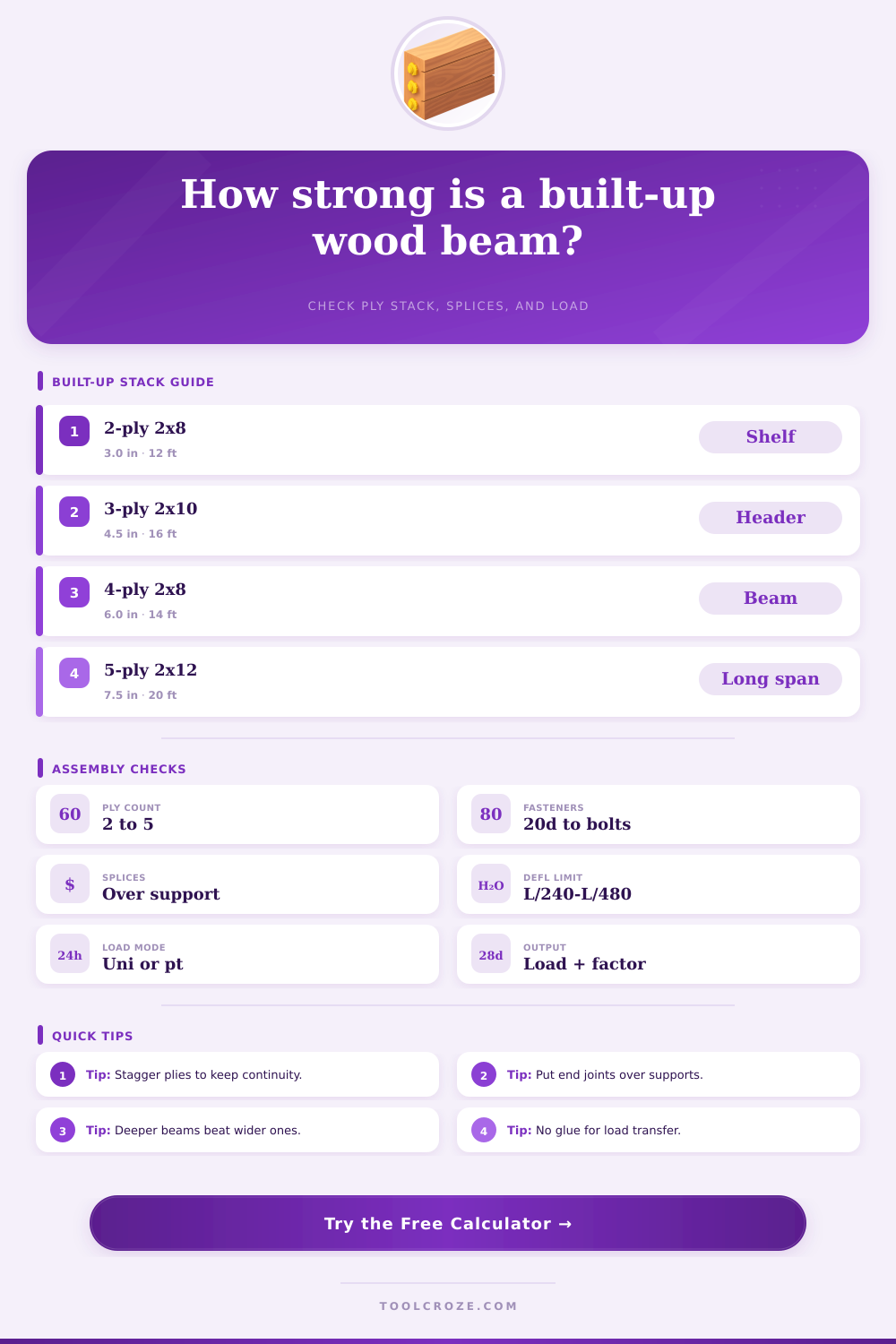
| Stack | Total width | S | Use |
|---|
| Fastener | Rows | Spacing | Note |
|---|
| Layout | Factor | Rule | Risk |
|---|
| Path | Factor | Use when | Watch |
|---|
Wood beams that are built up are constructed by fastening multiple piece of lumber together to create a single beam. A person may use this type of constructed beam to support heavy loads, such as a garage door header or a deck. These beams is typically made by nailing or bolting together individual plank of lumber.
However, if constructed incorrect, built-up beams can experience various problems. For instance, the planks can slip from one another, the built-up beam can twist under side loads, or the built-up beam can deflect or sag from the load. The strength of a built-up wood beam depend on the dimensions of the individual plies.
How to Build Strong Built-Up Wood Beams
A person may use a single 2×10 board to construct a shelf that can bear limited loads from objects placed on the shelf. However, to build a floor beam that must bear heavy loads, a person should use multiple plies of lumber. For instance, three plies of 1.5-inch lumber will provide a built-up wood beam with a total width of 4.5 inches.
Increasing the width of the beam or the depth of the beam can increase the strength of the built-up wood beam. However, increasing the depth is more effective than increasing the width of the beam. This is because the depth of the beam have the most influence on the beam’s strength, as the moment of inertia increase as the height of the built-up beam increases.
Therefore, beams that are deep and narrow are typically stronger than beams that are wide and shallow. Fasteners are required to hold the planks of the built-up wood beam together. For instance, two rows of 20d common nails placed 32 inches apart can be used to create the baseline for a roof beam.
However, three rows of nails or structural screws will increase the capacity of the built-up beam. Using structural screws and bolts will reduce the amount of slippage between the plies. Thus, using these types of fasteners will increase the strength of the built-up wood beam.
If the built-up beam has a poor type of fasteners, the assembly factor will drop and the built-up wood beam wont be able to reach its full strength. Built-up wood beams require splices if the lumber available is shorter than the length required for the built-up wood beam. In this case, the splice should be placed over the supports for the built-up beam.
Additionally, the splices should be staggered 16 or 24 inches apart. If the splice is placed in an unsupported portion of the built-up wood beam, the strength will significant drop. Furthermore, the direction of loading must be considered.
Loads from the joists are easier for the built-up beam to handle than side loads. The planks should be nailed on both sides of the built-up wood beam for this type of load. Another factor is the species of the lumber that will be used to construct the built-up beams.
Douglas fir-larch and southern pine have high resistance to bending stress and high elastic modulus. Softwood species like SPF are used for light loads but will bow more under deflection than Douglas fir-larch. Additionally, the environment in which the built-up beams are used will have an impact on the species of wood used.
For instance, beams used in dry areas of a building will have high strength. However, beams used on covered decks may lose some of their strength due to the moisture in the air. Furthermore, the beams used in wet areas of the building will lose their strength due to the moisture in the air over time.
Another factor to consider when constructing a built-up wood beam is the deflection of the built-up wood beam. For floors, the deflection limit will be set at L/360. For roofs, the limit can be set at L/240; however, for plaster ceilings, the limit will be L/480 because plaster will crack if the ceiling bends significant from the built-up wood beam. Finally, builders should of deduct 10 percent of the strength of the built-up wood beam as a safety margin to ensure that the built-up beam is conservative in its estimates and cannot fail.
Some of the most common mistakes in building built-up wood beams is choosing a beam that is too wide and has insufficient depth. A deeper beam will better handle loads than a wider beam. Placing beams in an unsupported portion of the built-up beam will significant reduce the strength of that built-up beam.
Furthermore, another mistake is failing to stagger the splices in built-up beams. Built-up beams that are constructed with marginal splices will not provide the strength that is required of the built-up beam. Additionally, builders should provide lateral bracing for built-up beams to keep the compression flanges of the built-up beam from buckling sideways.
Furthermore, the loads that should be considered when building built-up beams include the snow loads and the dead loads of the structure. Snow loads will increase the live load on the built-up beam, and dead loads will increase the total load on the built-up beam. By considering all of the factors and following the rules and guidelines for building built-up beams, builders can ensure that the built-up beams will remain stable and bear the loads for a long time without failing.
It is alot of work to get it right, but you’re going to recieve a better result.