🔧 Anchor Bolt Calculator | Tension and Shear Check
Screen tension, shear, embedment, and anchor size for base plates and concrete mounts
| Type | Tension | Shear | Use |
|---|
| Bolt | Area | Head / Hook | Embedment |
|---|
| f'c | Ratio | Note | Use |
|---|
| Case | Rule | Flag | Action |
|---|
Anchor bolts is used to connect steel component to concrete slabs. They are used to transfer the tension and shear force from the steel to the concrete slabs. Tension forces on the anchor bolt will pull the bolt out of the concrete.
Shear forces will push the bolt sideways through the concrete. If the anchor bolt are not installed correct into the concrete, the concrete will fail in a cone shape around the anchor bolt as the brittle material cannot withstand the tensile force. The edge distance of the anchor bolt is critical to the success of the connection between the steel and the concrete.
How Anchor Bolts Hold Steel to Concrete
If the installer place the anchor bolt too close to the edge of the concrete slab, the concrete will crack at the edge and break away from the remainder of the slab in a cone shape around the anchor bolt. As a result, many people will prioritize edge distance over than diameter of the anchor bolt. The spacing between anchor bolts are also important.
If the bolts are placed too closely together, the breakout zone in the concrete will begin to overlap. Overlapping breakout zone in the concrete will make the concrete weaker and the capacity for the anchor bolts to transfer the steel forces to the slab will decrease. Depending on the application of the anchor bolt, there are several differently types of anchor bolts.
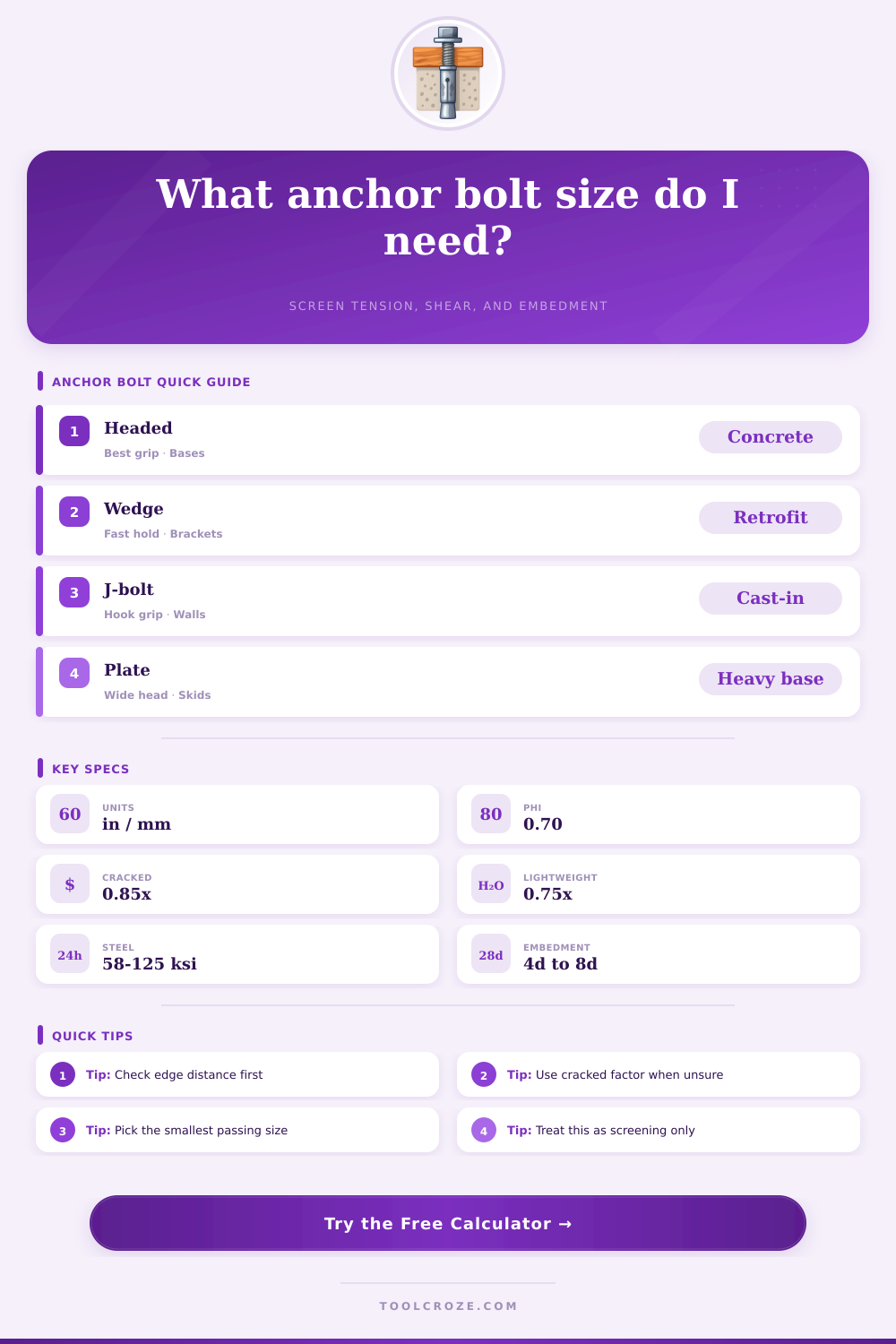
Headed bolts with nuts have high pullout resistance from the head of the bolt against the base plate of the steel. Headed anchor bolts are used for cast-in-place concrete as the workers place the bolts into position before the pouring of the concrete. Wedge anchor are used for retrofitting structures as the concrete pour is complete.
The wedge anchor is drilled into the pour of the concrete and expands to create a grip on the concrete. Another type of bolt is the J-bolt use in concrete walls. These anchor bolts have a hook in their shape that create the pullout strength in the wall.
The embedment depth of an anchor bolt is the depth that the bolt is driven into the concrete. The embedment depth is usually between four and eight times the diameter of the anchor bolt. Another factor that will decrease the capacity of the anchor bolt is the condition of the concrete.
If the concrete is new and has no crack, it will provide the maximum holding capacity for the anchor bolts. If the concrete has any cracks, it will provide less holding capacity for the bolts. If the concrete contain shrinkage cracks or uses lightweight aggregate, the capacity of the anchor bolt will have to be reduced.
Many people will reduce the capacity of the bolts by as much as thirty-five percent to account for cracks in the concrete that will allow the cracks to spread under the applied load. The grade of the steel used will also affect the performance of the anchor bolt. For most applications, grade 55 steel is used as it is a balance of strength and cost.
For applications that require more strength from the anchor bolt, grade 105 steel will be use. For both grade of steel, people must consider the tension of the steel against the strength of the concrete and the pullout strength of the anchor bolt. A safety factor, such as a phi factor of seventy percent, are applied to these calculations.
The embedment depth of the anchor bolt is another primary factor in determining the strength of the bolt. The greater the embedment depth of the anchor bolt into the concrete, the more greater the strength of the bolt. However, this is not a linear relationship.
The strength of the embedment depth increase according to a power of 1.5. Using a short embedment depth for the anchor bolt will increase the risk of the bolt pulling out of the poured concrete. If the distance from the edge of the poured concrete to the edge of the anchor bolt is less than one and a half times the embedment depth of the anchor bolt, the strength of the anchor bolt will significantly decrease.
Avoid common mistake when installing anchor bolts. Using an edge distance that is too short for aesthetic reasons will lead to the poured concrete breaking at the edges. Another common mistake with many construction worker is to assume that all poured concrete is the same.
However, cracked poured concrete will require larger anchor bolts to handle the tensile strength of the cracks. Finally, another mistake is to focus on the strength of the steel anchor bolts while ignoring the strength of the poured concrete foundation. Pouring concrete will dictate the strength of the entire connection.
A ten percent safety buffer will allow for unknown variable in the strength of the poured foundation. Finally, environmental factor will also affect the performance of the anchor bolt. In areas that are prone to earthquakes, the anchor bolts will have to withstand repeated tensile and shear forces.
In coastal areas, stainless steel anchor bolts should be used as the salt in the seawater will corrode the carbon steel anchor bolts. The temperature of the environment will cause the steel base plate to expand and contract at a different rate than the poured foundation. These temperature change will create additional tensile forces on the anchor bolts, especially at the edges of the poured concrete slab.
When checking the strength of a connection made with anchor bolts, it is critical to determine if the tension of the steel, the strength of the concrete at the point of breakout, or the strength of the bolt itself is the governing factor. This will dictate the weakest part of the structure and the limit of the total strength of the connection. If the calculations of the load that will be placed upon the connection is close to the calculated capacity for the connection components, the size of the anchor bolts should be increase or the embedment depth of the anchor bolts should be increased to increase the total strength of the connection.
Finally, the specifications of the bolts and the building codes for the structure should always be verified to make sure that the installation of the anchor bolts follows the safety standard for the structure in question.