🔧 Chainsaw Chain Pitch Calculator | Chain Fit Guide
Measure rivet span, match chain pitch, and confirm sprocket fit
| Pitch | 3-rivet span | Gauge | Common use |
|---|
| Gauge | Metric | Fits pitch | Note |
|---|
| Teeth | Pitch | Circle | Use |
|---|
| Bar class | Pitch | Drive links | Notes |
|---|
When you select a replacement chainsaw chains, the pitch of that replacement chain must match the specification of the bars and sprockets of your chainsaw. The pitch of the chainsaw chain is the distance between the drive rivet of the saw chain and those specifications is located on the sprocket or the bar of the saw. If the pitch of the replacement chainsaw chain dont match that of your saw, the replacement chain may skip on the sprocket, it may get stuck within the bar groove, or it may damage the sprocket.
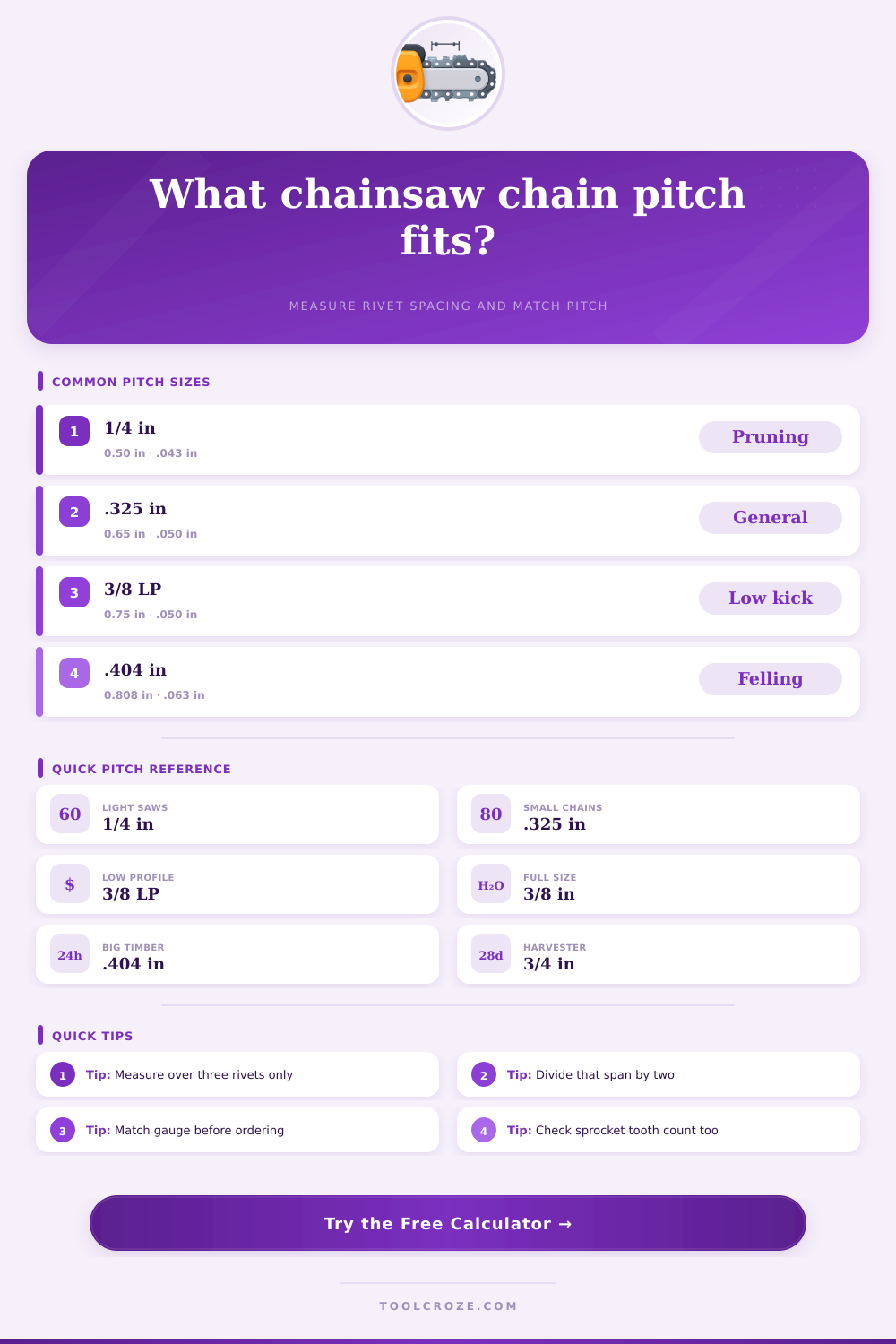
The malfunctioning of the chainsaw due to these issues mean that you should measure the pitch of the saw’s existing chainsaw chain prior to purchasing a new replacement chainsaw chain. The pitch of a chainsaw chain is determined by measuring the distance across three drive rivets and divide that measurement by two. For instance, if you measure the distance across three rivets as 0.65 inches, dividing that number by two indicate that the pitch of the saw’s chainsaw is.325 inches.
How to Measure and Choose the Right Chainsaw Chain
Using a caliper or ruler to take this measurement will ensure that the pitch of the new saw chain is measured precise. Individuals who attempt to visually gauge that measurement often incorrecty estimate chainsaw chainsaw pitches; these estimation often lead to the purchase of a replacement chainsaw chain that does not appropriately fit the saw. Therefore, determining the pitch of the saws existing chainsaw chain via a physical measurement will ensure that the new replacement saw chain appropriately match the specifications of the saw.
Another specification that must be considered for the replacement saw chain is the gauge of the saw chain. The gauge of the saw chain is the thickness of the drive links of the saw chain. The gauge specification of the saw chain must match the width of the saw bar groove.
If the gauge is too thick for example, the replacement saw chain will not be able to fit within the bar groove. Alternatively, if the gauge of the replacement saw chain is too thin, the saw chain may rattle within the saw bar groove. Both of these problem suggest the need for the saw chain gauge to match that of the saw bar groove.
In addition to the specifications of the saw bar and the gauge of the saw chain, the sprocket of the saw also introduce a third specification that should be considered for the purchase of a new saw chain. The sprocket teeth of the saw must engage with the drive links of the saw chain. If the pitch of the replacement saw chain does not match that of the sprocket teeth, those sprocket teeth will not properly seat within the drive links of the saw chain.
This can lead to the sprocket teeth stripping or the replacement saw chain snapping. Thus, the pitch of the saw chain should match the specifications of the sprocket as well. Finally, different types of saw chains is manufactured for different types of tasks.
For instance, tasks that involve lighter loads on the saw chain typically use chainsaw chains with a 3/8-inch low profile since that type of saw chain is designed to reduce kickback when operating the saw. In contrast, saw chains with a.404-inch pitch are typically used to fell large timber. Additionally, saw harvesters that perform heavy tasks with their saws may use saw chains with 3/4-inch pitch since manufacturers often manufacture those saw chains with a strength and durability to handle heavy industrial use.
Each of these type of saw chains should be used according to the capabilities of the saw and the task that is to be performed with the saw. To purchase a saw chain that will appropriately and safely perform the functions of the chainsaw, there are steps that can be taken. First, you should turn off the saw and engage the chainsaw brake.
Second, you should measure the pitch of the saw chain by measuring the span of the rivets of the saw chain. Third, you should measure the gauge of the saw chain to ensure it matches the saw bar groove. Fourth, the number of drive links of the saw chain should be counted to ensure that the length of the saw chain matches the length of the saw bar.
Finally, the sprocket specifications should be checked to ensure that it is compatible with the chainsaw chain pitch. By taking each of these steps, the chainsaw will operate correctly and the saw components wont be damaged during normal use.