🔧 Drill Point Angle Calculator
Calculate point length, chisel width, and depth correction for twist drills, split points, and specialty bits.
📌 Presets
📝 Calculator
🎯 Results
🧰 Quick Geometry
📊 Point Angle Reference
| Angle | Best for | Point | Note |
|---|
🧪 Material Guide
| Material | Density | Angle | Note |
|---|
🔧 Bit Style Guide
| Style | Default angle | Web ratio | Use |
|---|
📋 Common Drill Sizes
| Diameter | 118 deg point | 135 deg point | Drill note |
|---|
💡 Tips
This drill point angle calculator estimates point length, chisel width, and depth correction for twist drills so you can choose the right included angle for wood, metal, and plastics.
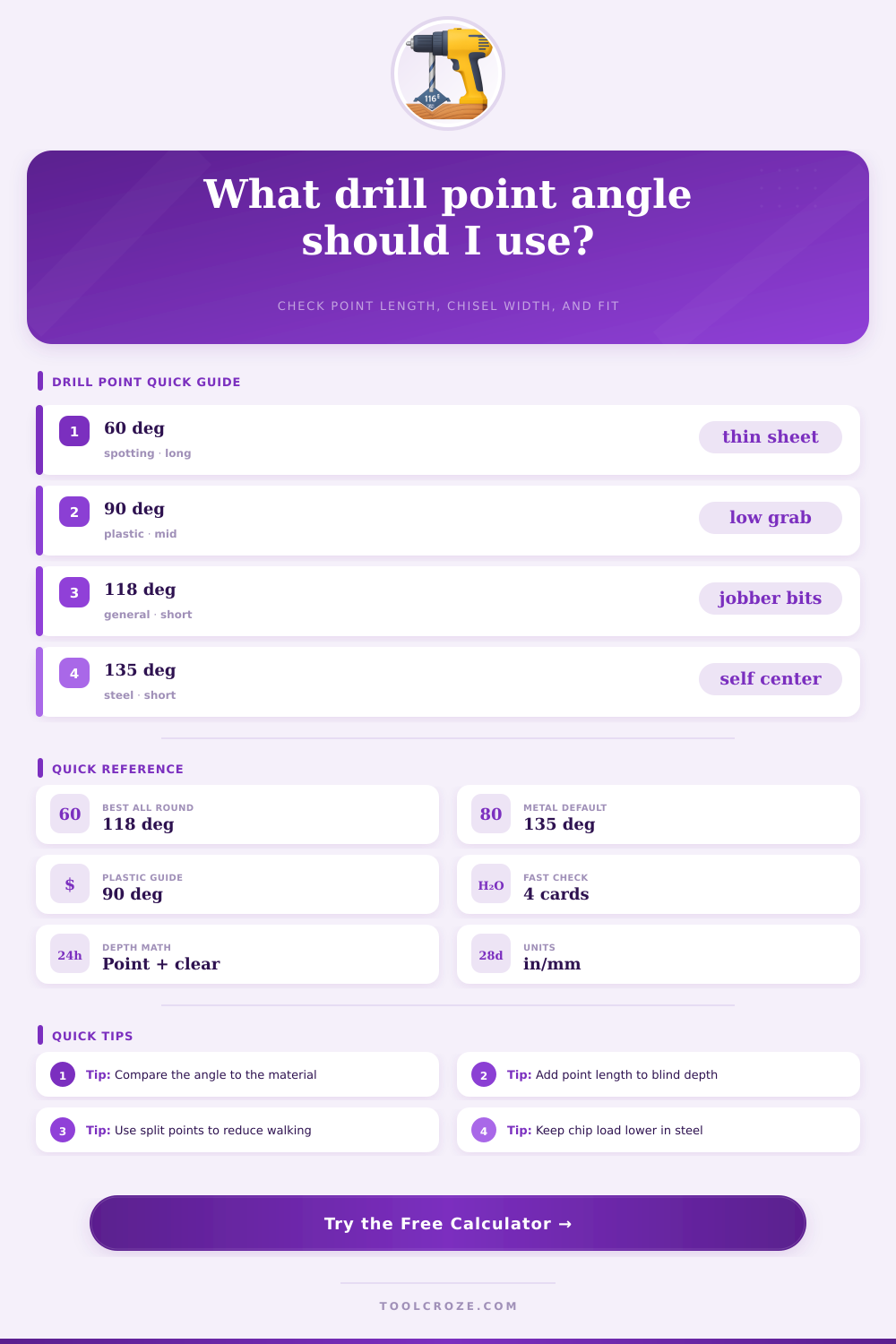
Drill bit angles is a critical component in determining how the drill bit will engage with the material. The two cutting lips of the drill bit that meet at the center of the drill bit create the angle at the tip of the drill bit. Drill bits with a steeper angle, such as 135 degrees, will create a blunt nose on the drill bit that is useful for drilling into tough metal like steel.
Drill bits with a shallower angle, such as 90 degrees, will have a longer point on the drill bit that is useful for drilling into soft plastics as it wont pull the drill bit sideways and crack the plastic. Many individual use 118-degree angle drill bits as the most common drill bits as the angle is adequate for most applications. However, the angle of the drill bit must match the material being drilled into; otherwise, the drill bit may burn the material.
Choose the Right Drill Bit Angle
The point length of a drill bit is the distance from the center chisel of the drill bit to where the drill bit begins to cut in its full diameter. You should understand the point length as it will affect the depth of the drill bits hole. If drilling into a blind hole, you must add the point length of the drill bit to the depth of the material that will be drilled into.
Otherwise, the depth of the blind hole may be shallower than intended. If the point length is ignored when drilling, the conical shape of the blind hole is created. Additionally, the web ratio of the drill bit is the width of the chisel of the drill bit, which is typically between 10 and 14 percent of the diameter of the drill bit.
The web should be thick enough to provide stability to the drill bit while drilling into the material. However, the cutting lips have to remain sharp enough to effectively cut the material being drilled. Different materials has different recommended drill bit angles.
For example, soft woods like pine are easy to drill into, so people typically use 118-degree drill bits. For stainless steel, the material is much harder so a 135-degree drill bit or a split point drill bit is recommended. Plastics require drill bits with a shallower angle so the drill bit does not delaminate the layers of the plastic.
Additionally, when drilling into wood, the exit point of the drill bit should be considered as the wood may splinter on the back face of the material. Drill bits come in many different style for various applications. For instance, people use split point drill bits for removing hardened steel due to the split point that reduces the chisels prying force on the material.
Brad point drill bits are used for drilling into wood as they score a clean perimeter of the wood piece. Carbide tip drill bits are used for drills that generate high heat as they maintain their cutting geometry. However, you must use the correct web for the carbide tip drill bit as the brittle edge of the carbide drill bit could chip.
The grind of the drill bit will change according to the style of the drill bit. To avoid common mistake when drilling with drill bits of different sizes and for different materials, certain procedures can be followed. For instance, metal drills should use a pecking motion to effectively clear chips that are created during drilling.
Additionally, drilling metal at too high of a speed will create too much heat that will soften the drill bits edges. Plastic should not use drill bits with a high rake angle as the plastic may shatter. When drilling into wood, placing tape on the exit face of the wood will prevent the wood from splintering.
Tables of the different angle of drill bits and their uses for different materials can be referenced to select the best drill bit for a specific task. For instance, people use drill bits with a 60-degree angle for spotting thin sheets of metal. Drill bits with a 90-degree angle are used for starting holes in plastic with a drill bit.
For metal applications, a 135-degree drill bit is the default drill bit angle. In calculating the depth of a blind hole, it is important to account for the point length of the drill bit. Additionally, a safety margin is needed in the depth calculation as 10 to 20 percent of the depth of the material should be accounted for in case of flute packing of the drill bit or tilt of the drill bit relative to the material.
By knowing the angle of the drill bit that best matches the material being drilled into, the point length of the drill bit being used, and by adding that length to the depth of the desired hole, the result of drilling will create an accurate hole in the material being drilled into. Its actualy a lot of work to get it right, but you should of checked the angle first.