Cabinet Door Overlay Calculator
Size cabinet doors, set overlay, and check hinge load for face-frame or frameless cabinets with a clean fit and consistent reveals.
Overlay Standards
| Style | Cover | Gap | Fit |
|---|---|---|---|
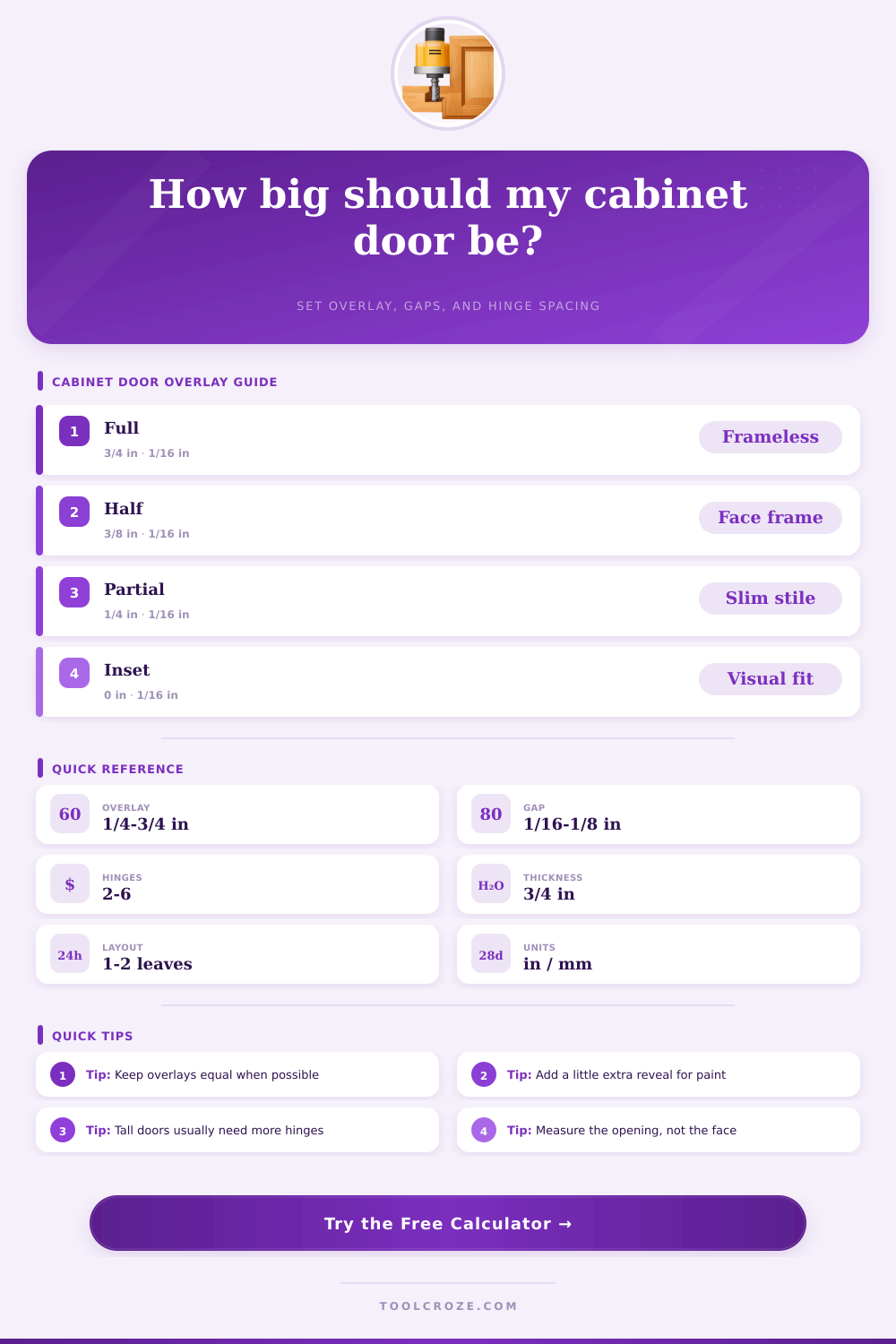
| Full | 3/4 in | 1/16 in | Frameless |
| Half | 3/8 in | 1/16 in | Face frame |
| Partial | 1/4 in | 1/16 in | Slim stile |
| Inset | 0 in | 1/16 in | Visual fit |
Hinge Setup Guide
| Hinge | Cup | Setback | Use |
|---|---|---|---|
| 110 concealed | 35 mm | 3 mm | Common |
| 165 concealed | 35 mm | 6 mm | Wide open |
| Face-frame | 35 mm | 3 mm | Overlay |
| Inset 35 mm | 35 mm | 2 mm | Inset ref |
Common Opening Examples
| Opening | Layout | Overlay | Note |
|---|---|---|---|
| 24 x 30 | Single | 3/4 in | Base door |
| 30 x 30 | Pair | 3/4 in | Upper run |
| 18 x 84 | Pair | 3/4 in | Pantry |
| 36 x 12 | Drawer | 1/2 in | Shallow front |
Material Quick Guide
| Material | Density | Edge | Use |
|---|---|---|---|
| Maple | 44 pcf | High | Paint or stain |
| Birch ply | 34 pcf | Good | Clean panels |
| MDF | 48 pcf | Fair | Painted doors |
| Thermofoil | 30 pcf | Good | Slab fronts |
This cabinet door overlay calculator sizes door leaves, sets gaps, and estimates hinge count so face-frame and frameless cabinets land with clean, consistent reveals.
Calculating the dimension for cabinet doors require taking several factor into consideration, including the measurement of the cabinet opening, the overlay style that are chosen for the door, and the inclusion of buffer for clearance. To calculate the dimension for cabinet doors, you must first measure the width and the height of the cabinet opening. After measuring the cabinet opening, you must choose an overlay style for the cabinet doors.
The overlay style will determine the amount of the cabinet box that the cabinet door will cover. There is several different overlay style for cabinet doors that an individual who are building their cabinets can choose. A full overlay door covers the majority of the front of the cabinet box and is often used for frameless cabinets.
How to Measure Cabinet Doors
A half overlay door covers approximately three eighths of an inch of the cabinet frame and is often used for face-frame cabinets. A partial overlay cabinet door leave the remainder of the frame exposed, and an inset door is one in which the cabinet door is flush with the opening within the cabinet. Each of these different overlay style changes the math for calculate the dimensions of the cabinet doors.
For example, you must calculate the width of the cabinet door as the left overlay width plus the width of the cabinet opening plus the right overlay width. However, this calculated number must be further reduced by a buffer for clearance between the cabinet door and the cabinet frame. The layout of the cabinet doors can also impact the math that are used to calculate their dimensions.
For example, single door can be used for single cabinet openings, but a pair of door may be used for wider cabinet openings. For applications of a pair of doors, the width of the opening are divided by two and the width of each door is calculated. However, a gap must be allowed between the two door that are opening towards each other.
A gap of one eighth of an inch is most common for this application, as this size door gap allow for the cabinet doors to open to they’re full extent. Finally, tall cabinet door may use a set of stacked doors. For these type of cabinets, the height of the opening within the cabinet are divided by two to create the height of each of the two cabinet doors.
The material used for the doors will impact the weight of the door. The weight of the doors will impact how many hinge are required to support the doors. For instance, birch plywood is a lighter material than medium density fiberboard (MDF).
The heavier the doors, the more hinge will be required to prevent the doors from sagging. A 30-inch door may only require three hinges but an 84-inch door can require five hinges to evenly support the weight of the 84-inch door. Hinges are an essential component of the doors.
Concealed European hinges use 35 millimeter cups to attach the doors to the cabinet. These hinges allow the doors to open to specific angle. The hinges must even be placed on the door.
The hinges have to be placed at fixed setback from the top and the bottom of the door. If there are not enough hinges to support the door, the weight of the door will cause the door to droop over time. The thickness of the finish for the doors should also be considered.
The application of paint and finishes can add to the thickness of the door. This additional thickness can cause the door to rub against the cabinet frame. Therefore, a safety margin should be incorporate into the measurements to account for the thickness of the paint applied to the doors.
Finally, the dimension of the cabinet opening should be measured. Cabinets can warp so the opening is not a perfect square. If the opening in the cabinet frame is not square, the door will not sit correct into the opening.
Lastly, the measurements should of been tested using scrap material prior to cutting the doors. By testing the measurements using scrap material, it is possible to ensure that the overlay, the clearance, and the hinges will be correctly place on the doors. If the scrap material comes out correctly, the cutting of the doors can begin.
By testing the measurements with scrap material, the individual ensure that there will be no mistake when cutting the door.