🔧 Pocket Hole Calculator | Screw Length and Layout Guide
Set screw length, bite depth, and hole spacing for pocket-hole joints
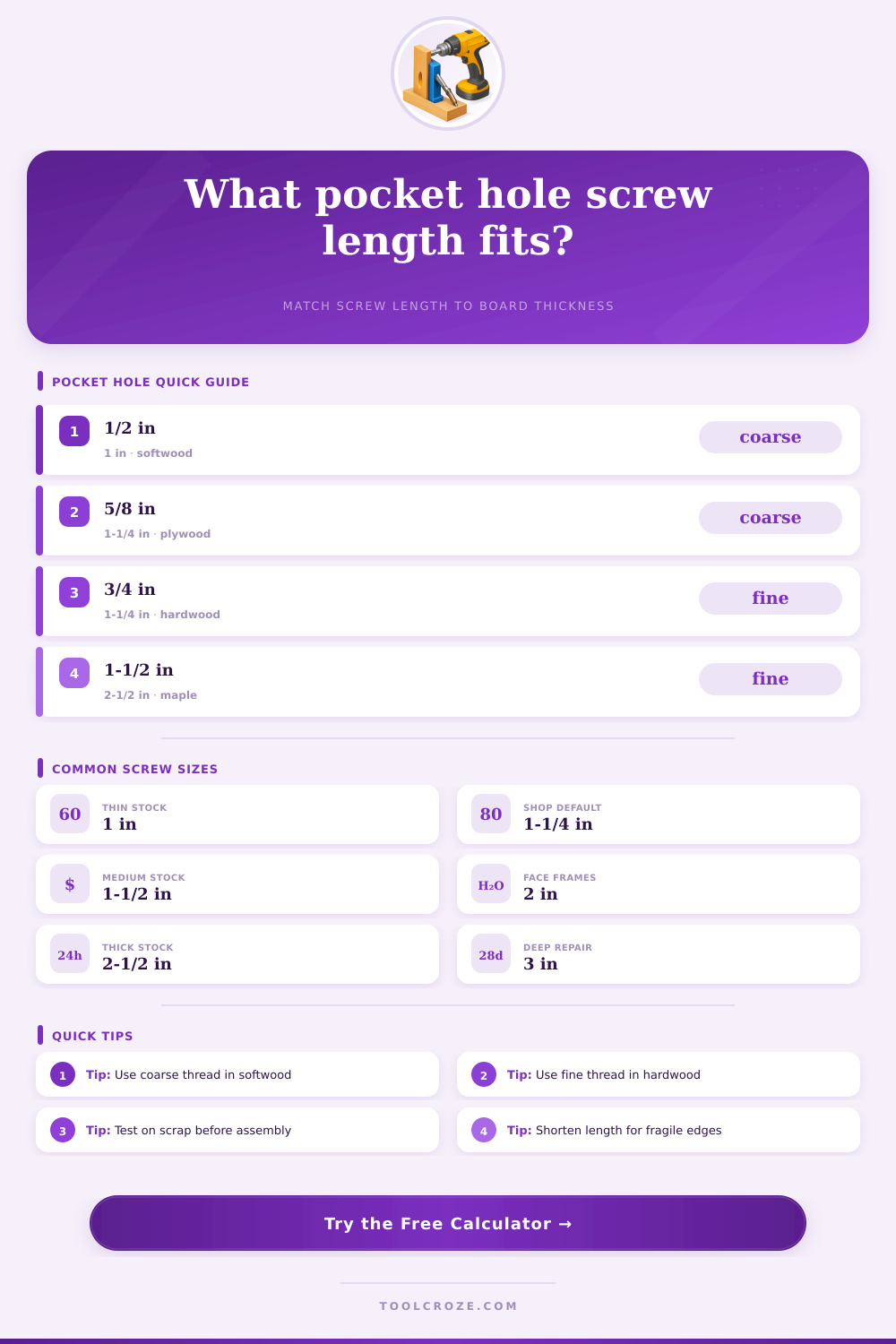
| Stock | Length | Thread | Note |
|---|
| Material | Density | Thread | Use |
|---|
| Screw | Stock | Bite | Best fit |
|---|
| Project | Stock | Length | Thread |
|---|
When cutting pocket holes for face frames on kitchen cabinet doors, you must choose the right length for a screws. If the screws is too long, they will go through the other side of the wood and ruin teh look of the cabinet door. On the other hand, if the screws is too short, the face frame will not be as sturdily as it should of been.
Pocket hole screws can make kitchen cabinet face frames both fast and strong, but you must get the size of the screws just right. The length of the screw will depend on an angle at which you drill the pocket hole and the thickness of the wood being used. If you drill at the standard 15 degree angle, the screw will travel a longer distance than the thickness of the wood.
Pick the Right Pocket Hole Screw Length for Cabinet Face Frames
Since the screw travels at an angle into the wood, it must have some extra length beyond the thickness of the board. At a minimum, it must penetrate at least a quarter of the thickness of the board it will join to ensure the joints strength. The type of wood that you are using will also have an impact on the type of screw that should be used.
For example, soft woods tend to react differently to screws than hardwoods. Softwoods like pine are much easier to drive screws into as compared to hardwoods like oak or maple that can split if the screw isnt the correct screw for the hardwood. Different types of wood require different types of screws.
Screws with coarse threads grip the fibers of soft woods and plywood well. Hardwoods have a tendency to split if you use screws with coarse threads, so screws with fine threads are better suited for hardwoods to avoid splitting the wood fibers. This is also true for plywood.
Since plywood has a layered structure, the screw should not be too long into the plywood board because delamination can occur. Delamination is when the layers of the plywood separate from each other, usualy because the screw went too far into the plywood when attaching the face frame. To determine the proper length of the screw for your project, you can use a calculator or reference grid.
The grid has the thickness of the wood to the appropriate screw length and thread. For instance, 5/8-inch MDF shelves require 1-1/4 inch coarse screws. At the same time, 1-1/2 inch maple rails require 2-1/2 inch fine screws.
Additionally, the angle of the screw hole impacts the length of the screw that you need. If the angle of the screw is larger, the screw has to travel a longer path into the receiving board. For instance, if you increase the angle of the screw to 20 degrees, the path of the screw has to be longer to properly attach the two pieces of wood.
Another thing to consider when driving screws into your project is the placement of the pocket holes. The pocket holes should be placed between 6 and 8 inch apart on long boards to keep them from sagging. Additionally, the distance from the end of the board should be at least 1 inch to avoid splitting the wood.
If the wood is made of particleboard, it is another story altogether. Particleboard splits easy when drilling into it, so the pocket holes should be even further from the end of the board. Finally, clamp the boards together when driving the screws to keep them in place while you are driving the screws into the project.
Lastly, always test the length of the screw on scrap wood. Drill a pocket hole into the scrap wood and insert the screw. The screw should dimple the wood but not break through the surface.
If the screw breaks through the surface, it is too long for the thickness of the wood. By following these suggestions, youll have strong flush pocket hole joint.