🌲 Wood Density Calculator | Board Weight Guide
Estimate density, weight, and moisture-adjusted mass for boards, panels, slabs, and logs.
📌Preset wood jobs
⚙️Calculator inputs
📊Results
🧰Species density grid
📋Density reference tables
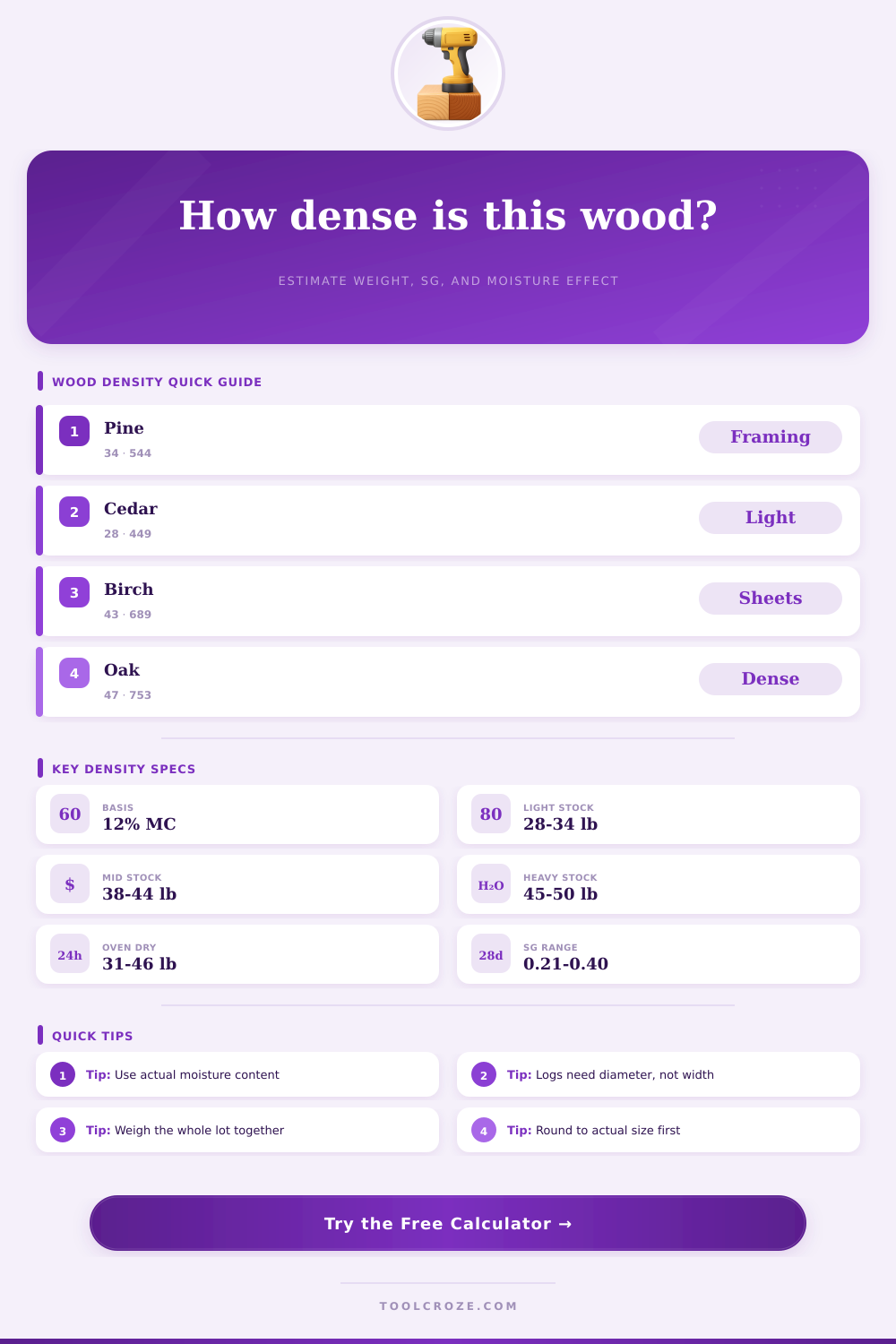
| Species | Density | SG | Use |
|---|
| MC | Factor | Weight shift | Use |
|---|
| Stock | Actual size | Volume | Note |
|---|
| Load | Weight | Lift aid | Note |
|---|
💡Practical tips
Wood densities is a measurement of the amount of mass within a specific volume of wood. Furthermore, wood density is a critical factor to consider when you are moving, stacking, or machining wood. The density of the wood can vary depending on the species of the wood and the amount of moistures that is present within the wood.
You must understand the density of the wood to calculate the weight that the individuals involved will have to move, as well as the weight that the transport vehicle can carry. The specific species of the wood will determine the density of the wood sample that is being measured. For instance, pine is an species of wood that will have a low density, while oak is a species of wood that will have a high density.
Wood Density and How It Affects Weight
Because oak is a heavy wood, one person may struggle to move it alone. In contrast, cedar is a light wood; if an individual overestimates the weight of cedar, they may struggle and think that it is lighter than it are. Knowing the species of the wood is necessary to determine it’s weight.
The moisture content of the wood will change the density of the wood sample. Green wood will have a high amount of water content, and this water content will increase the density of the wood. If the green wood is allowed to dry, the moisture and water will leave the wood, and the density of the wood will decrease.
Knowing the dimensions of the wood is also critical in calculating its weight. The dimensions of the wood will determine the volume of the wood, and the volume will determine the weight of the wood sample. If an individual simply reads the dimensions from the label of the lumber instead of measuring the lumber itself, the weight calculation wont be accurate.
In order to find the weight of the wood sample, the volume of the sample will need to be calculated along with the density of the wood. One can find the weight of a wood sample by weighing a sample of that type of wood. From that weight, the dimensions of the sample can be used to calculate the density of the wood.
If the calculated density of the wood is higher than the expected density, the wood will contain more moisture than is expected. By understanding the density of wood, individuals can make critical decision about the process and treatment of the wood in a kiln. Depending on the species of the wood, the weight of that type of wood will differ.
For instance, cedar will contain low densities in the weight of the wood. Because of this, cedar is an easy wood to use for decking. Birch will have medium densities of wood; it is an even even wood that is often used in plywood.
Walnut will have medium weights of wood, which is heavy enough for useful application of wood but will not be as heavy then oak. Pressure treated pine is high in weight because of the chemical that are added to the pine during the pressure treatment of the pine wood. Wood comes in many different species with different weight characteristic.
The lighter species of wood will allow for the wood to bend easy. In contrast, heavy species will require more strength from those moving the wood. During the calculation of the weight of wood, there are some common mistake that can be made.
One mistake that can happen is using the dimensions of the end of a rough sawn slab of wood instead of the middle of the slab, as the ends of rough sawn lumber may taper. Another mistake that can be made is failing to count every piece of wood in a bundle. If the count of the pieces is incorrect, the calculation of the total weight will be incorrect.
Additionally, another mistake that can be made is failing to account for the amount of moisture that is trapped in the pressure treated wood. An understanding of wood density allows individuals to make better decisions in the workshop in which the wood will be processed. For instance, when loading a trailer, it will be critical to understand if the weight of the wood will be too heavy for the trailer.
In the situation of using a kiln to dry the wood, it will be necessary to understand how much moisture is in the wood. Another example of the benefit of knowing the weight of the wood is when shipping the pallet of wood; knowing the weight allows for the company to understand how much the shipment will weigh. By measuring the dimensions and weighing the wood that is to be processed, the individuals in the workshop wouldnt have to guess as to the density of that type of wood.