🔧 Boring Bar Speeds and Feeds Calculator | Lathe Guide
Set RPM, feed per rev, and overhang for internal turning, deep bores, and finish passes with chatter-aware setup guidance.
📌 Presets
📊 Calculator
🧰 Material Spec Grid
📋 Speed and Feed Reference
| Material | SFM | Feed | Note |
|---|
🔧 Bar Selection Guide
| Bar | Max aspect | Use | Note |
|---|
📐 Common Bore Jobs
| Job | Bore | Bar | Setting |
|---|
💡 Practical Tips
⚠️ Safety Note
When using a boring bar to enlarge a pilot hole in a piece of steel, the relationship between the speed of the lathe and the stability of the boring bar is critical. If the speed are too high, the boring bar may begin to vibrate or even snap. If the speed is too low, the boring of the hole will take too long and the metal chips extracted from the workpiece will be of a poor quality.
The boring bar may experience vibration due to the length of the boring bar that extend from the tool holder. The length of the boring bar that extends from the tool holder is referred to as the overhang of the boring bar. The overhang of the boring bar determine the number of inches that the boring bar will deflect during the boring operation.
Using a Boring Bar: Speed, Feed and Vibration
Boring bar manufacturers calculates the aspect ratio to ensure the boring bar will not deflect too much during the boring operation. Dividing the length of the overhang of the boring bar by the diameter of the boring bar calculates the aspect ratio. A thick boring bar will experience less deflection during the boring operation then a thin boring bar of the same length.
Another factor to consider when setting the boring bar settings is the material that you are cutting. For instance, aluminum is a soft metal that allow for high surface feet per minute (sfpm) settings for the boring bars RPM. For metals like titanium, however, you must lower the sfpm because the metal is harder than aluminum.
Similarly, softer metals allow for higher feed rates than hard metals. For instance, 0.006 inches per revolution may be used for softer metals, but 0.001 inches per revolution may be used for hardened steel. High feed rates is used for roughing operations to remove metal quick.
Light feed rates are used for finishing operations so that the wall of the bored hole has a smooth surface. If the radial depth of cut is too great with respect to the feed rate of the boring bar, the nose radius of the boring bar will rub against the metal instead of cutting it. Chatter is vibration that can occur in the boring operation.
Chatter can cause waves to form on the walls of the bored hole. In extreme cases, chatter can damage the boring bar and the workpiece. Damped boring bars contain heavy materials, like tungsten, to absorb vibration.
Damped boring bars can have a longer overhang than standard steel boring bars. Standard steel boring bars are more rigid if the overhang is short. In boring bar calculators, preset settings allow an operator to determine the correct boring bar and overhang for the workpiece to minimize the risk of chatter.
The calculator will provide a verdict as to whether chatter is likely or not. Before setting the RPM of the lathe, you must consider the sfpm for the specific diameter of the hole. A speed of 1000 RPM will result in a different sfpm for a 0.5-inch diameter hole than for a 2-inch diameter hole.
In order to avoid cutting the metal too fast or too slow, calculate the sfpm that the metal will reach at the RPM that you plan to use. The radius of the tools cutting point will affect the finish of the bored hole. The nose radius will dictate the maximum feed rate for the boring bar.
If the feed rate and the nose radius is set correctly, the bored hole will have smooth walls. If the feed rate and the nose radius are not set to the proper value, there will be rubbing or ridges on the bored wall. Common mistakes when using a boring bar include using a boring bar that is too small for the size of the hole.
Small boring bars will chatter more than large boring bars. Another mistake is ignoring the entry of the boring bar into the workpiece. You must feed the boring bar slowly into the workpiece to allow the forces of the boring bar to stabilize.
Finally, people often fail to consider the type of hole that they are boring. If the hole is a blind hole, the boring bar will not have the same support as if it were boring a through hole. If the hole is filled with cast iron metal particle, the boring bar may need to be pecked and you may need to introduce coolant to remove the particles from the bored area.
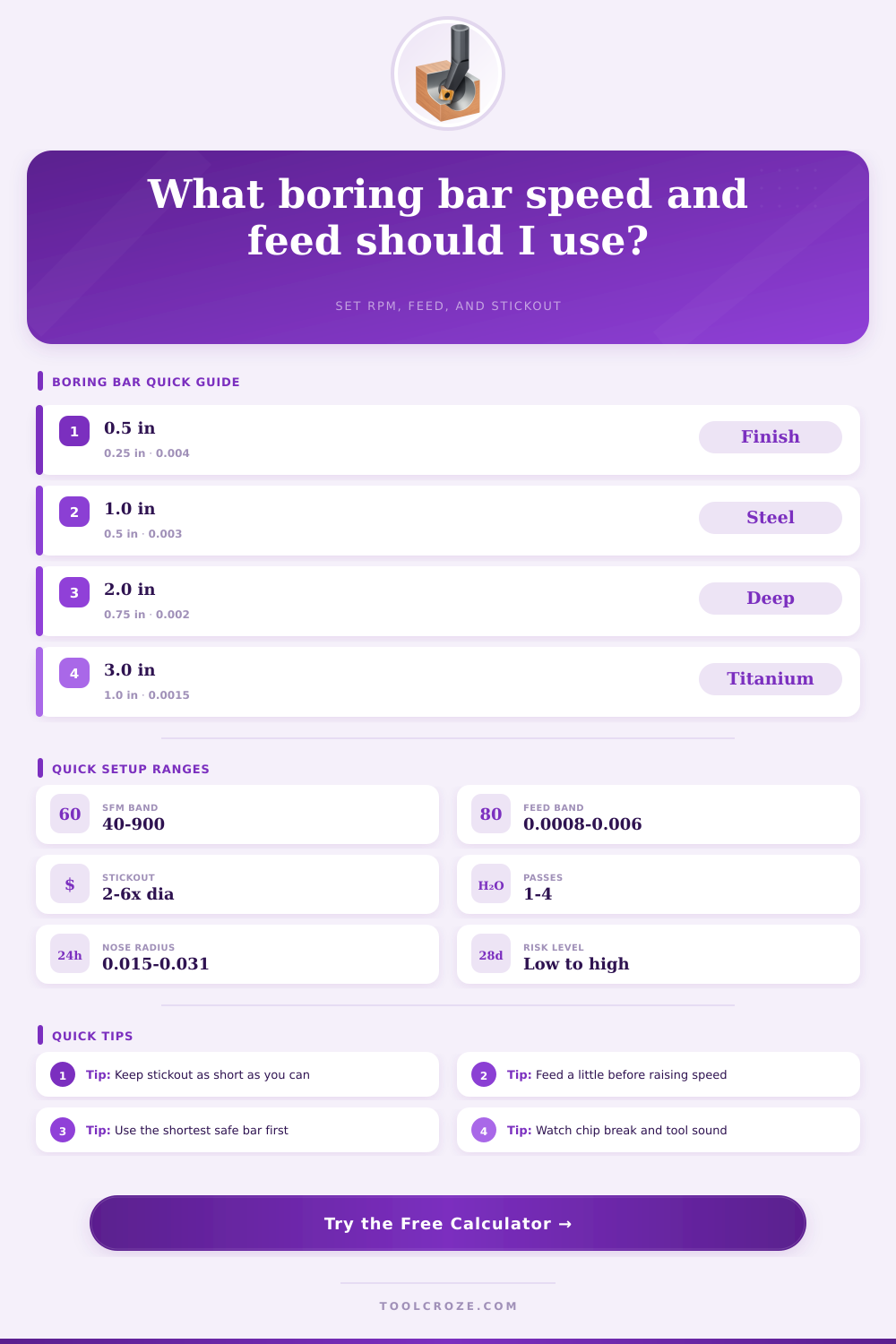
Regardless of what type of workpiece is being bored, there are certain steps and considerations that will ensure a succesful boring operation with a boring bar. Always use the shortest boring bar that will reach the depth of the required hole. Short boring bars are more rigid than long boring bars.
If you must use a long boring bar, use a damped boring bar. Increase the feed rate before the RPM of the boring bar. Increasing the feed rate will help to break the chips that the boring operation removes and will help to dampen the vibrations of the boring bar.
Finally, listen to the sound that the boring bar makes. The sound will change if the boring bar starts to vibrate. You should of checked teh sound more often to avoid damage.
Its important to recieve the right results when working with moddern steel.