
Sockets are precision tools that has specific design features for performing specific tasks. Using the correct size socket for the fastener is necessary to avoid damaging the fastener. If a mechanic use the wrong size socket, the socket may slip from the fastener.
Using a socket that slip from a fastener may round the edges of the bolt head. When the bolt head is rounded, it may become difficultly to remove the bolt, and in some cases, it may require specialized tools to remove the bolt. The square drive portion of a socket connect to a ratchet or breaker bar.
Choosing the Right Socket
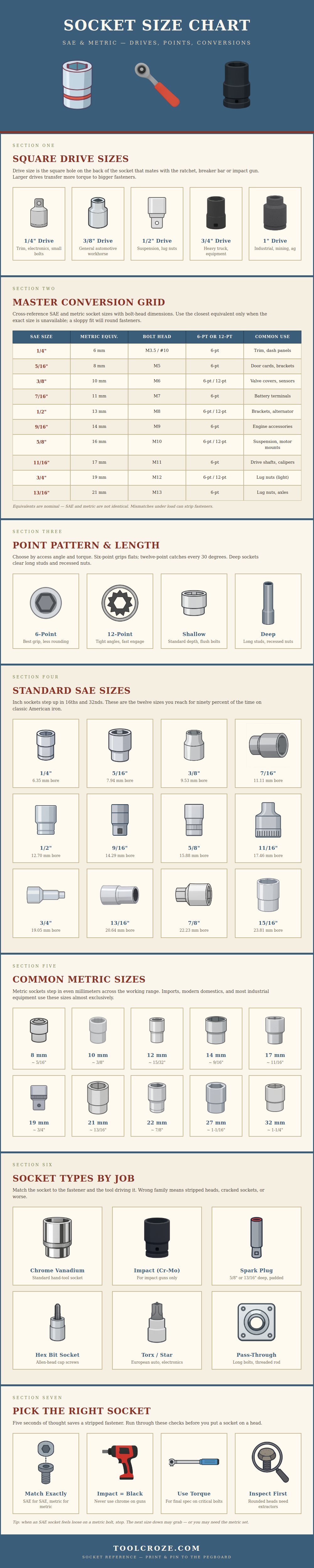
The size of the square portion of the socket determine the amount of torque that can be placed onto a fastener. Quarter-inch drives are small square drives that are used for precision work on delicate components. Three-eighths-inch drives are medium sized square drives that are used for most automotive repair jobs.
Half-inch drives are large square drives that are used for heavy automotive components. Three-quarter-inch and one-inch square drives are very large drives that is used for industrial components and heavy trucks. Using a square drive that is too small for the task limit the amount of leverage that can be applied to the bolt.
Additionally, using a square drive that is too large for the task may make the tool too bulky for the work area. Another design feature of a socket is the opening of the socket and the size of the opening. The opening of the socket must be the appropriate size for the bolt being use.
Additionally, the size of the bolt can be measured in SAE or metric measurements. SAE measurements is used primarily on older American cars. Metric measurements are used on most moddern cars and import cars.
Because SAE and metric measurements are not the same, a metric bolt will not securely fit into an SAE socket. If a mechanic forces an SAE socket into a metric bolt, the socket may chew the edges of the bolt head, damaging the bolt. Six-point sockets has six sides that engage the flat surfaces of the bolt head.
Twelve-point sockets have twelve points of contact with the bolt head. Six-point sockets are better for heavy tasks because they are less likely to slip from the bolt head. Shallow sockets are short sockets that allow tools to remain away from potential obstructions.
Deep sockets are long sockets that allow tools to reach bolts that is located in recessed areas of a car. Shallow and deep sockets may both be necessary in a set of sockets. The material used to make a socket determine what other tools can be used with that socket.
Chrome vanadium sockets are well-polished and used with hand tools. However, chrome vanadium sockets is brittle and can shatter if used with an impact gun. Impact sockets are made of black phosphate or chrome-moly materials.
Impact sockets are thick-walled to allow the socket to take the impact of an air tool. Chrome vanadium sockets should never be used with an impact gun; they can shatter like glass. When buying a set of sockets, it is important to ensure that there are different size and different types of sockets in the set.
A half-inch drive is the most common size. A half-inch drive kit that include six-point shallow and deep sockets will perform most automotive tasks. Additionally, quarter-inch drives is needed for interior components.
Three-eighths-inch drives are used for precision tasks. Most newer cars use metric measurements, so ensure that the set contain metric sizes. Finally, store the set in an organized manner to quickly find the size needed for a specific task.
Having sockets organized will improve the efficiency in which a mechanic can complete tasks.
