
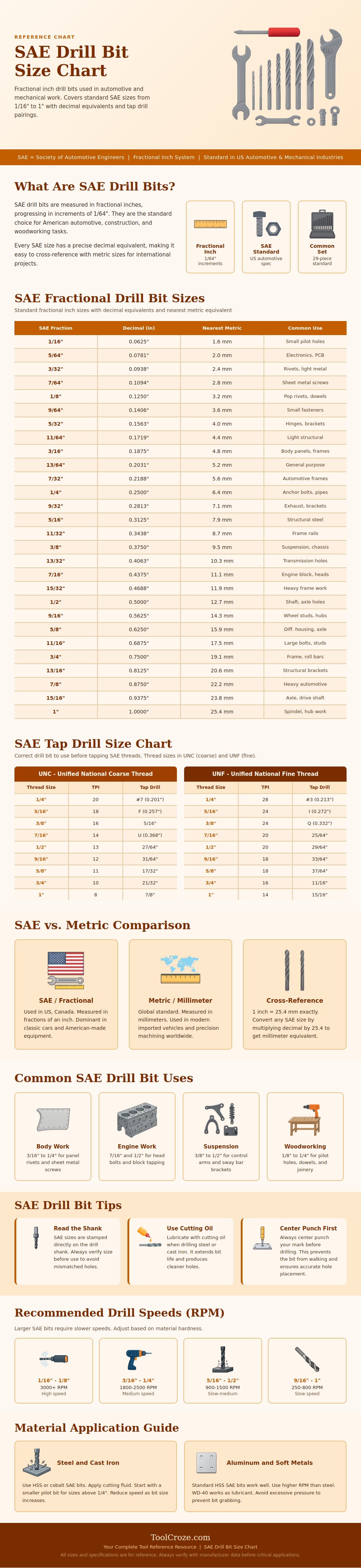
The twist drill bit was invented by Steven Morse in 1861. SAE tap drill charts help as reference during work with machine tools, screw threads or CNC operations. It delivers tap sizes together with advised drill diameters.
Also thread details and decimal inch equals appear here in easily read form. Each that does such work necessarily need it.
Drill Bit and Tap Size Charts
Drill bit size charts list standard sizes according to several systems. Between them are fractional, metric, wire gauge number and letter sizes. The charts point decimal equals of diameters, in inches and in millimeters.
Fractional sizes measure in inches, metric in millimeters. Such chart can add decimal inches for fractional, wire, letter and metric drill bits until 2 inches of diameter.
For tap the size points hole diameter and threads for inch. For instance, 1/4-20 wants to say hole of 1/4 inch with 20 threads each inch. Every material combo and thread type require its drill size.
In United States ANSI-SAE fasteners have several specifications for 1/4 inch, for instance 1/4-20 UNC coarse and 1/4-28 UNF fine. For 7/16-14 tap use “U” bit. At 1/4-28 tap answers #3 bit.
For M10-1.5 it is possible “Q” bit, but chart commonly advises 8.5mm. “Q” bit is 0.3320 inch.
Sizes have separate differences. T bit is little more small than 23/64. S size ends 4 thou above 11/32.
Some bits only a bit surpass 1/8 inch. Little bits easily break, especially if drilling is done by hand. Well order several.
Step drill do not answer for precise drill bit. Cheap step drills have metric sizes although marked SAE. You can find tables for imperial SAE and metric tap drill bit sizes.
The twisit drill bit was invented by Steven Morse in 1861. SAE tap drill charts help as reference during work with machine tools, screw threads or CNC operations. It delivers tap sizes together with advised drill diameters.
Also thread details and decimal inch equals appear here in easily read form. Each that does such work necessarily need it.
Drill bit size charts list standard sizes according to several systems. Between them are fractional, metric, wire gauge number and letter sizes. The charts point decimal equals of diameters, in inches and in millimeters.
Fractional sizes measure in inches, metric in millimeters. Such chart can add decimal inches for fractional, wire, letter and metric drill bits until 2 inches of diameter.
For tap the size points hole diameter and threads for inch. For instance, 1/4-20 wants to say hole of 1/4 inch with 20 threads each inch. Every material combo and thread type require its drill size.
In United States ANSI-SAE fasteners have several specifications for 1/4 inch, for instance 1/4-20 UNC coarse and 1/4-28 UNF fine. For 7/16-14 tap use “U” bit. At 1/4-28 tap answers #3 bit.
For M10-1.5 it is possibel “Q” bit, but chart commonly advises 8.5mm. “Q” bit is 0.3320 inch.
Sizes have separate differences. T bit is little more small than 23/64. S size ends 4 thou above 11/32.
Some bits only a bit surpass 1/8 inch. Little bits easily break, especialy if drilling is done by hand. Well order several.
Step drill do not answer for precise drill bit. Cheap step drills have metric sizes although marked SAE. You can find tables for imperial SAE and metric tap drill bit sizes.
