
Drill bits help to cut holes in various materials purely and quickly. Choose the right bit to spare time and ensure excellent result. Various bits answer for special usages, for instance for metal, for screwdriver sets either for wood.
Wrong choice can injure the material or the bit itself. For instance, for wood you commonly uses twist bits, while for metal you requires high-speed steel or cobalt utilities. For concrete you need bits with carbide peaks.
Types of Drill Bits and How to Choose Them
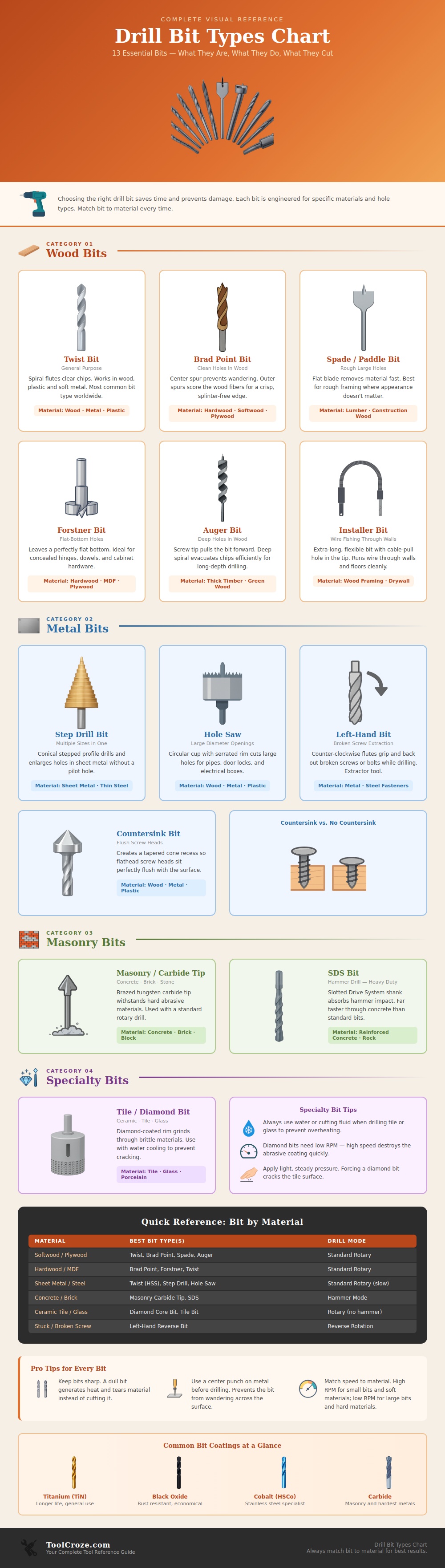
Twist drill bits are the most used species. They answer for everyday drilling in wood, metal and plastic. The name comes of the spiral grooves, called flutes, along the body.
During the bit penetrates in the material, the flutes drive the waste material upward and from the hole. Most of those bits are made up of high-speed steel (HSS). HSS bits does one from high-carbon alloy addressed heat for strengthen the hardness and the weight.
They do not suit for concrete. Cobalt drill bits like to HSS, but are stronger. They last the hardest metals.
Usually you mixes them with HSS for more heat-resistant utility. With lubricant you can keep the knives fresh while metalworking.
Other popular species are Forstner bits, that operates well in a drill press for maximum accuracy and posture. They give smooth edges and flat-bottomed holes. Brad point bits like that, creating pure flat-bottomed holes very regularly.
Spade bits, or speed bore bits, uses you chiefly for wood and imprecise work. For diameters more than 1 inch commonly you chooses a spade bit for wood and alike soft materials. Hole saw bits are round tools for big holes in one step.
They have kinds as bi-metal for steel or carbide-tipped for harder surfaces. Annular cutter bits like to hole saw bits, but intend metal instead of wood. They do precise holes without burr and leave to extract the core.
Step drill bits have cone-shaped pattern and are genuinely useful. It allows one tool to cut holes of various diameters. Everything until 1 inch it is possible with this.
You can first do a pilot hole by means of a twist bit, later expand it by means of the step bit. Step bits give perfectly smooth holes without tear out. Carbide drill bits does one from tungsten carbide.
That is dense and durable material, that bothers against wear and high temperatures. They well answer for hard stuff as ceramics, glass, concrete and strong metals as stainless steel or cast iron.
The shank enter in the drill chuck and induce the stability and compatibility. Straight shank is the most mutual and operate with standard drills have three-jaw chucks. Hex shank populars, because it twists easily in impact drivers.
Drill bit sizes measures one diversely. In United States you commonly uses fractional inch and gauge sizes. Almost everywhere otherwise metric sizes rule.
Other systems are letter sizes and wire gauge numbers.
