
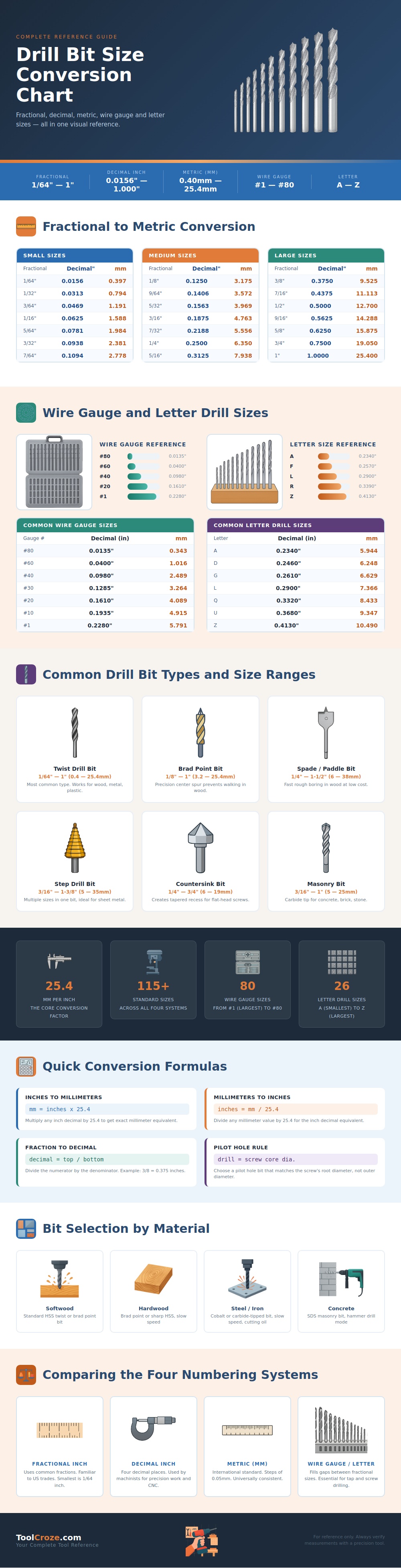
Finding the right drill bit size is important for projects. A drill bit size chart gives overviews about various measure standards, like fractional, metric, wire editions and letter indications. Like this you can easily choose the best bit for your work.
American standard drill sizes usually go of 1/16 until 1 inch, commonly with steps each 1/64 or 1/32 inch. They use the simplest fractions, for instance 2/64 simplifies to 1/32.
How to Use a Drill Bit Size Chart
For find the right diameter of pilot hole, you identify the drill bit size with screw or bolt. With tap and set of drill sizes, a tap chart helps to identify the nearest best bit. For instance, for #8-32 tap answers 9/64 drill bit.
Conversion maps simplifies course between metric and imperial units, where 25.4 mm matches one inches and 2.54 cm also one inches. Good chart shows decimal matches for fractional, wire, letter and metric sizes until 2 inches. Sometimes you uses decimal equivalent chart, that turns decimals in metric values.
Metric drill bit sizes mark himself by means of millimeters (mm), what simplifies everything, because the diameter stands directly here. One mm matches 0.03937 inches, so 6 mm is around 0.236 inches or 15/64 in the nearest. If size is not stamped on the shank, you must use caliper either micrometer for measure.
Number drill sizes go of 1 until 97, or of #80 (very little) until #1 (bigger). Letter sizes extend of A until Z with decimal match conversions and metric matches. Because of variations in numbering, some values are approximate, but stay inside 0.0001 inch.
