
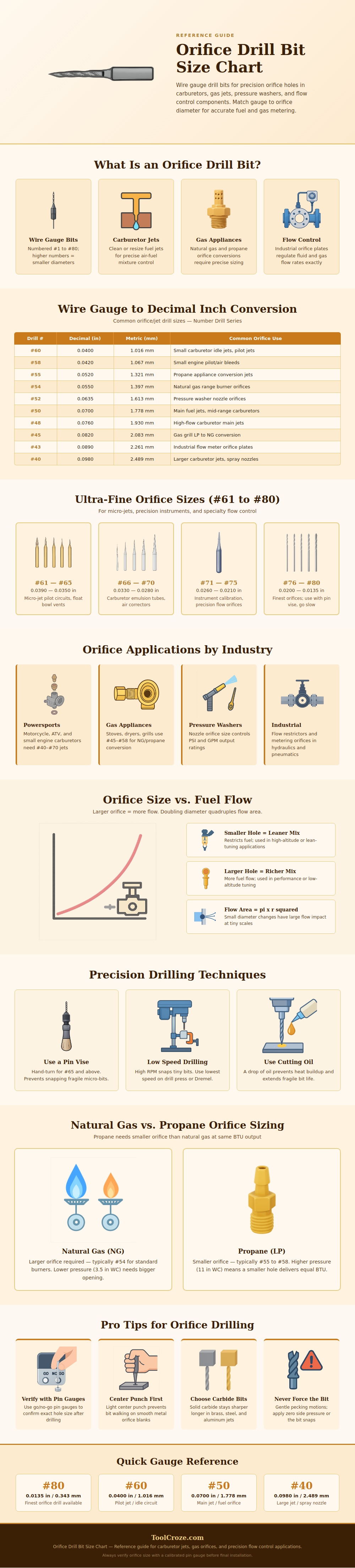
Find the right drill for the size matters for many jobs. Does not exist standard size, because it depends on the BTU. Natural gas requires bigger exit, on the other hand propane require more little.
During conversion of burner, you occasionally must expand the exit for reach same amount of propane. When the input pressure declines, the input volume necessarily grow for good flame. Many drills have brass exits, because they easily drill.
Choose the Right Drill Bit for Gas Burners
Even so bear too big hole can cause incomplete burn, with unburned natural gas messing up in the house. It can also cause burn in supply lines either others unintended places.
Chart of drill exit sizes help during conversions. That chart corresponds four different drill systems according to increasing size with their decimal inch diameters. The sizing commonly starts in 0,25 mm and expands in 0,05 mm steps.
For instance, 1,02 measure probably is in millimeters and match to 0,040 inches. Some bits have 1/4-inch hex shaft. One from them can store #60.
#68 exit matches 0,0310 inches, and you occasionally must expand it to 0,0420. #57 drill size is 0,043 inches. #48 exit size is 0,076 inches.
Working with such little holes, well are alter only one drill grade at a time and control the flame. Jump of 60 to 56 is big change for little burner. Of 53 to 52 usually do not show remarkable difference in flame characteristic, but three or four grades too big can dramatically alter it.
If 1/16-hole enter easily, the exits certainly surpass 53. For that want theoretical maximum BTU, gas exit capacity chart is usefull. Search the exit size and multiply the CFH in 1000 for natural gas or 2517 for LP.
Many factors affect the precise BTU-amount each cubic foot, as gas temperature, height and gasfonto. Ensure, that the drill hole is direct and well centered.
