Press Fit Force Calculator
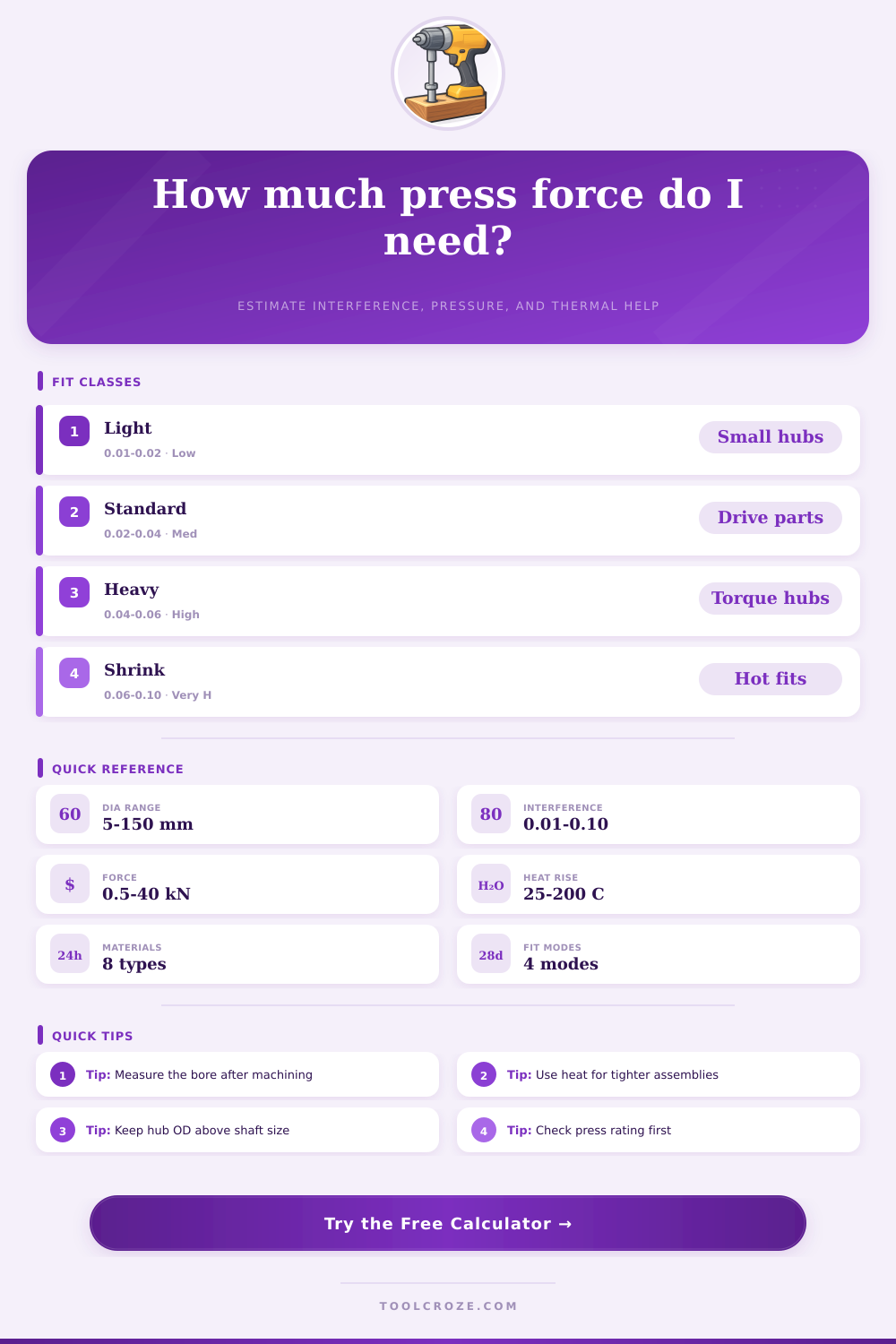
Estimate press load, interference, contact pressure, and thermal assembly clearance for shaft and hub fits.
| Check | Value | Meaning |
|---|
A press fit is kind of linkup in that two parts are pushed one against the another by means of opposition or normal pressure. In engineering one also calls it close fit interference fit or antagonistic fit. This mode tie happen between two parts that is strained.
They are pushed together for form bit that keeps the opposition. Commonly one encloses pole tightly in hole that is a bit more little. The force of the tie comes from the interference between pole and hole.
What is a Press Fit
This bulky malsameco creates motionless opposition and strong radial pressure what slosas the parts mutually and allow them bear burdens without seals or glue.
For do the process one uses force for enclose one bit in the another. Like this one creates intense antagonistic base for the connection. Occasionally pole from rigid material is tied to more flexible nave.
This happens because of dimensional interference between the exterior diameter of the pole and the internal diameter of the nave. One can add hits or splines on the pole for help. Two mainstream modes exist for reach it.
One use mechanical force where one part moves and the another stays set. The second requires heat one varmas the exteran bit or cool the internal for reduce the involved force for combination. For instance lay wing in fornilon in 350°F help during implementation.
Seriously are estimate the apt force. Maximum frota force helps to estimate the capacity of pressura pressure for turniga combination. It depends of the maximum sintruda fit so the biggest exterior diameter minus the most little internal diameter.
Various formulas help to find the finŝargon in tons. The calculation considers the contactarea between pole and trua surface the whole enprofundigon or material suspension and close factor. For instance bit from A36 steel broad 4 inches and thick 3/4 inch requires a bit more than 101 tons of force.
In production tool holders spindle connections and ĉukaj combinations depend of apt press because of ripeteblECO and accuracy. Rigid tie is usefull because it removes game that could inhibit precise maŝinadon. While enpremo of pole in internal race back the orientation of that race.
No kapu it of the exterior race while you press the internal.