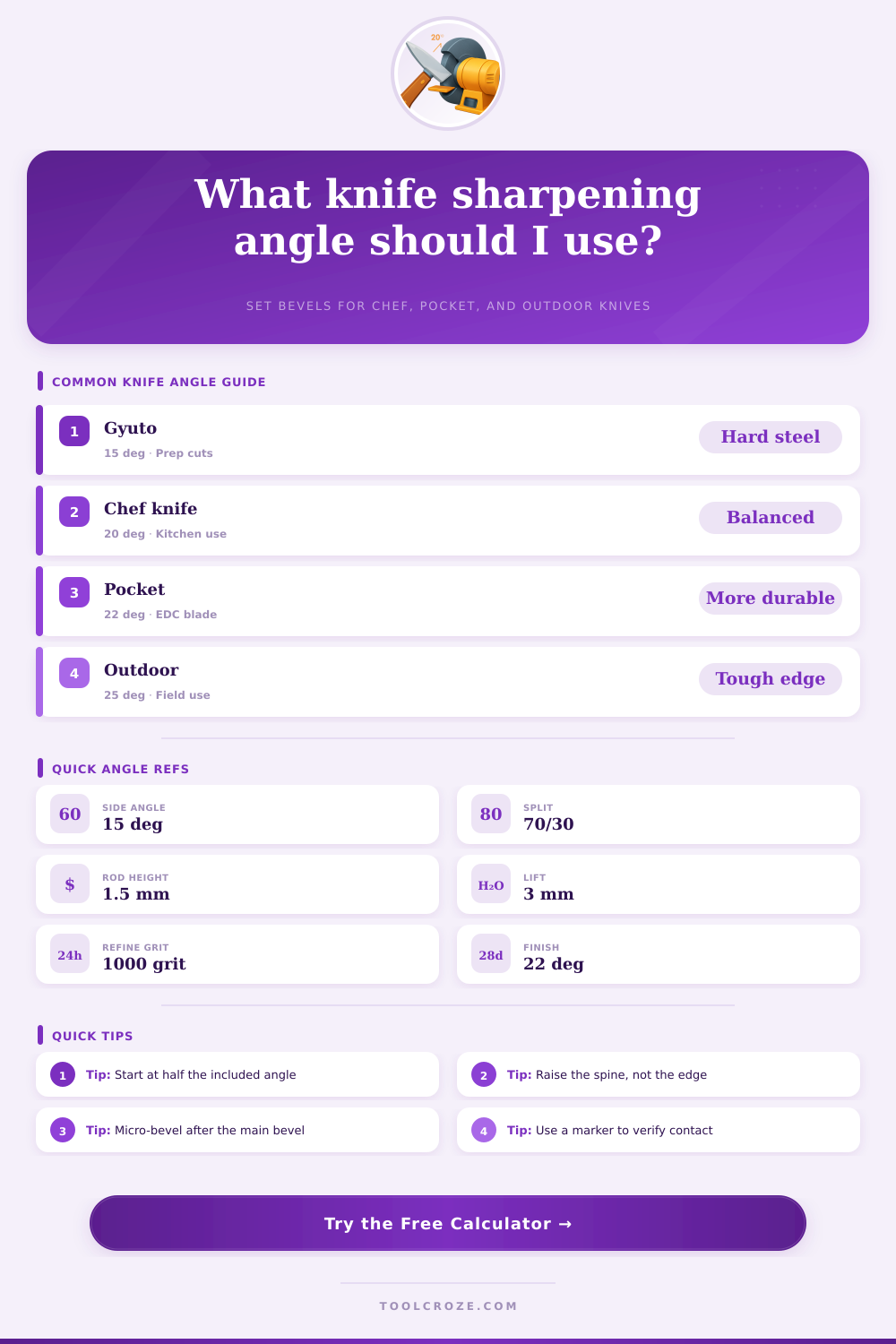
🔪 Knife Sharpening Angle Calculator
Set precise bevels for chef knives, pocket knives, and outdoor blades with guided-rod or freehand geometry.
📌 Presets
📊 Calculator
🧱 Knife and Steel Cards
📋 Angle References
| Knife Type | Per Side | Included | Use |
|---|---|---|---|
| Gyuto | 13-16° | 26-32° | Prep slicing |
| Western chef | 18-22° | 36-44° | Kitchen workhorse |
| Santoku | 14-17° | 28-34° | Clean push cuts |
| Pocket knife | 20-24° | 40-48° | Daily carry edge |
| Outdoor | 22-28° | 44-56° | Field durability |
| Bread knife | 17-20° | 34-40° | Serration touch-up |
| Cleaver | 20-25° | 40-50° | Chop and split |
| Single-bevel | 8-12° | 16-24° | True edge side |
| Steel | HRC | Angle | Grit |
|---|---|---|---|
| Soft stainless | 54-56 | 18-22° | 600-1000 |
| Kitchen stainless | 56-58 | 16-20° | 800-1000 |
| Carbon steel | 58-60 | 14-18° | 1000-3000 |
| Powder steel | 60-64 | 12-16° | 3000-6000 |
| Tool steel | 58-62 | 16-20° | 1000-3000 |
| Single bevel | 60+ | 8-12° | 3000-8000 |
| Guide Size | Rod Height | Angle | Note |
|---|---|---|---|
| 40 mm | 10.7 mm | 15° | Fine kitchen edge |
| 50 mm | 13.4 mm | 15° | Easy repeat setup |
| 60 mm | 16.1 mm | 15° | Longer blade arc |
| 70 mm | 18.8 mm | 15° | Stable rod travel |
| 80 mm | 21.4 mm | 15° | Large chef knife |
| 90 mm | 24.1 mm | 15° | Outdoor blade |
💡 Tips and Safety
The right angle depends on the hardness of the steel, the thickness of the blade and the way you use the knife. It ranges between below 10 grades and more than 30 grades. Many knives have a bevel on both sides.
If you say that you lay a 20-grade corner on knife, that wants to say 20 grades for every side. The angle match half of the corner of the sharp edge, because you sharpen on both sides. For understand that, imagine line that extends from the spine of the blade down until the edge.
How to Pick the Right Angle for Your Knife
The corner between that line and the sharpening surface is the angle.
In the sharpening of knives count some rules. Big corner gives stronger edge, but the cutting fails. Rather, little corner does the knife sharper, but the edge lasts less.
Broad corner strengthens the edge. Narrow or acute corner makes it sharper, but less rugged. The less big the corner, the less sharp the knife.
For cut hard materials answers corner between 20 and 22 grades. For soft stuff you can use even less big corner. 30-grade corner you suggest for knives with heavy use, for instance for wire, carpet or cardboard.
Different knives require different corners. Japanese knives, known because of easy tasks and extremely sharp edges, operate best with low corner, usually around 15 grades. High carbon blades, typical for Japanese knives and special steels, last corners of 15 until 17 grades.
Pocket knives usually have around 20 grades, during hunting either heavy knives use 25 until 30 grades. Kitchen knives range of under 10 grades for Japanese until more than 25 for axes. For all kitchen knives answer stable 20-grade angle, because it gives excellent base for cutting.
For one knife that cuts tomatoes and break bones, use 20 grades for every side. At slim blades bid 20 grades, while for thick edges or axes choose 25, 30 grades.
Guide for blade on corner is one from the most useful tools for newcomers. More seriously are find corner, that you can permanently keep than the precise number of grades. Lay the knife on the stone and lift it a bit upward.
The less you raise, the less big the corner. If the edge does not destroy, you can sharpen in lower corner. Also jig can help reach good edge.
By means of it you escape the little variations that happens during freehand sharpening.