
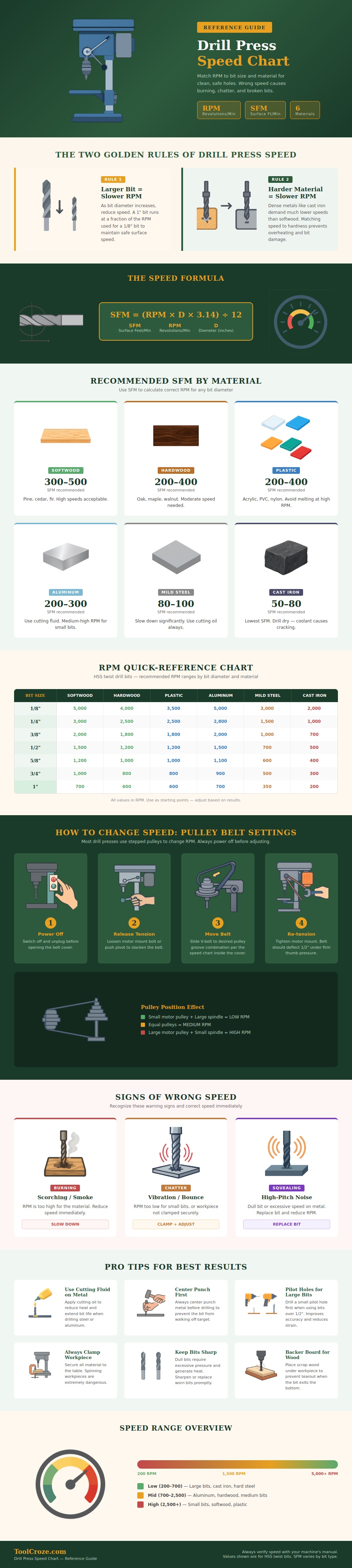
Drill press speed is measured in revolutions per minute, or RPM. Getting the speed right matters a lot. Too fast, and there is a risk of burning the drill bit and the work piece.
Too slow, and the cutting becomes inefficient, which can potentially damage the motor. The ideal speed depends on the material being drilled, the size of the drill bit, and the type of drill bit being used.
How to Set the Right Speed on a Drill Press
A typical drill press often has an RPM limit between 2000 and 3600 RPM. If a speed chart specifies a higher RPM than the machine is capable of, it should not cause a problem to run at a lower RPM. Some benchtop models can go as low as 250 RPM, which is handy for tougher jobs
Not only injured or broken fingers, but also amputated fingers have often been the result of not using the correct speed. Safety is no joke here.
Most drill presses have two three-stage sheaves, one mounted to the motor and the other to the spindle, with a belt between them. They are mounted in opposition, so when the smallest sheave is on the motor, it ataches to the largest sheave on the spindle. There is usually a screw or lever on the side of the drill press.
Loosening the screw lets the motor move forward, giving slack on the belt. With that slack, the belts can be configured on the pulleys for the desired speed. Forcing a screwdriver onto the belt can tear up the belt and pulleys.
For drilling steel, 600 RPM is often way too fast. A speed as low as 150 to 300 RPM is better for harder steels or large hole saws. When shopping for a drill press, it helps to look at the speeds offered.
Some presses are very high speed, so finding one that can go as slow as possible is important.
Wood is much more forgiving. In practice, a drill press can handle practically everything in wood at one set speed without noticeable issues. Scorching typically will not happen at the low or medium speed that most presses are left at.
The recommendation for wood and softer materials is usually high, in the 2000 to 3000 RPM range. Using the slowest speed gives the most power, and just enough feed to keep the bit cutting rather than rubbing works well for tougher spots. Soft woods can actually be more difficult to drill cleanly.
Full carbide drill bits can run an 8mm diameter at 6000 RPM in soft wood for very fast drilling and very clean holes, but that requires a fitting drill press. Speed charts with recommended RPMs for twist drill bits, Forstner bits, brad point bits, and spade bits are handy references to keep inthe shop.
