🔧 Workbench Height Calculator
Find a bench height that matches your elbow height, task type, top thickness, and standing setup.
| Task | Elbow | Offset | Top |
|---|
| Top | Thick | Feel | Use |
|---|
| Setup | Raise | Feel | Use |
|---|
| Depth | Reach | Fit | Note |
|---|
Getting the right workbench height matters a lot. There is no such thing as one size fits all when it comes to workbench height. An inch or two plus or minus can make a big difference, depending on how the bench will be used.
The standard height for workbenches and power tools in general has been set at 36 inches. It may be ok for some, but certainly not for everyone.
Find the Right Workbench Height
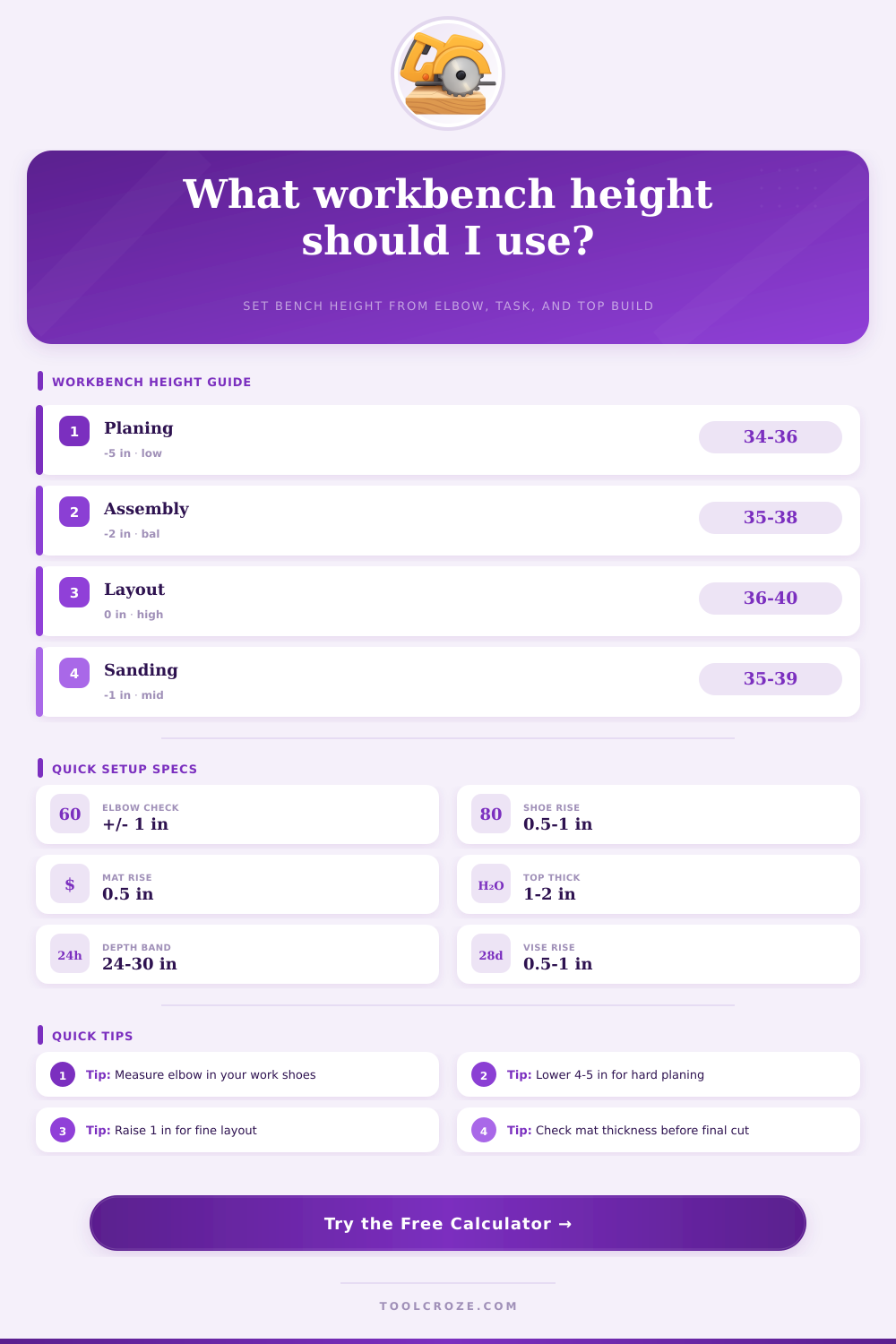
A common rule of thumb is about two inches below the elbow. Stand with arms at the side, elbows bent 90 degrees to the body, and the bench top should be about two inches below that point. Another method is to stand with arms relaxed by the side and measure from the floor to the point where the pinky finger joins the hand.
Yet another approach is to grab a chisel, bend the forearm so it is level to the floor with the chisel pointing down, and measure from the chisel tip to the floor
The vast majority of woodworkers end up with a workbench about half their height. Someone who is 5 feet 5 inches tall might use a 34-inch bench. Half the height, then add an inch or two.
A person who is 6 feet 2 inches might go with 40 or 41 inches. Guys usually fall somewhere between 34 and 42 inches for benches, depending on height and the type of work being performed.
If the workbench is for light or small work, build it just below elbow height. If it is for heavy or large work, build it three to six inches lower. A low workbench around 29 to 30 inches is good for hand work, especially hand thikness, since it lets the worker get body weight over the bench.
A tall bench around 38 to 39 inches works better for finer tasks. Tools such as a vise or a grinder obviously increase work height, which is an easy mistake to overlook.
Adjustable height workbenches are a solid option. Some can be set anywhere from 28 to 42 inches high, so the user can work comfortably whether standing or sitting. Electric adjustable height workbenches and pneumatic lift tables also exist.
One pneumatic lift table adjusts from 8 inches all the way to 66 inches and works off acompressor.
For sitting work, bench height becomes less of an issue when using an adjustable stool. A 36-inch bench works well for a miter saw, while a 34-inch bench is comfortable for general tasks. If space allows only one bench, some prefer 42 inches.
The best approach is to try different heights and adjust until it feels right. A small table with some blocks can help figure out what works before committing to a final build.