
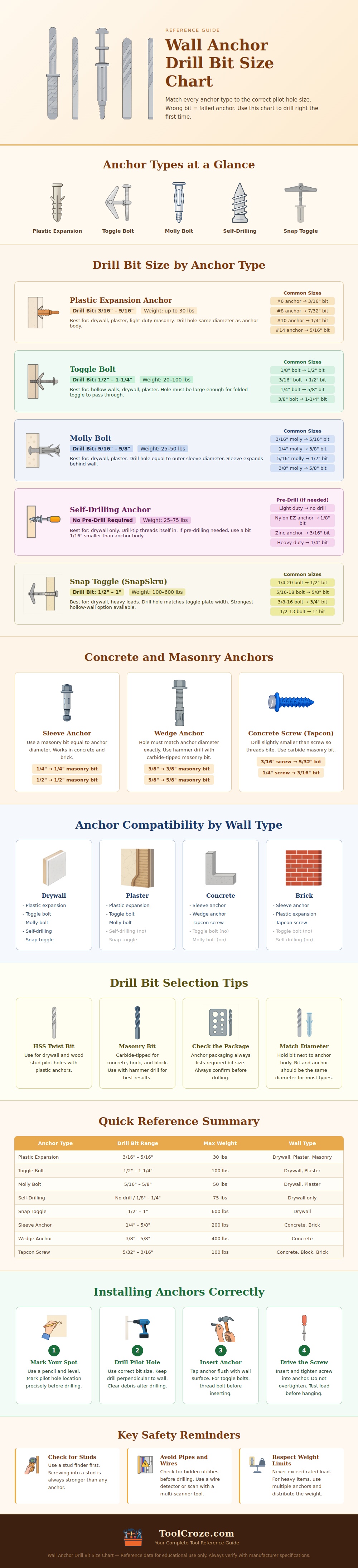
Picking the right drill bit for a wall anchor seems easy but commonly goes bad. The drill bit must match the diameter of the anchor body. The hole needs to be broad enough so that you can push the anchor in with a thumb.
Forcing it is not a good idea.
Pick the Right Drill Bit for Wall Anchors
Measure the shank of the drill against the front part of the anchor. Its diameter should be the same or 1/16 inch bigger to open the hole for the screw. When the edge of the anchor shows barely on both sides of the drill, that is the right one.
It must fit tight, but not so tight that drywall rips during the push of the anchor.
Normal 1/4 inch bit works best. The drill should be a bit broader than the anchor, but narrower than the flat head that holds everything during the screwing. Yellow plastic anchor usually requires 3/16 inch drill, while 1/4 inch anchor commonly requires 5/16 inch.
At expansion anchors the bit size must match the exterior diameter of the non-expanded part.
Different anchor types require differnet drills. For lightweight jobs use 1/4 to 3/8 inch bits. Toggle anchors for heavy tasks require bigger holes.
At drywall toggle anchors, look at the package for the right drill bit size. Some anchors self-strike with PH2 bit, and the pilot hole works with something smaller.
The same diameter rule counts for several types. Wedge, sleeved, split-fast, pin-drive and hammer-drive anchors all use a drill that matches the anchor diameter. For 10 mm bolt in wall, 8 mm SDS drill works, because the pilot hole matches the shaft diameter so only the thread bites the wall.
The wall material matters also. For concrete start with 1/4 inch bit. Brick is similar and probably requires a bigger drill.
At concrete wall with plastic plug choose something slightly smaller than the plug, so that it enters by means of a light hammer tap.
Critically choose a diameter that works for the anchor. Drill bits are not universal for all. If the anchor does not enter smooth, stop pushing.
Try another, smaller size bit and see whether it goes easily. Too deep holes deface the wall. Drywall anchors press the back of the wall, so the item stays flat, does not loosen or fall, and they also stop the drywall from crumbling.
Right bit size is the first step for goodwork.
