Cabinet Knob Placement Calculator
Mark consistent drill points for cabinet doors, drawers, and mirrored fronts with edge setbacks, symmetry, and floor-height checks.
Placement Results
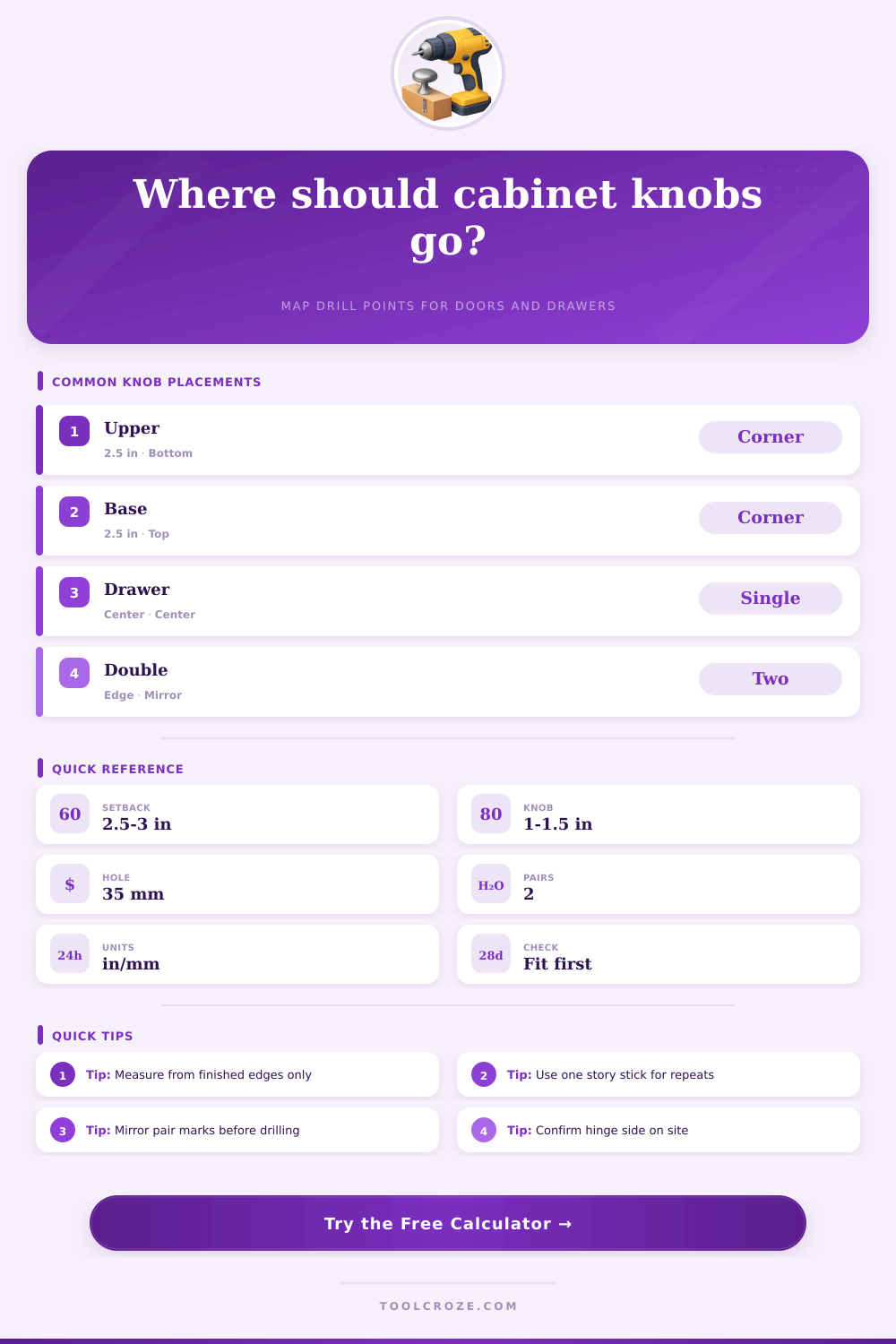
| Front type | X offset | Y offset | Note |
|---|---|---|---|
| Upper door | 2.5 in | Bottom | Opposite hinge |
| Base door | 2.5 in | Top | Opposite hinge |
| Drawer front | Center | Center | Single knob |
| Double door | Edge | Mirrored | Two knobs |
| Knob dia | Safe setback | Drill note | Use |
|---|---|---|---|
| 1.0 in | 2.5 in | Standard | Most doors |
| 1.25 in | 2.75 in | Balanced | Shaker |
| 1.5 in | 3.0 in | Keep space | Large fronts |
| 2.0 in | 3.5 in | Check rail | Oversized |
| Front size | Common use | Mark | Note |
|---|---|---|---|
| 12 x 18 | Wall door | Lower corner | Compact |
| 18 x 30 | Upper door | Corner | Very common |
| 24 x 30 | Base door | Upper corner | Kitchen base |
| 30 x 6 | Drawer | Center | Centered knob |
| Material | Bit | Tape | Risk |
|---|---|---|---|
| Hardwood | Brad point | Light tape | Split edge |
| MDF | Sharp twist | Backer board | Fuzzing |
| Plywood | Brad point | Mask both | Veneer lift |
| Laminate | Step bit | Full tape | Chipping |
The position of cabinet knobs matter more than many believe. There are not strict and fast rules about what is right or wrong, but general guidelines ensure that the hardware are proportional and well placed on the cabinet. First decide whether to use knobs, pulls, or a mix of them.
For wall cabinets over the counter space, knobs commonly sit 2 to 3 inches from the bottom corner of the door panel. At base cabinets, the top screw of a pull lay between 2.5 and 3 inches from the top corner of the cabinet, against the hinges. Knobs usually install 2.5 to 3 inches from the edge of the door or drawer.
Where to Put Cabinet Knobs and Pulls
The key is ensure the right height and centering on the door or drawer.
Size and shape of the cabinet doors and drawers are among the most important things. Most cabinet knobs have diameter of 1 to 1.5 inches. Choose hardware fit for the size of your cabinet drawer or door.
Classic cabinets call for round knobs, while modern sleek ones benefit from long horizontal pulls.
For five-piece paneled cabinets you usually center the knob in the corner of the face frame, so that it sits in the center of the vertical and horizontal frame pieces, called stiles and rails. At flat panel cabinets knobs sit center or a bit lower. On doors they can center on stile and rail, on the inner edge of the rail, or with knob edge flush with that edge.
Knobs work well on doors, while drawers most commonly have horizontal pulls. Pulls and knobs best go where your hand naturally falls when you open a drawer or door. At really tall cabinets like pantries, long pulls work better than knobs.
A hardware placement jig do the whole job simpler. One method is first drilling through with a drill bit much smaller than that for the knob screws. That gives precise hole according to the marks.
Later drill the right hole halfway from both sides of the cabinet faces improve accuracy and reduce splintering. A jig worth your money because of the convenience and ease. Install 10 pulls of various lengths and 12 knobs involve only one or one and a half hours with good jig.
A homemade one from scrap plywood also work for many same knobs. Except a cordless drill and drill bits, a cabinet hardware placement jig are a must because of accuracy.